
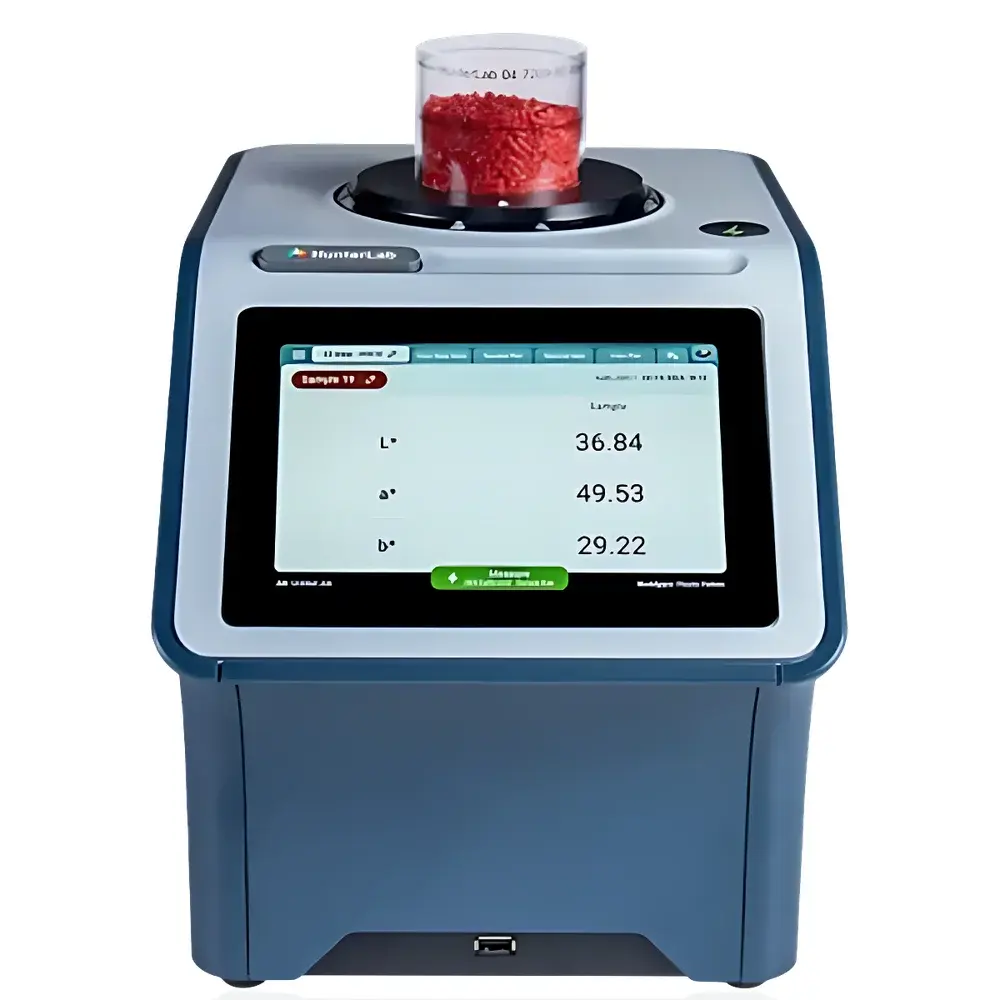
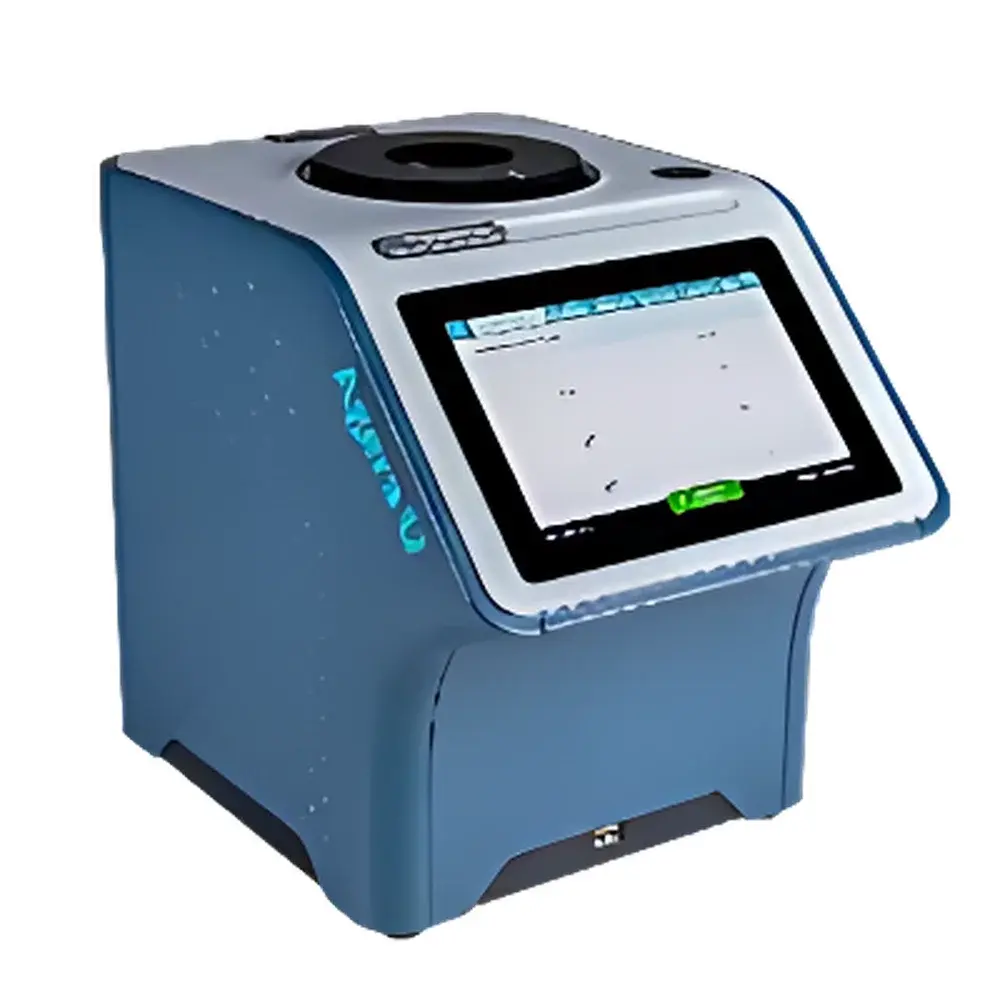
HunterLab Agera L2 Benchtop Spectrophotometric Color Difference Meter
| Brand | HunterLab |
|---|---|
| Origin | USA |
| Model | AGRL2 |
| Product Type | Color Difference Meter |
| Instrument Type | Benchtop |
| Optical Geometry | 45/0° |
| Light Source | Full-spectrum Balanced LED Array |
| Spectral Range | 400 nm – 700 nm |
| Repeatability | ΔE*₀₀ ≤ 0.03 |
| Measurement Aperture | Large-area (up to 16× standard) |
| Integrated Functionality | Simultaneous Color + 60° Gloss Measurement |
| Imaging Capability | Built-in Sample Observation Camera with Image Capture and Synchronization to Spectral Data |
Overview
The HunterLab Agera L2 is a high-precision benchtop spectrophotometric color difference meter engineered for industries where visual color consistency, measurement robustness, and regulatory traceability are mission-critical. Operating on the CIE 45/0° optical geometry—designed to emulate human visual perception under standardized D65 illumination—the Agera L2 delivers spectrally resolved reflectance data across the visible spectrum (400–700 nm). Its core measurement principle relies on full-spectrum LED illumination coupled with a diffraction grating spectrometer and silicon photodiode array detection, enabling calculation of CIELAB (L*a*b*), CMC, ΔE*₀₀, and other industry-standard color difference metrics per ISO 11664, ASTM E308, and CIE 15:2018. Unlike traditional tristimulus meters, the Agera L2 captures full spectral curves at each measurement, supporting post-acquisition re-evaluation using alternative illuminants or observer functions without physical re-measurement. This architecture ensures metrological integrity in environments lacking controlled viewing booths—making it particularly suitable for production floors, QC labs, and R&D settings where ambient lighting variability cannot be fully eliminated.
Key Features
- Large-Area Measurement Aperture: Engineered with an expanded field-of-view—up to 16× larger than conventional 45/0° instruments—this aperture significantly improves statistical representativeness for textured, patterned, or directionally anisotropic materials such as PET chips, spunbond nonwovens, embossed films, and recycled plastic granules.
- Integrated Visual Verification System: Features a high-resolution coaxial sample observation camera synchronized with spectral acquisition. Each measurement automatically captures and embeds a georeferenced image into the data record, ensuring unambiguous sample positioning, operator training validation, and forensic audit readiness.
- Simultaneous Color & Gloss Reporting: Measures CIELAB coordinates and 60° specular gloss (per ASTM D523 and ISO 2813) in a single instrument cycle. Eliminates manual repositioning or dual-instrument workflows, reducing operator-induced variance and accelerating throughput in high-volume QA/QC operations.
- D65-Referenced Visual Truth Engine: Implements HunterLab’s proprietary “Visual Truth” calibration framework, which maps spectral reflectance to perceptually uniform color space coordinates aligned with human observer response under D65 daylight simulation—even under non-ideal ambient conditions.
- Rugged Industrial Design: Constructed with thermally stable aluminum housing, sealed optical path, and vibration-damped base—optimized for continuous operation in manufacturing environments subject to temperature drift, particulate exposure, and mechanical shock.
Sample Compatibility & Compliance
The Agera L2 is validated for use with low-reflectance materials (R < 20%), including PET polymer chips, ground resin flakes, opaque packaging substrates, retroreflective sheeting, and pharmaceutical tablet coatings. Its large-aperture geometry mitigates edge effects and microstructural bias common in granular or irregularly shaped samples. The instrument complies with ISO/IEC 17025:2017 requirements for testing laboratories when operated within documented calibration and verification protocols. All firmware and software modules support audit trail generation, electronic signatures, and user-access controls aligned with FDA 21 CFR Part 11 and EU Annex 11 expectations for regulated color release testing.
Software & Data Management
Controlled via HunterLab’s Universal Software Platform (USP v5.x), the Agera L2 supports centralized method management, multi-instrument fleet synchronization, and automated report generation compliant with ISO 9001 documentation standards. Raw spectral data (.spc), metadata-rich measurement records (.hld), and embedded JPEG images are stored in a relational database structure with configurable retention policies. Export options include CSV, PDF, XML, and direct integration with LIMS via HL7 or RESTful API. Version-controlled method templates ensure consistent pass/fail criteria across global manufacturing sites—critical for harmonized color approval in multinational supply chains.
Applications
Primary application domains include color release testing of PET bottle-grade resin chips in polymer extrusion facilities; batch-to-batch consistency verification of recycled PET flake in circular economy operations; shade matching of metallized packaging films; quality gate inspection of safety-critical reflective materials (e.g., ANSI/ISEA 107-compliant garments); and stability monitoring of light-sensitive pharmaceutical excipients during accelerated aging studies. The instrument is routinely deployed in ISO/IEC 17025-accredited laboratories performing contract color analysis for automotive interior suppliers, medical device OEMs, and food packaging converters.
FAQ
What is the recommended calibration frequency for the Agera L2 in a GMP-regulated environment?
Annual factory recalibration is required, supplemented by daily verification using NIST-traceable ceramic tile standards and documented operational qualification (OQ) per IQ/OQ/PQ protocol.
Can the Agera L2 measure translucent or semi-crystalline PET pellets without grinding?
Yes—its large-aperture 45/0° geometry minimizes subsurface scattering artifacts; however, consistent packing density and orientation must be maintained per SOP to ensure inter-laboratory reproducibility.
Does the integrated camera satisfy ALCOA+ data integrity requirements?
Yes—the system enforces image capture prior to spectral acquisition, timestamps all metadata, prevents post-hoc image substitution, and logs all user actions in a non-erasable audit trail.
Is gloss measurement traceable to national standards?
Gloss readings are referenced to NIST SRM 192X series standards and validated per ASTM E2539 for instrument-specific gloss scale linearity and repeatability.
How does the Agera L2 handle measurement of highly directional materials like brushed metal or oriented PET film?
The large aperture inherently averages directional reflectance variation; optional rotation stage integration (via third-party motorized platform) enables automated multi-angle sampling for anisotropy characterization.




