
HunterLab ColorFlex EZ for Short Fibers & Loose Fibers
| Brand | HunterLab |
|---|---|
| Origin | USA |
| Model | ColorFlex EZ |
| Measurement Principle | 45°/0° Geometry Reflectance Spectrophotometry |
| Illuminant | D65, A, C, F2, F7, F11 |
| Observer Angle | 10° |
| Wavelength Range | 400–700 nm |
| Optical Resolution | 10 nm |
| Repeatability | ΔE*ab < 0.08 (for white tile, 10 readings) |
| Interface | USB 2.0 |
| Software Compatibility | EasyMatch QC v5.0+ |
| Compliance | ASTM E308, ISO 7724, CIE No. 15, USP <1061>, FDA 21 CFR Part 11 (audit trail enabled) |
Overview
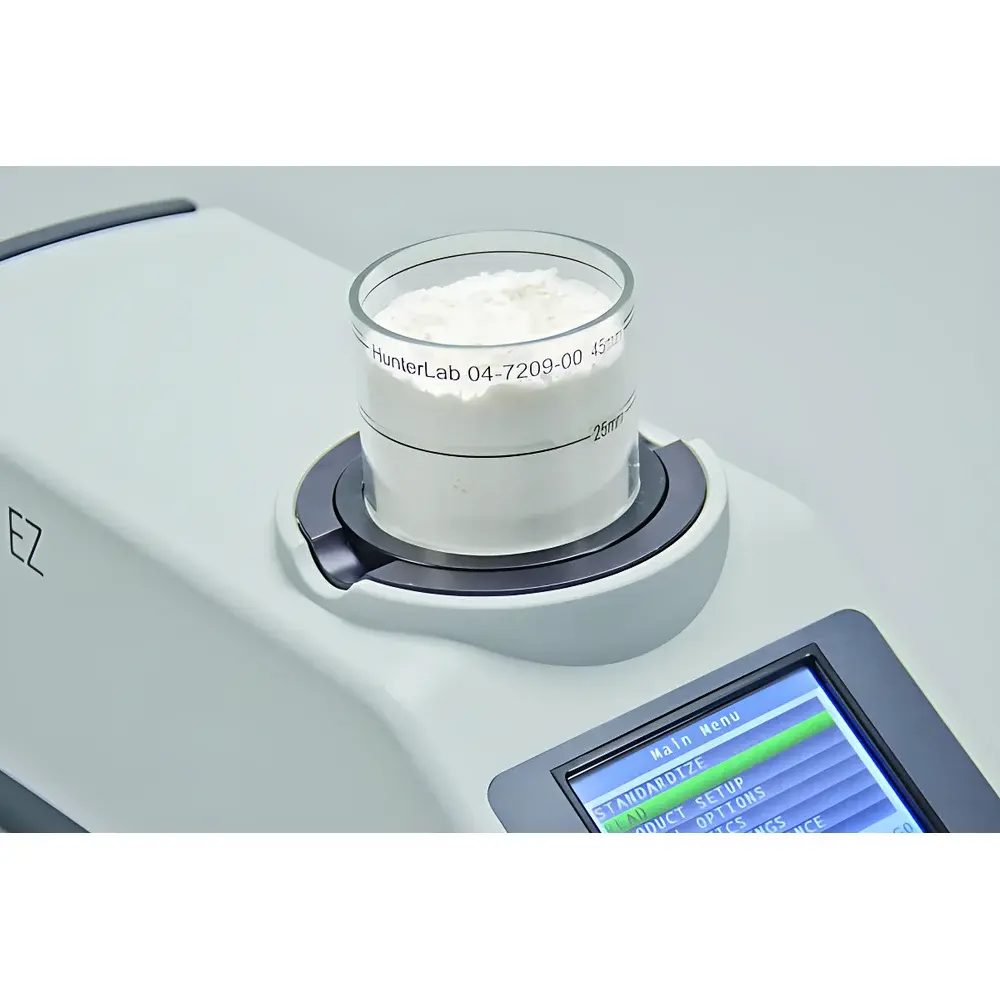
The HunterLab ColorFlex EZ for Short Fibers & Loose Fibers is a dedicated benchtop reflectance spectrophotometer engineered for precise, repeatable color measurement of heterogeneous, non-uniform, and low-density food matrices—including chopped fibers, ground spices, shredded cheese, milled grains, dried herbs, tobacco shreds, and fragmented confectionery products. Unlike general-purpose 0°/45° or d/8° instruments, the ColorFlex EZ integrates an optimized 45°/0° optical geometry with a large-area annular illuminator and a vertically oriented sample port (sample-up configuration), enabling stable, operator-independent positioning of loose, irregular, or aerated materials without compaction or pressurization. Its solid-state diode array detector captures full spectral data from 400 to 700 nm at 10 nm intervals, supporting CIE L*a*b*, L*C*h°, Yellowness Index (ASTM E313), Whiteness Index (CIE/ASTM E313), Color Strength (ΔE*cmc, ΔE*94), and custom index calculations—all traceable to NIST-traceable standards. Designed specifically for high-throughput QC environments in food manufacturing, co-packing, and export certification labs, the system delivers metrological stability across shifts and operators.
Key Features
- 45°/0° reflectance geometry optimized for scattering, porous, and fibrous samples—minimizes directional bias and shadowing effects common in d/8° systems
- Vertical sample port with integrated sample support plate and optional fiber containment ring for consistent packing density and surface presentation
- Pre-aligned, factory-calibrated tungsten-halogen and LED light sources ensuring long-term illuminant stability (D65, A, C, F2, F7, F11)
- 99 programmable user methods—each storing target standards, tolerance limits (ΔL*, Δa*, Δb*, ΔE*), pass/fail logic, and reporting templates
- Onboard memory for >10,000 measurements with time/date stamping; USB 2.0 interface for direct data export to LIMS or ERP systems
- Rugged anodized aluminum housing rated IP20; compliant with IEC 61000-4 electromagnetic immunity standards
Sample Compatibility & Compliance
The ColorFlex EZ accommodates bulk solids with minimal preparation: loose tobacco strands, cotton linters, flax fibers, ground coffee, freeze-dried fruit particles, powdered dairy blends, and cereal flakes. Optional accessories—including the Fiber Cup Kit, Low-Density Sample Holder, and Light Diffuser Dome—extend measurement robustness for materials with high void fraction or variable surface texture. The instrument conforms to ASTM E308 (computing tristimulus values), ISO 7724-1 (colorimetry fundamentals), CIE Publication No. 15 (colorimetric observers), and USP (instrument qualification for pharmaceutical-grade color assessment). When paired with EasyMatch QC software, it supports 21 CFR Part 11-compliant audit trails, electronic signatures, and role-based access control—meeting GLP/GMP requirements for regulated food export documentation (e.g., USDA-FSIS, EU Regulation (EC) No 1333/2008).
Software & Data Management
EasyMatch QC v5.0 or later provides validated, scalable color management—from single-point calibration verification to multi-site statistical process control (SPC). The software enables real-time deviation mapping against master standards, batch trending with X-bar/R charts, and automated report generation (PDF/CSV/XLSX) including measurement metadata, operator ID, environmental conditions (optional ambient sensor integration), and instrument diagnostics. All method configurations, standard sets, and historical data are stored in encrypted SQLite databases with automatic daily backup. Raw spectral files (.spc) are retained for retrospective reanalysis under revised tolerances or updated color difference formulas (e.g., CIEDE2000 vs. CMC(l:c)).
Applications
- Monitoring color consistency of extruded snack pellets, puffed rice, and dehydrated vegetable flakes during continuous production
- Verifying shade conformity of ground spices (e.g., paprika, turmeric) against buyer-specified Munsell or CIELAB targets
- Quantifying browning kinetics in roasted nuts and coffee beans via L* and a* trajectory analysis
- Validating whiteness retention in bleached wheat flour batches per AACC Method 14-50A
- Assessing pigment dispersion uniformity in colored confectionery coatings and chewing gum bases
- Supporting FDA-mandated colorant verification (e.g., FD&C dyes) in ready-to-eat meals and infant formula powders
FAQ
Does the ColorFlex EZ require sample compaction for loose fibers?
No. Its 45°/0° geometry and vertical sample port eliminate the need for pressing or pelletizing—measurements are performed on naturally settled material.
Can it measure translucent or semi-opaque samples like thin cheese slices?
Not recommended. The ColorFlex EZ is optimized for opaque, scattering media. Translucent samples require transmission-capable instruments such as the UltraScan VIS.
Is NIST-traceable calibration verification included?
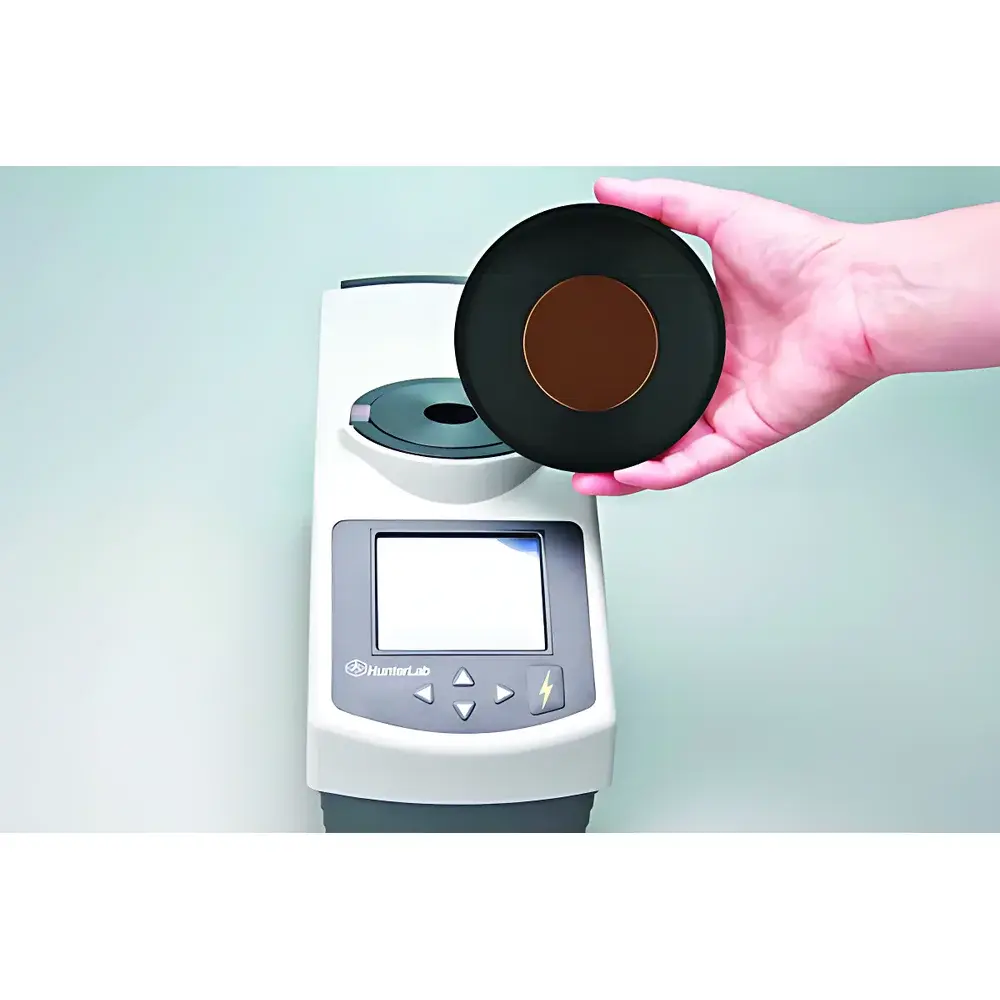
Yes. Each unit ships with a certified ceramic tile set (L*, a*, b* values with ±0.02 uncertainty) and documented calibration history traceable to NIST SRM 2010.
How often must the instrument be recalibrated?
Daily zero and white calibration is recommended before first use and after ambient temperature shifts >5°C; full wavelength calibration every 6 months or per internal SOP.
Does EasyMatch QC support multi-language UI for global labs?
Yes—localized interfaces available in English, Spanish, French, German, Simplified Chinese, Japanese, and Korean, with locale-specific number/date formatting and regulatory terminology.






