
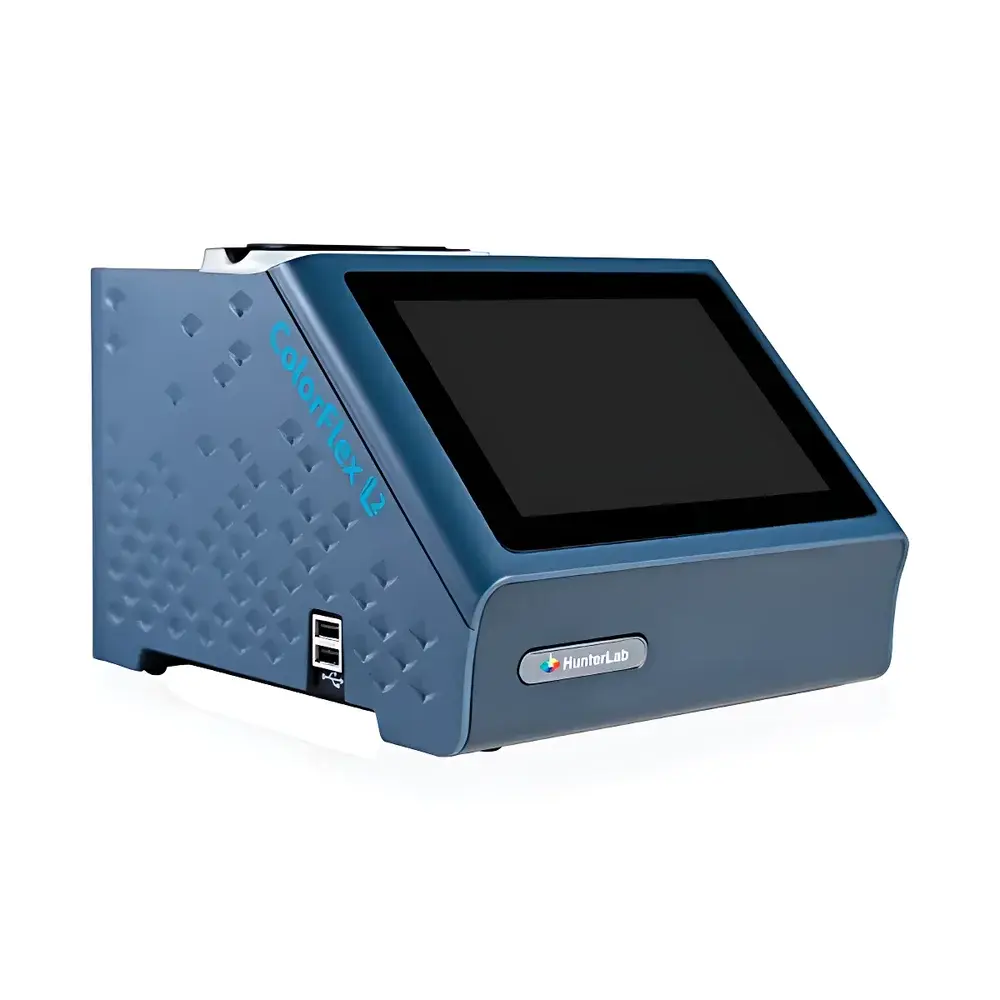
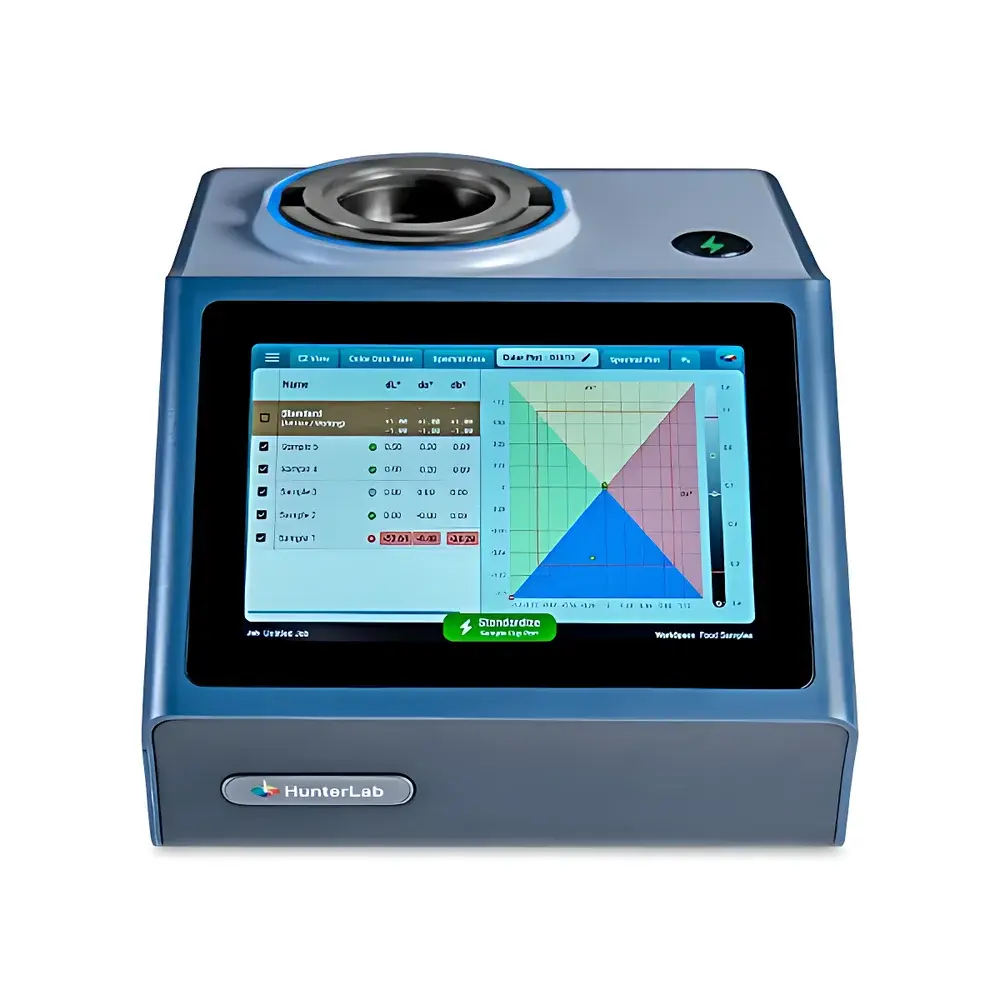
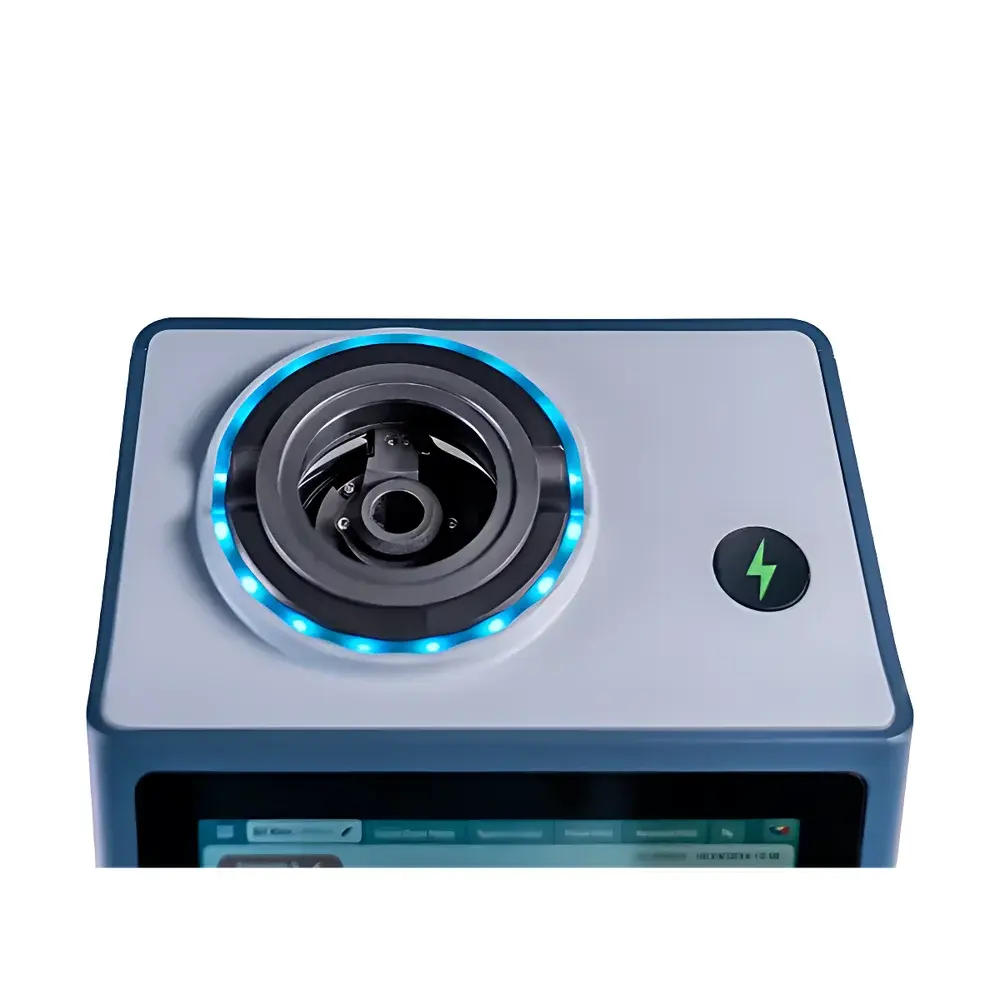
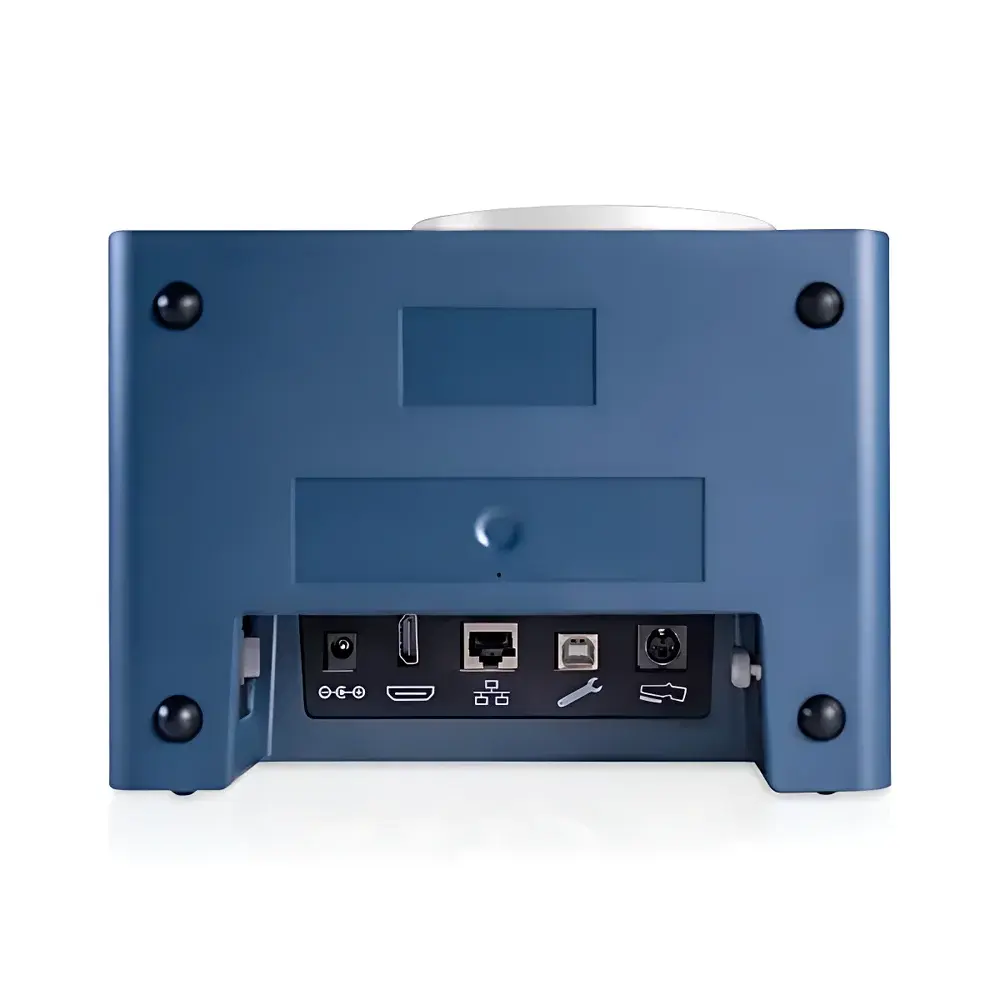
HunterLab ColorFlex L2 (CFL2) Spectrophotometer
| Brand | HunterLab |
|---|---|
| Origin | USA |
| Model | ColorFlex L2 (CFL2) |
| Spectral Range | 400–700 nm |
| Spectral Resolution | < 3 nm |
| Effective Bandwidth | 10 nm |
| Illuminant Options | A, C, D50, D55, D65, D75, F2, F7, F11 |
| Observer Angles | 2° and 10° |
| Geometry | 45°/0° (specular component excluded) |
| Aperture | 31.8 mm illumination / 25.4 mm measurement |
| Repeatability | ΔE*2000 < 0.03 (D65/10°, white tile, 20 readings) |
| Inter-instrument Agreement | ΔE*2000 < 0.15 (D65/10°, BCRA CCSII tiles) |
| Light Source | Pulsed xenon lamp (10-year typical lifetime) |
| Measurement Time | 1 second |
| Compliance | CIE 15:2004, ISO 7724-1, ASTM E1164, DIN 5033-7, JIS Z 8722 Condition C |
| Traceability | NIST-traceable calibration per CIE Pub. 44 and ASTM E259 |
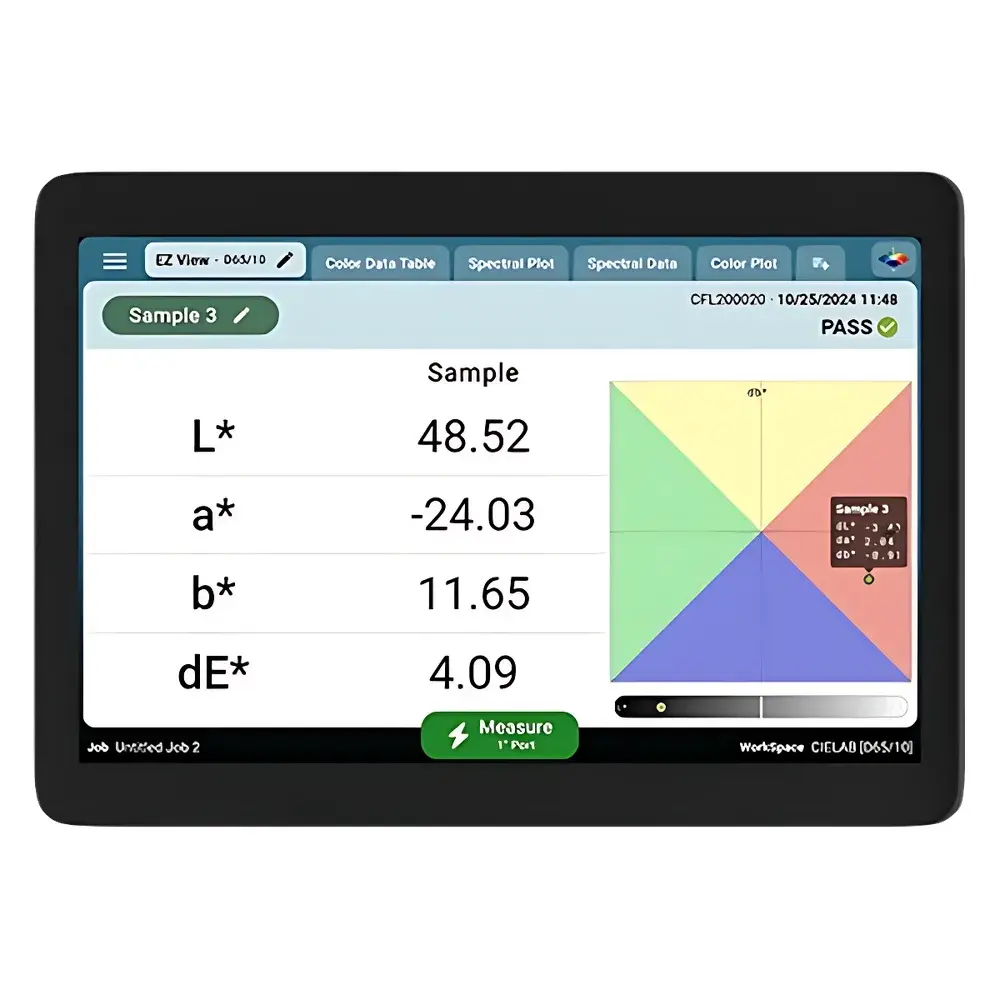
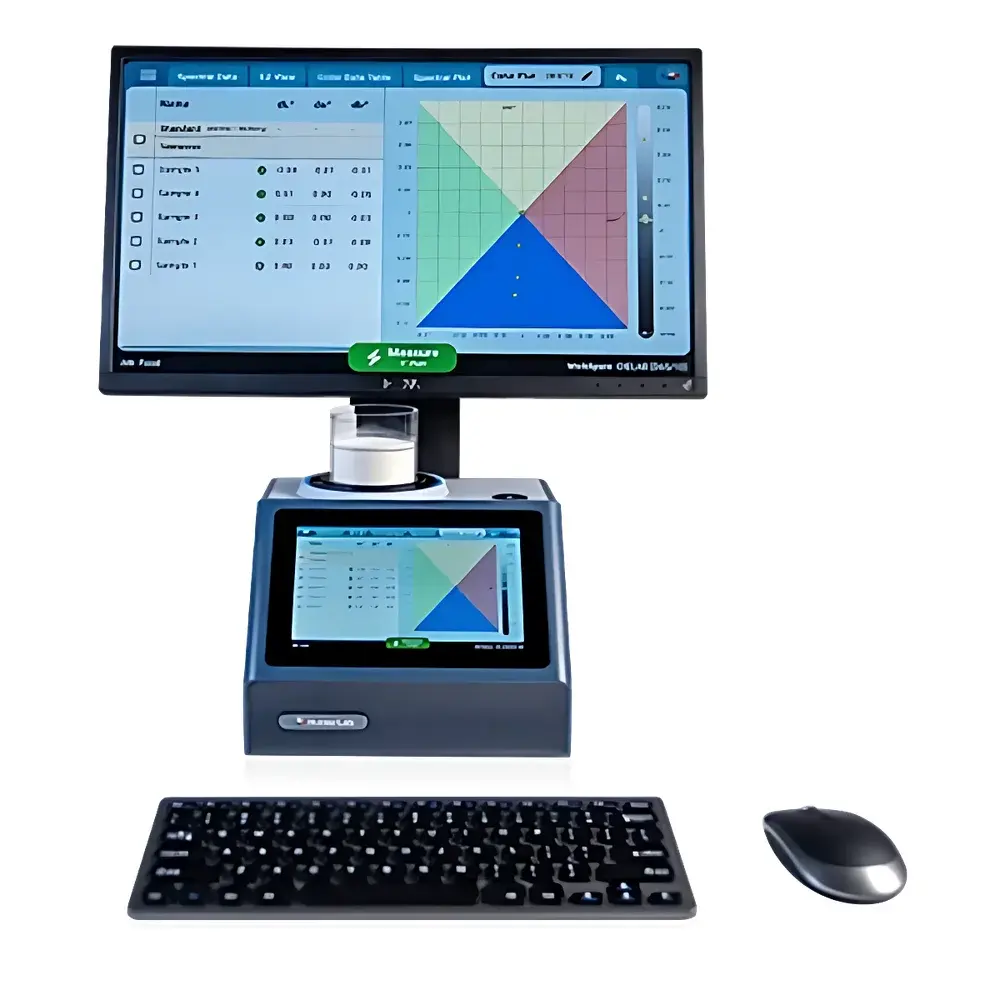
| Display | 7″ capacitive touchscreen (1280 × 800) |
| Dimensions | 16 cm H × 21 cm W × 24 cm D |
| Weight | 2.75 kg |
| Power | 90–240 VAC, 47–63 Hz → 24 VDC/3.75 A |
| Operating Environment | 10–30 °C, 10–90% RH (non-condensing) |
Overview
The HunterLab ColorFlex L2 (CFL2) is a high-precision, dual-beam spectrophotometer engineered for industrial color quality control in demanding laboratory and production environments. It employs a 45°/0° directional optical geometry with specular component excluded (SCE), ensuring consistent, geometry-independent measurements across diverse sample types—including opaque solids, translucent films, liquids, powders, granules, pastes, and suspensions. Its pulsed xenon light source delivers full-spectrum illumination (400–700 nm) with exceptional stability and long-term photometric repeatability—critical for regulatory compliance and inter-laboratory data harmonization. Unlike filter-based colorimeters, the CFL2 captures full spectral reflectance or transmittance data at ≤3 nm resolution, enabling retrospective analysis, advanced color difference calculations, and robust metamerism assessment. Designed as a direct evolutionary upgrade from the ColorFlex EZ platform, it maintains identical illumination geometry and spectral response, allowing seamless migration of legacy standards, tolerances, and historical datasets without requalification.
Key Features
- 7-inch high-resolution capacitive touchscreen interface with intuitive, context-aware navigation—optimized for gloved operation and rapid method execution.
- Industrial-grade tempered glass front panel and reinforced chassis, rated for continuous use in manufacturing floors, QC labs, and R&D facilities with elevated dust or vibration exposure.
- Essentials 2.0 software suite pre-installed—featuring automated calibration verification, real-time pass/fail evaluation against user-defined tolerances, and one-click report generation compliant with internal SOPs.
- Onboard high-resolution camera enables image capture synchronized with spectral data, supporting visual documentation of sample condition, surface texture, or heterogeneity prior to measurement.
- Full USB flash drive support for secure configuration backup, multi-unit deployment synchronization, and export of raw spectra, tristimulus values, and time-stamped results directly to Excel-compatible CSV formats.
- Multi-language UI (English, Spanish, French, German, Italian, Japanese, Simplified & Traditional Chinese) and comprehensive built-in help system—including interactive setup wizards and contextual tooltips—reduce operator training time by up to 60% versus previous-generation instruments.
Sample Compatibility & Compliance
The CFL2 accommodates a broad spectrum of physical forms without mechanical modification: flat or curved solids (e.g., painted panels, plastic injection-molded parts), free-flowing powders (coffee, spices, pharmaceutical excipients), viscous liquids (juices, sauces, resins), and semi-transparent gels or emulsions (dairy products, cosmetics). Its 25.4 mm measurement aperture ensures representative sampling of heterogeneous materials while minimizing edge effects. All optical and electronic components are validated per ISO/IEC 17025 requirements for testing laboratories. Instrument performance conforms to ASTM E1164 (Standard Practice for Describing and Measuring Performance of Spectrophotometers), ISO 7724-1 (Colorimetry — Part 1: CIE Standard Colorimetric Observers), and CIE 15:2004 (Colorimetry, 3rd Edition). Calibration traceability is maintained to NIST SRM 2035 (Diffuse Reflectance Standard) and NIST SRM 2036 (Transmittance Standard), with certificates provided for each shipped unit per CIE Publication 44 and ASTM E259.
Software & Data Management
Essentials 2.0 operates natively on the instrument’s embedded Linux platform and supports audit-ready data governance. Every measurement event logs timestamp, operator ID (optional RFID or PIN login), instrument serial number, calibration status, and environmental metadata (ambient temperature/humidity if external sensors are connected). All color data—including spectral curves, CIE L*a*b*, ΔE*2000, whiteness/yellowness indices (ASTM E313, D1925), opacity, and color strength—are stored in encrypted SQLite databases with automatic daily backup to internal storage or removable USB media. The software enforces FDA 21 CFR Part 11-compliant electronic signatures, role-based access control, and immutable audit trails—fully compatible with GLP and GMP workflows. Data export modules generate PDF reports with embedded spectral plots, statistical summaries (mean, SD, CPK), and annotated pass/fail overlays aligned with customer-specific AQL limits.
Applications
The CFL2 serves as a primary color verification tool across regulated and non-regulated industries where color consistency directly impacts brand integrity, regulatory acceptance, and process yield. In food & beverage, it quantifies batch-to-batch variation in ground coffee, tomato paste, dairy powders, and fruit juices—supporting shelf-life studies and supplier qualification per ISO 8587. In coatings and plastics, it validates color match accuracy on automotive clearcoats, architectural panels, and medical device housings under multiple illuminants to detect metamerism. In pharmaceuticals, it measures color uniformity of tablets and lyophilized powders per USP , tracks degradation-induced hue shifts, and verifies dye concentration in liquid formulations. Additional applications include quality release of cement, concrete admixtures, textile dyes, laundry detergents, and cosmetic foundations—where its SCE mode eliminates interference from surface gloss and texture.
FAQ
Is the ColorFlex L2 compatible with existing ColorFlex EZ standards and methods?
Yes. The CFL2 shares identical 45°/0° optical geometry, spectral response, and calibration algorithms with the ColorFlex EZ. Legacy standards, tolerances, and measurement protocols migrate directly without recalibration or revalidation.
Does the instrument support GLP/GMP-compliant data handling?
Yes. Essentials 2.0 includes electronic signature capability, user authentication, immutable audit trails, and export controls aligned with FDA 21 CFR Part 11 and EU Annex 11 requirements.
What is the recommended calibration frequency?
HunterLab recommends daily verification using the supplied NIST-traceable white tile and annual full recalibration by an accredited service center—documented per ISO/IEC 17025.
Can the CFL2 measure transparent or translucent samples?
Yes. When used with the optional transmission cell holder and integrating sphere accessory (sold separately), it performs accurate transmittance measurements on clear liquids, films, and gels per ASTM D1003 and ISO 13468.
How is instrument-to-instrument agreement ensured across a multi-site enterprise?
Each unit ships with factory-applied inter-instrument agreement validation using BCRA Series II tiles. Optional site-to-site matching protocols and master standard exchange programs are available through HunterLab’s Global Metrology Network.




