
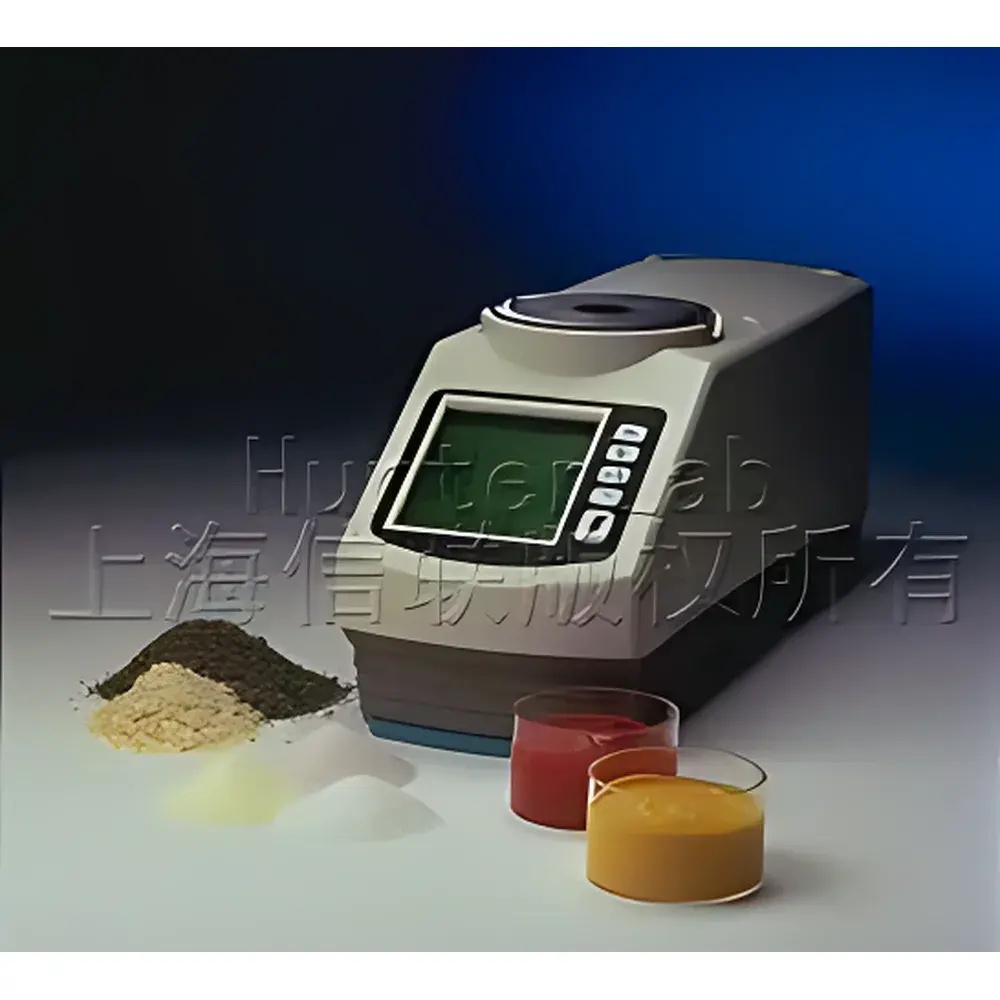
HunterLab ColorFlex Titanium Dioxide Whiteness Analyzer
| Brand | HunterLab |
|---|---|
| Origin | USA |
| Manufacturer Type | Authorized Distributor |
| Product Category | Imported Instrument |
| Model | HunterLab ColorFlex |
| Product Type | Spectrophotometric Colorimeter |
| Instrument Form Factor | Benchtop |
| Optical Geometry | 0°/45° Integrating Sphere |
| Light Source | Pulsed Xenon Lamp |
| Spectral Range | 400–700 nm |
| Repeatability | ΔE*ab ≤ 0.05 |
Overview
The HunterLab ColorFlex Titanium Dioxide Whiteness Analyzer is a benchtop spectrophotometric colorimeter engineered for precise, repeatable whiteness and color measurement of titanium dioxide (TiO₂) pigments and related white powder materials. It operates on the principle of spectral reflectance measurement using a pulsed xenon lamp and a 0°/45° optical geometry with an integrating sphere—optimized to minimize directional bias and specular component influence in matte, granular, or lightly compressed TiO₂ samples. Unlike general-purpose colorimeters, this system is specifically calibrated and validated for the high-reflection, low-absorption characteristics of rutile and anatase TiO₂ grades, supporting critical quality control parameters including CIE Whiteness (ISO 11475, ASTM E313), Yellowness Index (ASTM E313), and spectral reflectance curves across the visible spectrum (400–700 nm). Its design conforms to international pigment industry testing practices, enabling direct correlation with regulatory and customer specification limits used by global TiO₂ producers and compounders.
Key Features
- Benchtop form factor with compact footprint—designed for integration into QC labs, production line stations, or R&D environments without requiring dedicated optical tables.
- 0°/45° integrating sphere optical configuration—provides stable, geometry-controlled illumination ideal for non-uniform, textured, or loosely packed TiO₂ powders; eliminates interference from surface gloss and minimizes inter-particle scattering artifacts.
- Pulsed xenon lamp light source—delivers full-spectrum output with high intensity and exceptional stability over time, eliminating warm-up drift and ensuring consistent spectral power distribution across repeated measurements.
- Integrated touchscreen interface with large backlit LCD—displays real-time spectral reflectance curves, CIE L*a*b*, whiteness indices, and pass/fail status against user-defined tolerances—no external PC required for routine operation.
- Sealed membrane keypad—resistant to dust, moisture, and chemical exposure typical in pigment handling areas, meeting IP54-rated environmental robustness for industrial settings.
- Modular accessory support—including powder cups with pressure plates, sample compressors, and calibration tile sets traceable to NIST standards—enables method standardization per ISO 7724-1 and ASTM D280.
Sample Compatibility & Compliance
The ColorFlex analyzer accommodates a wide range of TiO₂ physical forms: dry powders, slurry dispersions (with optional liquid cell), pressed pellets, and coated substrates. Its optical path and sample port geometry are validated for use with standard 30-mm and 50-mm diameter powder cups compliant with ASTM D280 and ISO 7724-1. The instrument supports GLP-compliant data capture through built-in audit trail functionality (user login, parameter changes, calibration events) and meets documentation requirements for FDA-regulated pigment applications under 21 CFR Part 11 when deployed with optional network-enabled software modules. All factory calibrations are traceable to NIST SRM 2035 and 2036, and spectral response is verified per CIE Publication 15:2018.
Software & Data Management
The embedded ColorFlex software provides full spectral analysis without external computing hardware. It includes preconfigured TiO₂-specific methods for Whiteness (CIE, Ganz, Berger), Yellowness Index, Tint (b* shift), and relative scattering efficiency (R∞). Data export supports CSV, XML, and PDF report generation with embedded spectral plots and metadata (operator ID, timestamp, instrument serial number, calibration history). Optional ConnectIQ™ software enables centralized fleet management, remote firmware updates, and integration with LIMS or SAP QM modules via ODBC or RESTful API. All measurement records include digital signatures and immutable timestamps to satisfy ISO/IEC 17025 and ICH Q7 audit requirements.
Applications
- Batch release testing of rutile/anatase TiO₂ pigments for whiteness consistency, batch-to-batch color matching, and yellowness deviation monitoring.
- Raw material qualification of TiO₂ feedstocks prior to dispersion or surface treatment processes.
- Stability assessment of coated TiO₂ under accelerated aging (UV, heat, humidity) via spectral shift tracking.
- Formulation development for white masterbatches, paints, and plastics—correlating lab-scale measurements with end-product performance.
- Supplier qualification and technical service support for global TiO₂ manufacturers including DuPont, Huntsman, and domestic leaders such as Tongling Supercolor and Panzhihua Iron & Steel Titanium Division.
FAQ
Does the ColorFlex support d/8° geometry for comparison with other industry instruments?
No—the ColorFlex Titanium Dioxide model is configured exclusively with 0°/45° geometry to optimize measurement repeatability for high-gloss-sensitive, particulate TiO₂ samples. For d/8° applications, HunterLab offers the UltraScan VIS or MiniScan EZ platforms.
Can spectral data be exported for third-party statistical process control (SPC) analysis?
Yes—CSV exports include wavelength-by-wavelength reflectance values (10-nm intervals), CIE tristimulus values, and derived indices, compatible with JMP, Minitab, and Python-based SPC libraries.
Is NIST-traceable calibration verification included with shipment?
Each unit ships with a Certificate of Calibration valid for 12 months, referencing NIST SRM 2035 (white ceramic) and SRM 2036 (gray ceramic), along with spectral irradiance validation data.
How is sample presentation standardized for loose TiO₂ powder?
HunterLab recommends the A10-1001 Powder Compaction Kit, which applies consistent 10 kPa pressure across a 30-mm cup aperture—reducing void fraction variability and improving inter-laboratory reproducibility per ISO 7724-1 Annex B.




