
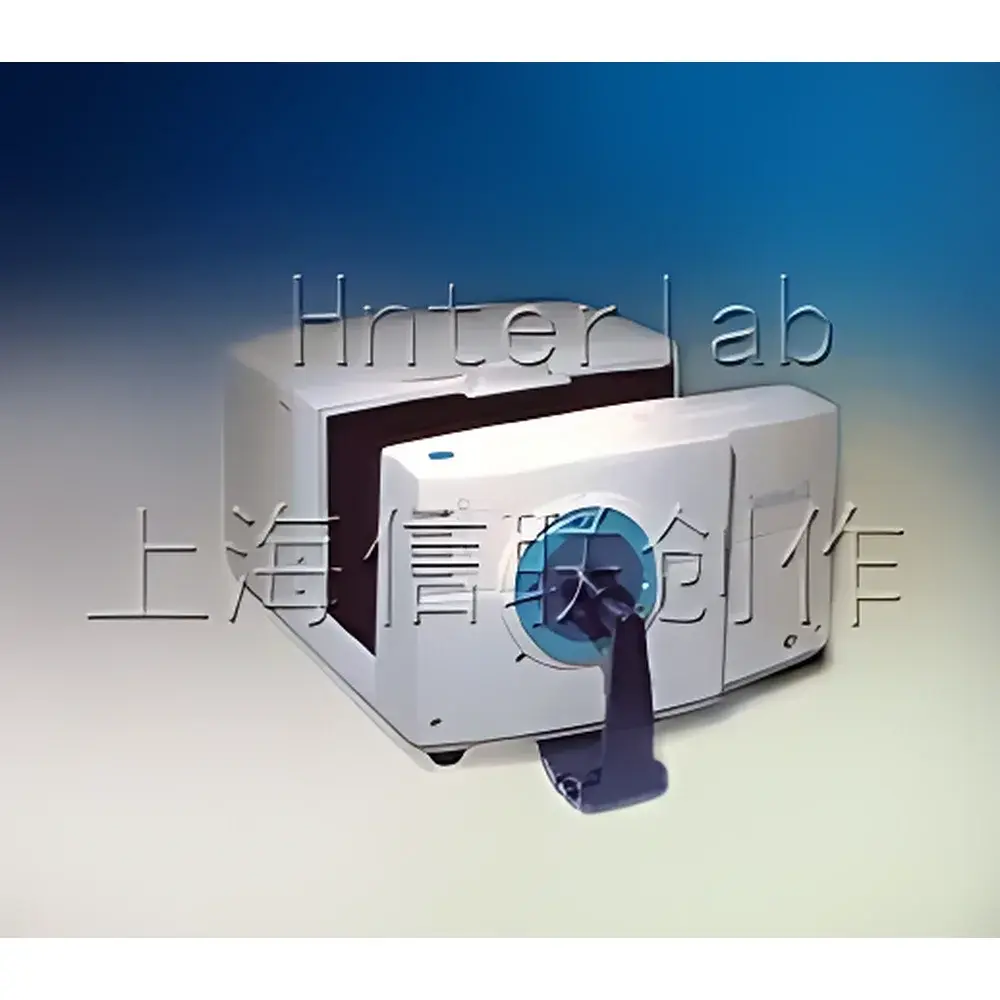
HunterLab ColorQuest XE Benchtop Spectrophotometer
| Brand | HunterLab |
|---|---|
| Origin | USA |
| Model | ColorQuest XE |
| Product Type | Benchtop Spectrophotometer |
| Optical Geometry | d/8° Integrating Sphere |
| Light Source | Pulsed Xenon Lamp |
| Spectral Range | 400–700 nm |
| Repeatability (ΔE*ab) | ≤ 0.03 |
| Wavelength Resolution | < 3 nm |
| Wavelength Accuracy | ±0.1 nm |
| Effective Bandwidth | 10 nm (triangular) |
| Photometric Range | 0–200% |
| Photometric Resolution | 0.003% (reported as 0.01%) |
| Measurement Time | < 1 s |
| Minimum Interval Between Measurements | 3 s |
| Transmission Modes | Direct and Total |
| Integrating Sphere Diameter | 15.2 cm |
| Sphere Coating | Spectraflect |
| Standard Aperture | 25.4 mm (illumination), 19.0 mm (measurement) |
| Optional Apertures | 9.5 mm / 6.3 mm (SAV), 4 mm (MAV) |
| Mirror Finish Compensation | Automatic Inclusion/Exclusion |
| Lamp Lifetime | > 1,000,000 flashes |
Overview
The HunterLab ColorQuest XE is a benchtop spectrophotometer engineered for precision color measurement across reflective, transmissive, and translucent samples in industrial quality control and R&D environments. It operates on the principle of dual-beam spectral photometry, utilizing a 256-element diode array detector coupled with a high-resolution concave holographic grating to deliver stable, high-fidelity spectral data. Its d/8° optical geometry—compliant with CIE No. 15, ASTM E308, ISO 7724, and DIN 5033—ensures consistent illumination and viewing conditions ideal for evaluating color uniformity, batch-to-batch consistency, and formulation stability. Designed for repeatable operation in both laboratory and production-floor settings, the instrument features a robust integrating sphere (15.2 cm diameter) coated with Spectraflect—a highly diffuse, near-Lambertian material with >97% reflectance across 400–700 nm—to minimize directional bias and enhance measurement reproducibility.
Key Features
- Dual-beam spectral architecture with real-time reference correction, minimizing drift from lamp aging or thermal fluctuation.
- Pulsed xenon lamp with D65 spectral simulation—no warm-up required, no filament degradation, and >1 million flash lifetime; user-replaceable without recalibration.
- Automatic aperture switching between Large Area View (LAV: 25.4 mm × 19.0 mm), Small Area View (SAV: 9.5 mm × 6.3 mm), and Micro Area View (MAV: 4 mm)—all motorized and software-controlled.
- Integrated specular component compensation (SCI/SCE) via automatic mechanical trap positioning—enabling simultaneous reporting of surface-inclusive and surface-excluded measurements per ASTM E2194 and ISO 13655.
- Optimized transmission module with three-sided open chamber for flexible sample handling—including cuvettes, bottles, and flat panels—supporting both direct (directional) and total (diffuse + direct) transmittance modes.
- Full spectral output at 10 nm reporting intervals across 400–700 nm, with wavelength accuracy of ±0.1 nm and effective bandwidth of 10 nm (triangular).
Sample Compatibility & Compliance
The ColorQuest XE accommodates opaque solids (e.g., plastics, textiles, ceramics), semi-transparent films (e.g., packaging laminates, coated glass), and clear or hazy liquids (e.g., solvents, beverages, pharmaceutical solutions). Its modular sample compartment supports standard 10 mm and 50 mm pathlength cuvettes, as well as custom holders for irregular geometries. The instrument complies with regulatory frameworks governing color-critical industries: it supports audit-ready data logging aligned with FDA 21 CFR Part 11 requirements when used with optional QualiSpect™ software; meets GLP/GMP documentation standards through timestamped, user-identified measurement records; and enables traceability to NIST-traceable standards via factory calibration certificates and optional annual verification kits. All reported indices—including CIE L*a*b*, ΔE*ab, Yellowness Index (ASTM E313), Whiteness Index (CIE/ISO 11475), APHA/Pt-Co (ASTM D1209), Haziness (ASTM D1003), and Opacity (ASTM D5344)—are calculated using internationally recognized algorithms.
Software & Data Management
The instrument is fully compatible with HunterLab’s EasyMatch QC software—a validated platform supporting method creation, tolerance definition (box, ellipsoid, or custom), pass/fail reporting, and statistical process control (SPC) charting. Raw spectral data (.spc files) are exportable in CSV, XML, or ASTM E2534-compliant formats for integration into LIMS or ERP systems. Audit trail functionality logs all user actions—including parameter changes, calibration events, and result modifications—with immutable timestamps and operator IDs. Optional QualiSpect™ adds electronic signature capability, role-based access control, and automated backup to network drives or cloud repositories—meeting stringent requirements for regulated environments in pharmaceuticals, food & beverage, and automotive coatings.
Applications
The ColorQuest XE serves as a primary color measurement tool in sectors where spectral fidelity and inter-instrument agreement are critical. In polymer manufacturing, it verifies pigment dispersion consistency and detects thermal degradation-induced yellowness shifts. In textile dyeing, it quantifies metamerism risk under multiple illuminants (D65, A, F2) and supports recipe prediction via HunterLab’s proprietary color matching engine. In paint & coating labs, it measures hiding power (opacity), gloss-independent color, and film thickness effects via multi-angle transmittance analysis. In paper and board production, it monitors brightness stability, optical brightener efficiency, and recycled fiber content impact on whiteness. In liquid applications—from edible oils to disinfectant solutions—it delivers repeatable APHA, Gardner, and Saybolt color assessments without manual filtration or dilution steps.
FAQ
What is the difference between SCI and SCE measurement modes?
SCI (Specular Component Included) captures total reflected light—including mirror reflection—and is preferred for appearance-matching of textured or matte surfaces. SCE (Specular Component Excluded) excludes the specular peak and correlates more closely with human visual assessment of color on glossy materials.
Can the ColorQuest XE measure fluorescent samples?
Yes—the pulsed xenon source provides broad-spectrum excitation, and the instrument’s spectral acquisition enables detection of fluorescence emission within the 400–700 nm range. Fluorescent whitening agent (FWA) response is quantified via UV-adjusted illuminants (e.g., CIE F11) when configured with optional UV filter kits.
Is calibration transfer possible between ColorQuest XE units?
Yes—HunterLab’s Inter-Instrument Agreement (IIA) protocol, based on NIST-traceable ceramic tiles and liquid standards, ensures ΔE*ab ≤ 0.15 between instruments operating under identical geometry and software versions.
Does the system support Good Manufacturing Practice (GMP) compliance?
When deployed with QualiSpect™ software and documented procedures, the system satisfies GMP Annex 11 and FDA 21 CFR Part 11 requirements for electronic records and signatures, including full audit trails, electronic approvals, and secure user authentication.
How often does the instrument require recalibration?
Factory calibration remains valid for 12 months under normal use. Annual verification using HunterLab’s Certified Reference Standards (CRS) is recommended; daily verification with a white tile is advised for critical applications.



