
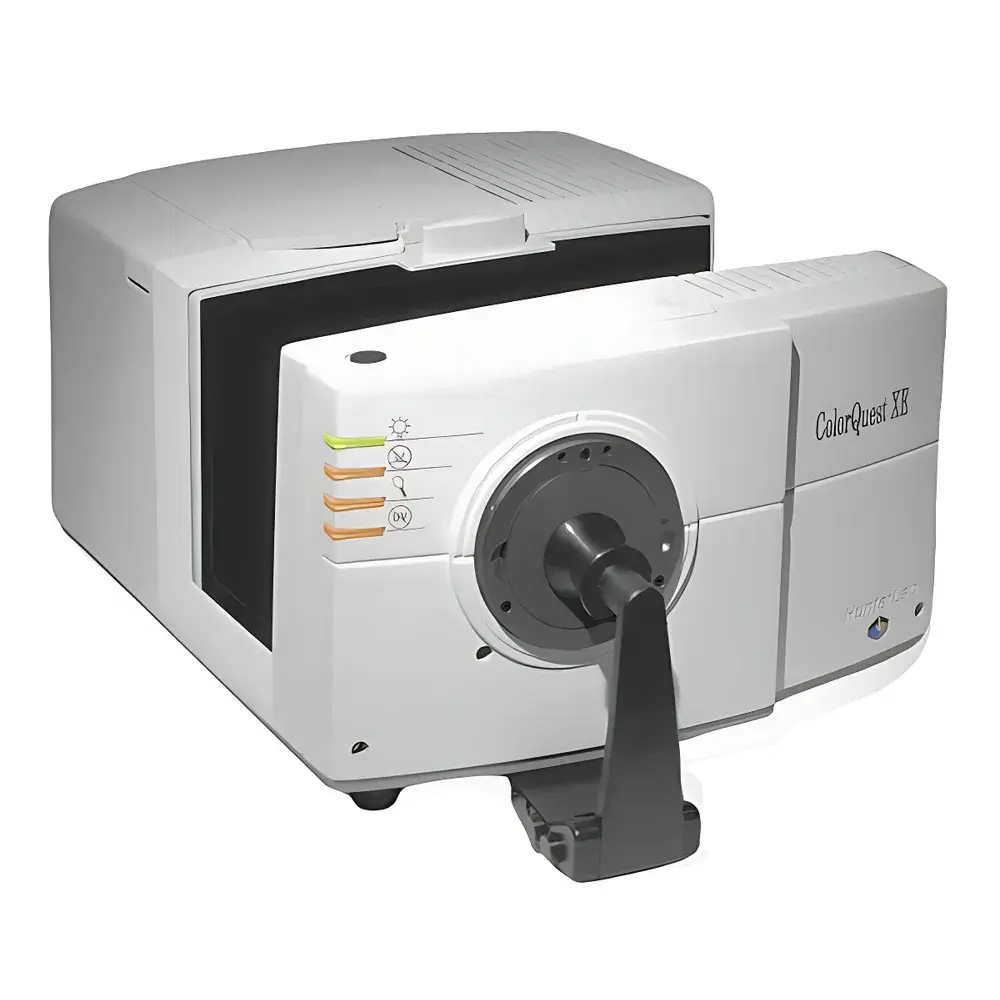
HunterLab ColorQuest XE Benchtop Spectrophotometer
| Brand | HunterLab |
|---|---|
| Origin | USA |
| Model | ColorQuest XE |
| Product Type | Benchtop Spectrophotometer |
| Optical Geometry | d/8° integrating sphere |
| Light Source | Pulsed xenon lamp simulating D65 illuminant |
| Spectral Range | 400–700 nm |
| Repeatability | < 0.03 ΔE* |
| Integrating Sphere Diameter | 15.2 cm (6″) |
| Spectral Resolution | < 3 nm |
| Wavelength Accuracy | ±0.1 nm |
| Effective Bandwidth | 10 nm |
| Photometric Range | 0–200% |
| Photometric Resolution | 0.003% (reported as 0.01%) |
| Measurement Time | < 1 s |
| Minimum Interval Between Measurements | 3 s |
| Lamp Lifetime | > 1,000,000 flashes |
| Compliance | CIE No.15, ISO 7724-1, ASTM E1164, DIN 5033-7, JIS Z 8722 Condition C |
Overview
The HunterLab ColorQuest XE is a precision-engineered benchtop spectrophotometer designed for rigorous color measurement, whiteness evaluation, and quantitative optical property analysis across diverse industrial and laboratory environments. Operating on the principle of dual-beam spectral photometry, it employs a high-stability 256-element diode array detector coupled with a holographic concave grating to deliver consistent, high-fidelity spectral data from 400 nm to 700 nm. Its d/8° geometry—compliant with CIE, ISO, ASTM, and DIN standards—enables both reflectance and transmittance measurements under diffuse illumination and 8° viewing, ensuring metrological traceability for colorimetric calculations including CIELAB, CMC, ΔE*, whiteness (CIE, Ganz, Berger), yellowness index (ASTM E313), APHA/Pt-Co, Gardner, Saybolt, haze (ASTM D1003), and opacity metrics. The instrument’s core architecture is optimized for long-term stability: its integrating sphere is coated with Spectraflect®, a barium sulfate–based material engineered for minimal spectral drift and resistance to yellowing over time; the pulsed xenon light source provides stable D65 simulation without thermal load or aging-related spectral shift, eliminating routine lamp replacement for over one million flashes.
Key Features
- Dual-beam optical path design minimizes drift and enhances measurement reproducibility across extended operational cycles.
- Automated specular component inclusion/exclusion (SCI/SCE) enables independent assessment of surface gloss influence on color perception—critical for quality control in coated, polished, or textured materials.
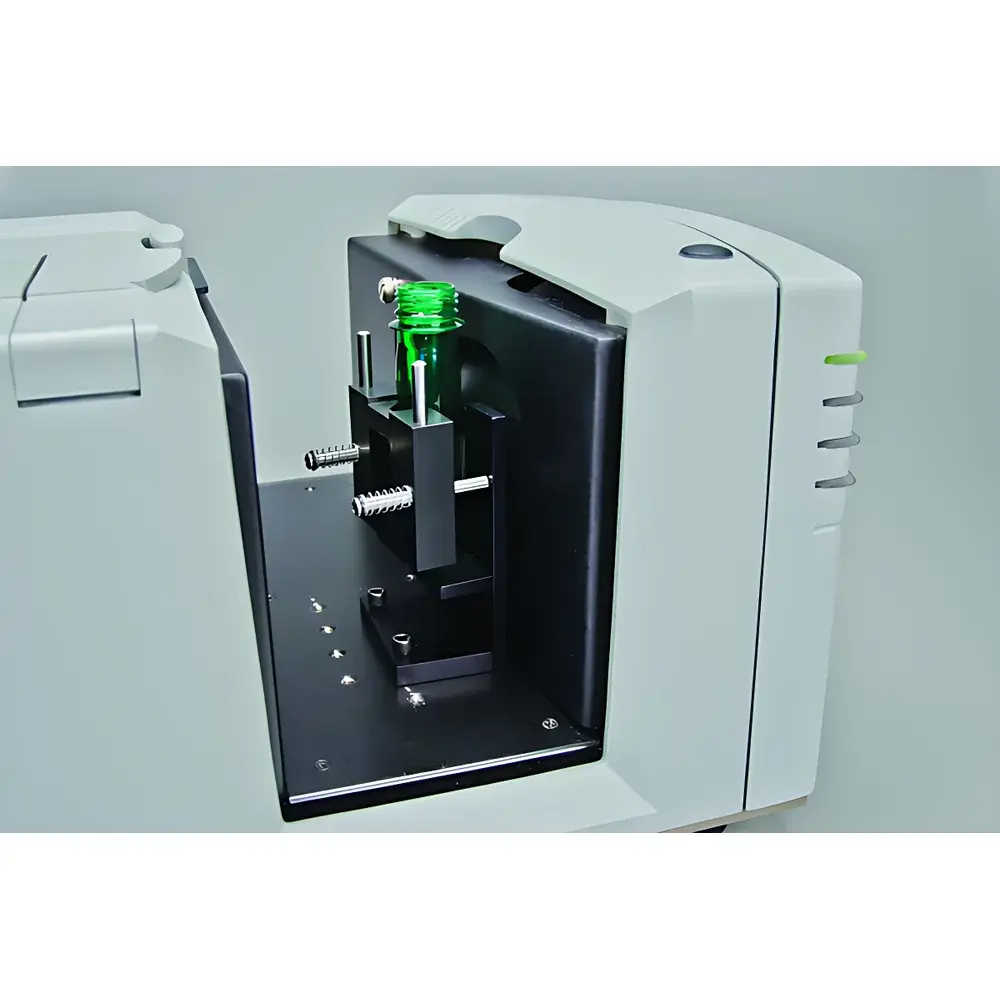
- Triple-opening transmission chamber accommodates rigid solids, flexible films, bottles, cuvettes, and bulk liquids without reconfiguration—supporting both directional (direct) and total transmittance modes per ASTM E308 and ISO 13655.
- Motorized aperture selection (LAV: 25.4 mm / SAV: 9.5 mm / MAV: 4 mm) allows precise area definition for heterogeneous or patterned samples, with automatic lens switching and real-time mode confirmation via status LED indicators.
- Robust mechanical sample holder facilitates rapid, repeatable positioning of irregular or fragile specimens—including powders, granules, pastes, and viscous liquids—without requiring custom fixtures.
- Integrated firmware supports real-time pass/fail evaluation against user-defined tolerances, batch averaging, and statistical reporting compliant with GLP documentation requirements.
Sample Compatibility & Compliance
The ColorQuest XE accepts opaque, translucent, transparent, and semi-crystalline solids—as well as clear, hazy, or colored liquids—across industries including polymer compounding, pharmaceutical excipient validation, food-grade packaging, architectural coatings, textile dye lot approval, and optical filter manufacturing. All optical measurements adhere to internationally recognized metrological frameworks: reflectance conforms to CIE Publication 15:2018, ISO 7724-1:2019, ASTM E1164-22, DIN 5033-7:2017, and JIS Z 8722:2022 Condition C; transmittance follows ASTM E1164 and DIN 5033-7 protocols. Instrument calibration traceability is maintained through NIST-traceable ceramic tiles and liquid standards, with optional IQ/OQ documentation packages available for regulated environments governed by FDA 21 CFR Part 11 and EU Annex 11.
Software & Data Management
ColorQuest XE operates natively with HunterLab Universal Software (version 8.x or later), a validated platform supporting multi-user role-based access control, electronic signatures, audit trail logging, and secure data export in CSV, XML, and PDF formats. The software implements full 21 CFR Part 11 compliance—including operator authentication, change history tracking, and immutable record retention—for laboratories operating under GMP/GLP regimes. Advanced modules enable spectral database creation, formulation prediction (via color matching algorithms), trend analysis over time-series batches, and automated report generation aligned with internal SOPs or customer-specific templates. Data integrity is reinforced through encrypted local storage and optional cloud synchronization with enterprise LIMS integration via RESTful API.
Applications
This spectrophotometer serves as a primary color verification tool in QC labs for raw material acceptance (e.g., titanium dioxide whiteness in paints, polymer pellet hue consistency), in-process monitoring (e.g., dyestuff concentration in textile baths, clarity of parenteral solutions), and final product release (e.g., tablet film coating uniformity, bottle resin yellowness, solar panel anti-reflective coating performance). It is routinely deployed for APHA/Pt-Co scale quantification in purified water systems, haze measurement in automotive glazing, Gardner color grading of resins and oils, and whiteness index validation in paper and detergent formulations. Its stability and repeatability make it suitable for method development per ICH Q5E and analytical procedure validation per USP .
FAQ
What is the recommended calibration frequency for the ColorQuest XE?
Calibration verification using certified white tile and black trap standards is advised before each shift or at least every 8 hours of continuous use. Full recalibration is required after instrument relocation, major maintenance, or if drift exceeds ±0.02 ΔE* in daily verification.
Can the instrument measure fluorescence or UV-excited samples?
No—the optical path is limited to the visible spectrum (400–700 nm) and does not include UV excitation capability or fluorescence correction algorithms.
Is remote operation supported?
Yes—Universal Software supports TCP/IP network deployment, enabling centralized monitoring and control across lab networks, with optional VNC or RDP compatibility for IT-managed infrastructure.
Does the system support custom color difference formulas?
Yes—users may define proprietary ΔE equations, weighting functions, and tolerance ellipsoids within the software, with full export of calculation parameters for audit purposes.
How is data security ensured during transfer to LIMS?
All exported datasets include embedded metadata (operator ID, timestamp, instrument serial number, calibration status), digital signature hashing, and optional TLS 1.2 encryption for API-based transfers—fully aligned with ALCOA+ data integrity principles.




