
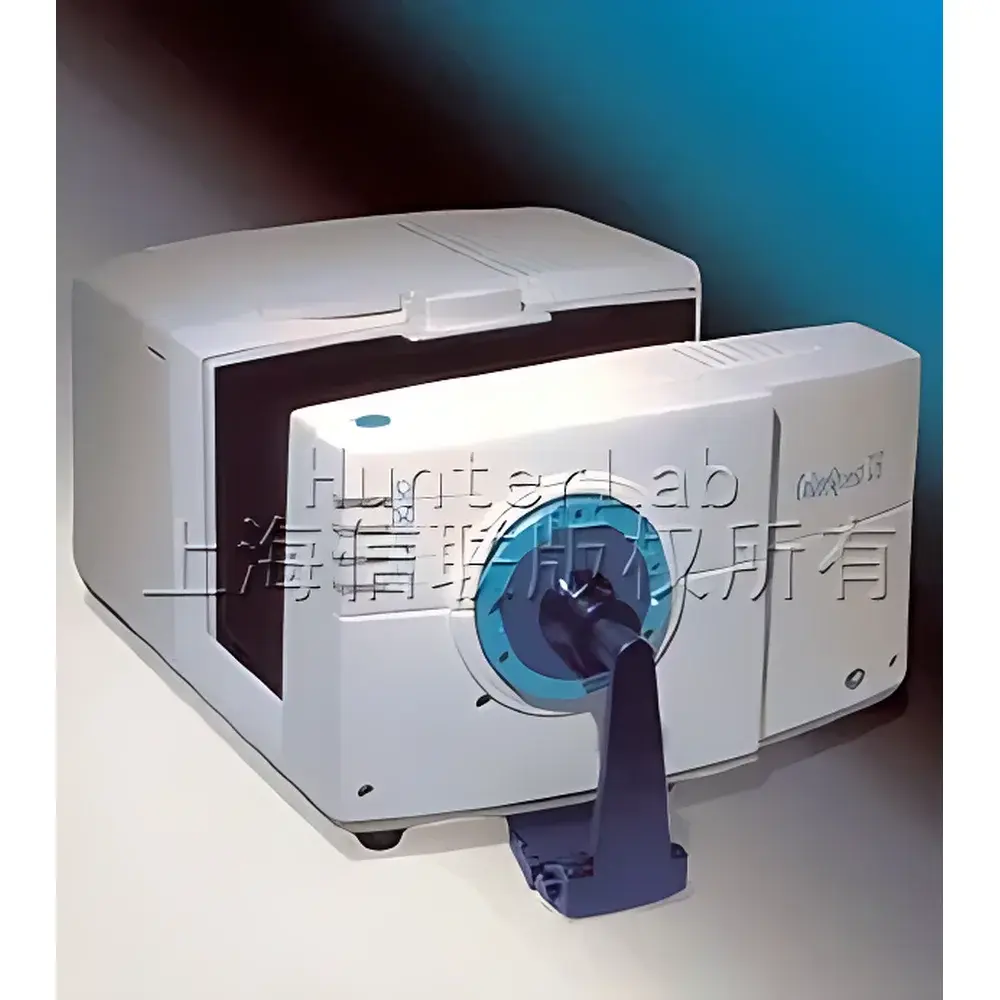
HunterLab ColorQuest XE Desktop Spectrophotometer
| Brand | HunterLab |
|---|---|
| Origin | USA |
| Type | Benchtop Color Difference Meter |
| Optical Geometry | d/8° (diffuse illumination, 8° viewing) with specular component included/excluded |
| Light Source | Pulsed Xenon Flash Lamp (D65 simulated) |
| Spectral Range | 400–700 nm |
| Spectral Resolution | 10 nm |
| Repeatability | ΔE*ab ≤ 0.03 |
| Measurement Modes | Reflectance, Transmittance, Opacity, Haze, Yellowness Index (YI E313), Whiteness Index (WI CIE/ASTM), APHA/Pt-Co, Gardner, Saybolt, L*a*b*, L*C*h*, ΔE*ab/ΔE00, %R, %T |
| Compliance | ASTM D2244, D6290, D313, D5386, ISO 7724, ISO 11664, CIE No. 15, USP <631>, FDA 21 CFR Part 11 ready (with optional software) |
Overview
The HunterLab ColorQuest XE is a benchtop spectrophotometer engineered for high-precision color measurement and quantitative spectral analysis across diverse industrial and laboratory environments. Operating on the principle of diffuse/8° (d/8°) geometry—compliant with ISO 7724-1 and ASTM D2244—it delivers traceable, reproducible colorimetric data for both reflective and transmissive samples. Its pulsed xenon flash lamp provides stable D65 illumination without thermal drift, eliminating the need for frequent lamp replacement and ensuring long-term photometric stability. The instrument integrates a high-quality, matte-finish integrating sphere with patented internal coating to minimize stray light and enhance signal-to-noise ratio. Designed for routine QC and R&D applications, the ColorQuest XE supports full spectral acquisition (400–700 nm at 10 nm intervals), enabling calculation of CIE L*a*b*, L*C*h*, ΔE*ab, and ΔE00, as well as specialized indices including Yellowness Index (ASTM E313), Whiteness Index (CIE/ASTM E313), APHA/Pt-Co, Gardner, Saybolt, haze (ASTM D1003), and opacity (ASTM D5386). Its dual optical path architecture ensures consistent alignment between reference and sample beams, contributing to exceptional inter-instrument agreement—a critical requirement in multi-site manufacturing networks.
Key Features
- d/8° optical geometry with user-selectable specular component inclusion/exclusion (SCI/SCE), enabling accurate assessment of surface texture and gloss effects on color perception
- High-stability pulsed xenon flash lamp calibrated to CIE Standard Illuminant D65—no warm-up time, no intensity decay over lifetime
- Large three-sided transmission compartment accommodating bottles, cuvettes, and flat panels up to 50 mm thick
- Integrated status indicator lights and tactile sample button for intuitive, glove-friendly operation in production environments
- Patented integrating sphere coating optimized for uniform Lambertian diffusion and minimal spectral deviation across visible range
- Robust mechanical design with vibration-damped base and sealed optical path—suitable for factory floor deployment without environmental enclosures
- Quick-change sample holders for solids, powders, pastes, liquids, and films—minimizing cross-contamination and setup time
Sample Compatibility & Compliance
The ColorQuest XE accommodates opaque, translucent, and transparent materials—including plastics, textiles, coatings, ceramics, glass, paper, pharmaceutical tablets, and liquid formulations (e.g., beverages, solvents, APIs). It meets regulatory and industry-standard requirements for color evaluation in GMP-compliant facilities: fully compatible with 21 CFR Part 11 when paired with Vision32 or Universal Software with audit trail, electronic signature, and role-based access control. Validation documentation (IQ/OQ/PQ protocols) and calibration verification tools are available per ASTM E2535 and ISO/IEC 17025 guidelines. Instrument performance is verified against NIST-traceable standards, and inter-unit agreement is maintained within ΔE*ab ≤ 0.08 across global installations—ensuring consistency in multi-lab color specification workflows.
Software & Data Management
Controlled via HunterLab’s Vision32 or Universal Software platforms, the ColorQuest XE supports automated data capture, statistical process control (SPC), tolerance setting (ellipsoidal or rectangular), batch reporting, and export to LIMS or ERP systems (CSV, XML, PDF). Software modules include Color Quality Manager for formulation support, MatchPaint for spectral matching, and Compliance Suite for FDA/EMA audit readiness. All measurements store full spectral data (31-point reflectance/transmittance curves), enabling retrospective analysis, spectral difference mapping, and method reprocessing without re-measurement. Data integrity safeguards include timestamped audit trails, operator ID logging, and immutable raw-data archiving.
Applications
The ColorQuest XE serves as a primary color measurement platform in quality assurance laboratories across chemical manufacturing, polymer compounding, paint & coatings R&D, textile dyeing, food & beverage processing, pharmaceutical solid-dose development, and cosmetic formulation. Typical use cases include incoming raw material inspection (e.g., pigment batches), in-process color verification during extrusion or coating lines, finished-product release testing (per USP for clarity/yellowness), shelf-life stability studies, and supplier color conformance auditing. Its ability to quantify haze, yellowness, and APHA simultaneously with color coordinates makes it indispensable for transparency-critical applications such as medical device packaging and optical film production.
FAQ
Is the ColorQuest XE compliant with FDA 21 CFR Part 11?
Yes—when operated with Vision32 or Universal Software configured with electronic signatures, audit trail, and secure user authentication.
Can it measure both reflectance and transmittance on the same instrument?
Yes—the d/8° geometry and large three-sided transmission chamber support seamless switching between modes without hardware modification.
What is the typical inter-instrument agreement specification?
ΔE*ab ≤ 0.08 for BCRA Series II tiles under repeatability conditions; certified per ASTM D2244 and ISO 7724-2.
Does it require annual recalibration?
No—HunterLab recommends annual performance verification using supplied calibration standards; full recalibration is only required if physical damage or out-of-tolerance verification occurs.
Is APHA/Pt-Co measurement supported natively?
Yes—APHA, Gardner, Saybolt, and other platinum-cobalt scale methods are built-in calculation options with automatic dilution correction.



