
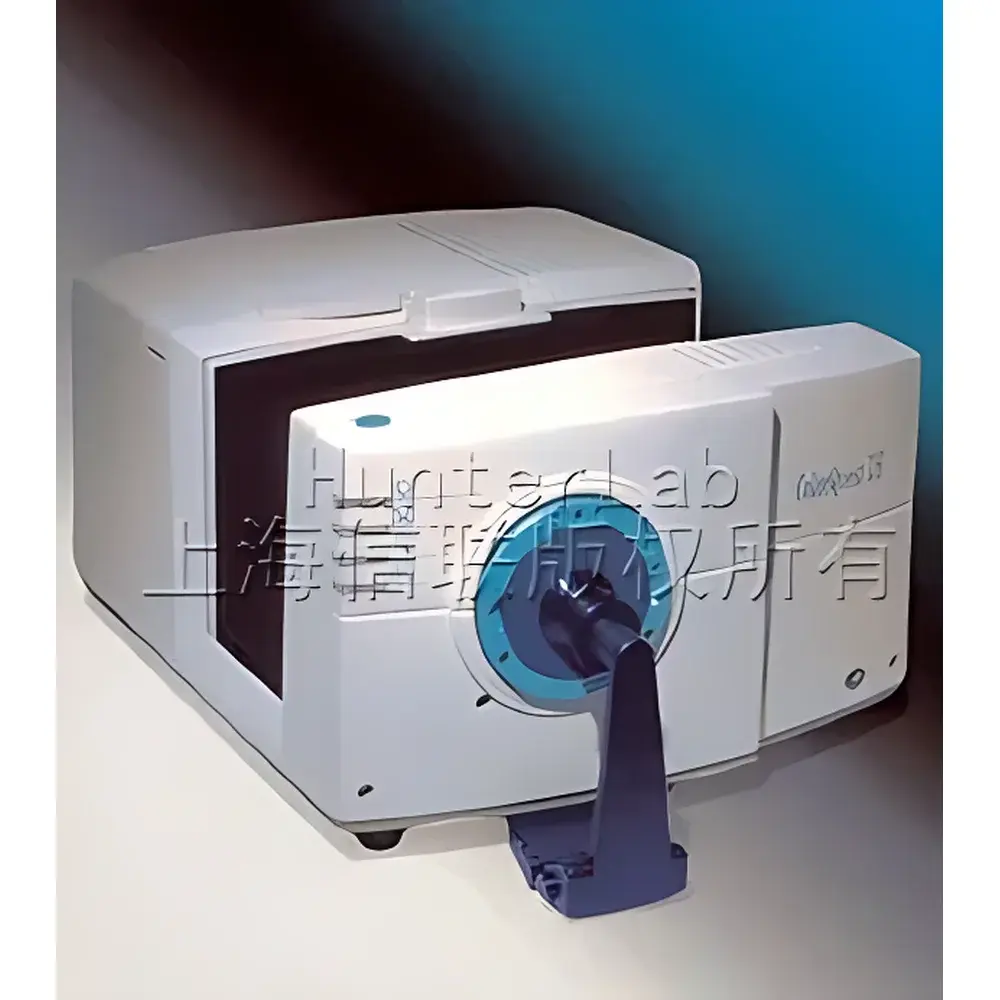
HunterLab ColorQuest XE Desktop Spectrophotometer
| Brand | HunterLab |
|---|---|
| Origin | USA |
| Manufacturer Type | Authorized Distributor |
| Origin Category | Imported |
| Model | ColorQuest XE |
| Product Type | Spectrophotometric Colorimeter |
| Instrument Type | Benchtop |
| Optical Geometry | d/8° Integrating Sphere |
| Light Source | Pulsed Xenon Lamp |
| Spectral Range | 400–700 nm |
| Repeatability | ΔE*ab ≤ 0.03 |
Overview
The HunterLab ColorQuest XE is a high-precision benchtop spectrophotometer engineered for objective, repeatable color measurement of transparent, translucent, and opaque optical substrates—including optical lenses, coated glass, architectural glazing, and ophthalmic materials. Operating on the principle of dual-beam spectral photometry, it employs a 256-element diode array detector coupled with a high-resolution concave holographic grating to deliver full-spectrum reflectance and transmittance data at 10-nm intervals across the visible spectrum (400–700 nm). Its d/8° integrating sphere geometry—compliant with CIE No. 15, ISO 7724-1, ASTM E308, and DIN 5033—ensures diffuse illumination and hemispherical viewing, minimizing directional bias and enabling robust inter-instrument agreement. The 15.2 cm (6″) sphere is internally coated with Spectraflect®, a highly stable, near-Lambertian barium sulfate-based material certified for long-term spectral uniformity and minimal aging drift.
Key Features
- Dual-optical-path design with real-time reference compensation for enhanced photometric stability and reduced thermal drift
- Auto-switching LAV/SAV/XX-SAV apertures: standard 25.4 mm (1″) illumination / 19.0 mm (3/4″) measurement; optional 9.5 mm (3/8″) / 6.3 mm (1/4″) and 4 mm measurement ports for precise lens center-spot evaluation
- Automated specular component inclusion/exclusion (SCI/SCE) via motorized baffle—critical for distinguishing surface vs. body color in anti-reflective or hard-coated optics
- Pulsed xenon lamp with >1,000,000 flash cycles lifetime; zero warm-up time and no spectral shift over operational life
- Sub-second measurement cycle (<1 s) with 3 s minimum interval—optimized for high-throughput QC labs handling multiple lens batches per hour
- Integrated transmittance chamber with three-sided open configuration supporting both direct (directional) and total transmittance modes per ISO 13468-2 and ASTM D1003
Sample Compatibility & Compliance
The ColorQuest XE accommodates plano-convex, biconvex, aspheric, and freeform optical lenses up to 100 mm in diameter using customizable sample holders and alignment fixtures. Its large-port geometry and adjustable stage support thicknesses from 0.5 mm to 25 mm, including laminated safety glass and low-emissivity coated substrates. All measurements adhere to international colorimetric standards: CIE 1931 2° and 10° standard observer functions, illuminants A, C, D50, D65, F2, and custom user-defined spectra. Data traceability meets GLP/GMP requirements through instrument calibration verification logs, NIST-traceable white tile certification (certified SRM 2036), and built-in diagnostic routines compliant with ISO/IEC 17025 metrological validation protocols.
Software & Data Management
Equipped with EasyMatch QC software (v5.0+), the system provides audit-trail-enabled data acquisition, statistical process control (SPC) charting, pass/fail tolerance mapping, and multi-site instrument synchronization. Raw spectral data (31-point or 100-point) exports in CSV, XML, and CxF/XRGA formats for integration into LIMS, MES, or ERP platforms. Software supports 21 CFR Part 11-compliant electronic signatures, role-based access control, and immutable record retention—essential for regulated optical manufacturing environments serving automotive (e.g., ISO/TS 16949), medical device (ISO 13485), and aerospace (AS9100) supply chains.
Applications
- Quantitative evaluation of chromatic aberration in precision lens assemblies via ΔE*ab, ΔL*a*b*, and Yellowness Index (YI E313) across production lots
- AR coating uniformity assessment by measuring spectral transmittance deviation at critical wavelengths (e.g., 450 nm, 550 nm, 650 nm)
- Batch-to-batch consistency verification for tinted ophthalmic lenses (gray, brown, green) per ANSI Z80.3 specifications
- Color shift monitoring during thermal tempering or chemical strengthening of float glass substrates
- Validation of UV-blocking performance in polycarbonate and CR-39 lenses using integrated UV-cutoff analysis tools
FAQ
Is the ColorQuest XE suitable for measuring curved optical surfaces without distortion artifacts?
Yes—the d/8° sphere geometry combined with large-area illumination (25.4 mm) and motorized aperture selection minimizes edge diffraction effects. For high-curvature lenses, SAV mode (9.5 mm illumination) improves spatial resolution while maintaining compliance with CIE geometry definitions.
Can spectral transmittance data be used to calculate Abbe number or dispersion curves?
While the ColorQuest XE does not compute Abbe numbers directly, its high-fidelity 10-nm spectral transmittance data (400–700 nm) can be exported and processed in third-party optical design software (e.g., Zemax OpticStudio, CODE V) to derive refractive index dispersion models when correlated with reference prism measurements.
Does the system support calibration transfer between multiple instruments in a global manufacturing network?
Yes—HunterLab’s Inter-Instrument Agreement (IIA) protocol enables spectral calibration transfer using master tiles and matrix-matching algorithms, achieving ΔE*ab < 0.15 across ≥5 instruments—validated per ASTM E2539 and widely deployed by Tier-1 automotive glazing suppliers.





