
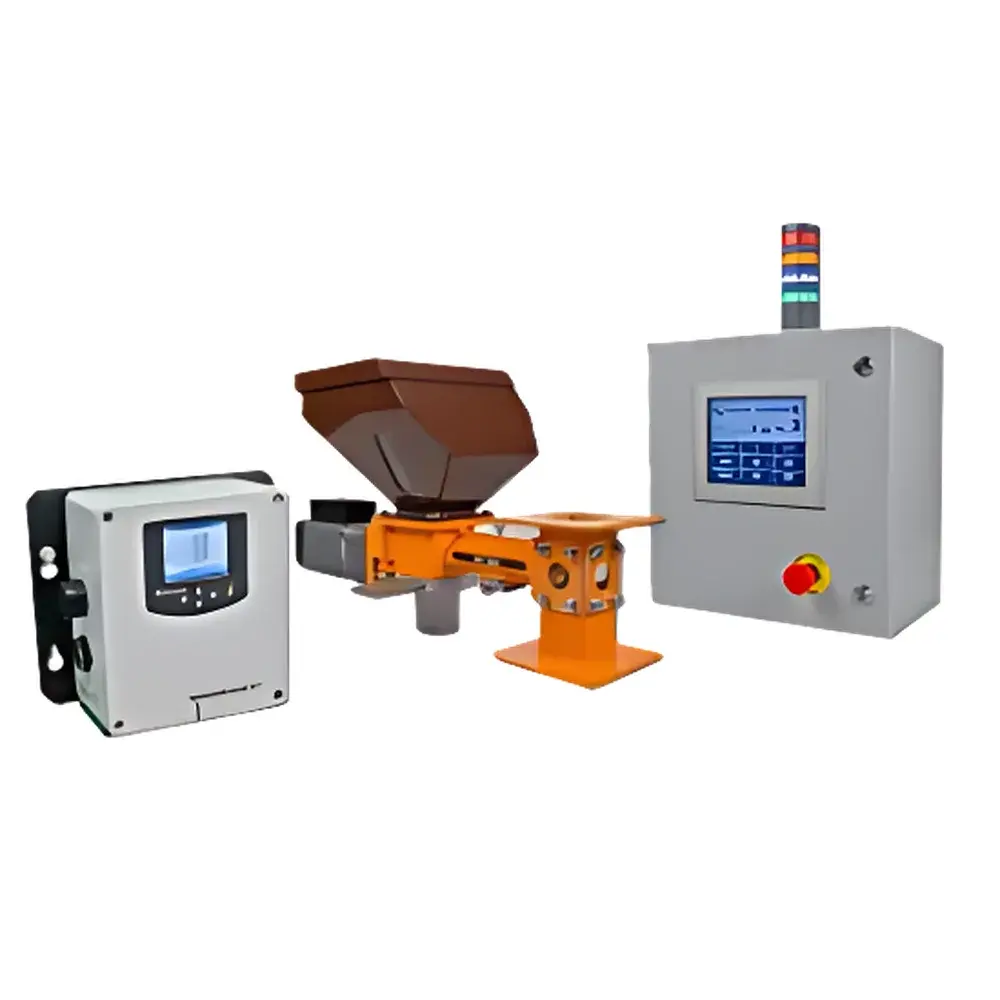
HunterLab cPAT Online Color Measurement and Control System
| Brand | HunterLab |
|---|---|
| Origin | USA |
| Model | cPAT |
| Type | Online Color Difference Meter |
| Optical Geometry | 0°/45° Integrating Sphere |
| Application Domain | Plastic Extrusion, Compounding, and Profile Manufacturing |
| Compliance Framework | Designed for ISO 13655 (M0/M1/M2/M3), ASTM D2244, ASTM E308, CIE No. 15, and GLP/GMP-aligned process validation |
| Data Management | FTP/USB Export, Audit-Trail-Ready Calibration Logging, Real-Time Scan History (100+ scans on-screen) |
| Control Interface | PLC-Integrated Touch HMI with Closed-Loop Actuator Output (Feeder Speed, Pump Rate, Line Speed Motor, Oven Thermostat) |
Overview
The HunterLab cPAT (Color Processing Automation Technology) is a purpose-built online color measurement and closed-loop control system engineered for continuous, non-contact spectral monitoring in thermoplastic manufacturing environments. Unlike conventional benchtop or handheld colorimeters, the cPAT integrates a ruggedized 0°/45° geometry spectrophotometer—based on HunterLab’s proven SpectraTrend HT optical architecture—directly into extrusion lines, compounding hoppers, profile chillers, and calendering stations. Its core measurement principle relies on diffuse illumination and directional collection under standardized CIE illuminants (D65, A, F2, etc.), enabling high-reproducibility ΔE00 calculations traceable to NIST-traceable standards. The system operates continuously during production, capturing spectral reflectance data at user-defined intervals (e.g., every 1–30 seconds), thereby transforming static QC checkpoints into dynamic, statistically robust process endpoints aligned with Six Sigma color tolerance thresholds.
Key Features
- Real-time, non-contact color measurement integrated directly into plastic extrusion, blending, and profile-forming processes
- 0°/45° integrating sphere optical design compliant with ISO 13655 and ASTM D2244 for minimized texture and gloss sensitivity
- PLC-synchronized touch HMI interface supporting intuitive recipe-based calibration, tolerance band definition, and alarm threshold configuration
- Closed-loop actuator control outputs (4–20 mA or digital relay) for automatic adjustment of masterbatch feeder speed, liquid colorant pump rate, line drive motor RPM, and oven zone temperature setpoints
- In-line defect detection logic that flags out-of-spec color excursions exceeding configurable ΔL*, Δa*, Δb*, or ΔE00 limits—triggering visual alerts, data logging, and optional reject signal output
- On-device storage of ≥100 consecutive spectral scans with timestamped metadata; real-time waveform visualization of L*, a*, b* trends over time
- Automated calibration reminder system based on cumulative scan count and elapsed time since last NIST-traceable standard verification
Sample Compatibility & Compliance
The cPAT is validated for use with opaque and semi-transparent thermoplastic substrates including PVC, ABS, polypropylene, polycarbonate, and engineered blends—whether in molten strand, cooled pellet, extruded sheet, or rigid profile form. Surface finish variations (matte, gloss, textured) are accommodated via the 0°/45° geometry’s inherent insensitivity to specular reflectance. All measurement protocols adhere to ISO 13655:2012 (spectral measurement conditions M0–M3), ASTM D2244 (color difference calculation), and ASTM E308 (CIE tristimulus value computation). System validation documentation supports FDA 21 CFR Part 11 compliance when deployed in regulated pharmaceutical packaging or medical-grade polymer production, with full audit trail capability for calibration events, operator actions, and process parameter changes.
Software & Data Management
cPAT firmware includes embedded color science algorithms compliant with CIE Publication 15:2018 and the latest ΔE00 (CIEDE2000) formula. Raw spectral data (360–780 nm, 10 nm intervals) and derived colorimetric values are stored locally in CSV-compliant format. Historical datasets are retrievable via USB mass storage mode or scheduled FTP push to enterprise MES/SCADA servers. Each data packet contains instrument serial number, timestamp (UTC), operator ID (if logged), material batch ID (via optional barcode integration), and full spectral signature—enabling retrospective root-cause analysis and multivariate SPC charting. Calibration logs include reference standard ID, date/time, deviation metrics, and operator confirmation—fully traceable per GLP and GMP documentation requirements.
Applications
The cPAT system is deployed across high-volume plastic manufacturing segments where color consistency directly impacts brand integrity and regulatory acceptance: vinyl siding and window profile extrusion; colored film and sheet production; compounded masterbatch quality assurance; food-contact polymer pellet lines; and automotive interior trim color matching. In compounding operations, it enables feed-forward correction of pigment dispersion variability before downstream processing. In extrusion, it stabilizes color drift caused by thermal degradation or residence time shifts. For custom profile manufacturers, cPAT reduces first-piece approval cycles and eliminates manual color sorting post-extrusion—lowering scrap rates by up to 40% in validated installations.
FAQ
What color standards and illuminants does the cPAT support?
The system natively computes CIE L*a*b*, L*C*h°, Yellowness Index (ASTM E313), Whiteness Index (ISO 11475), and ΔE00 under D65, A, F2, F7, and F11 illuminants per CIE 15:2018.
Can cPAT integrate with existing PLCs and SCADA systems?
Yes—it provides native Modbus TCP and analog 4–20 mA I/O for seamless integration with Allen-Bradley, Siemens, and Omron PLC platforms, as well as Ignition, WinCC, and FactoryTalk SCADA environments.
Is NIST-traceable calibration included?
HunterLab supplies certified ceramic tile standards (L*, a*, b* certified ±0.02 ΔE00) with full NIST-traceable certificates; annual recalibration services are available through authorized service centers.
How is cybersecurity handled for network-connected units?
Firmware implements TLS 1.2 encryption for FTP transfers, role-based access control (admin/operator/guest), and disabled default credentials—meeting IEC 62443-3-3 SL1 requirements for industrial device hardening.
Does cPAT require periodic maintenance beyond calibration?
No consumables or moving parts are present; optical path integrity is verified automatically during startup self-test, and environmental sealing meets IP65 for operation in humid, dusty plant-floor conditions.





