
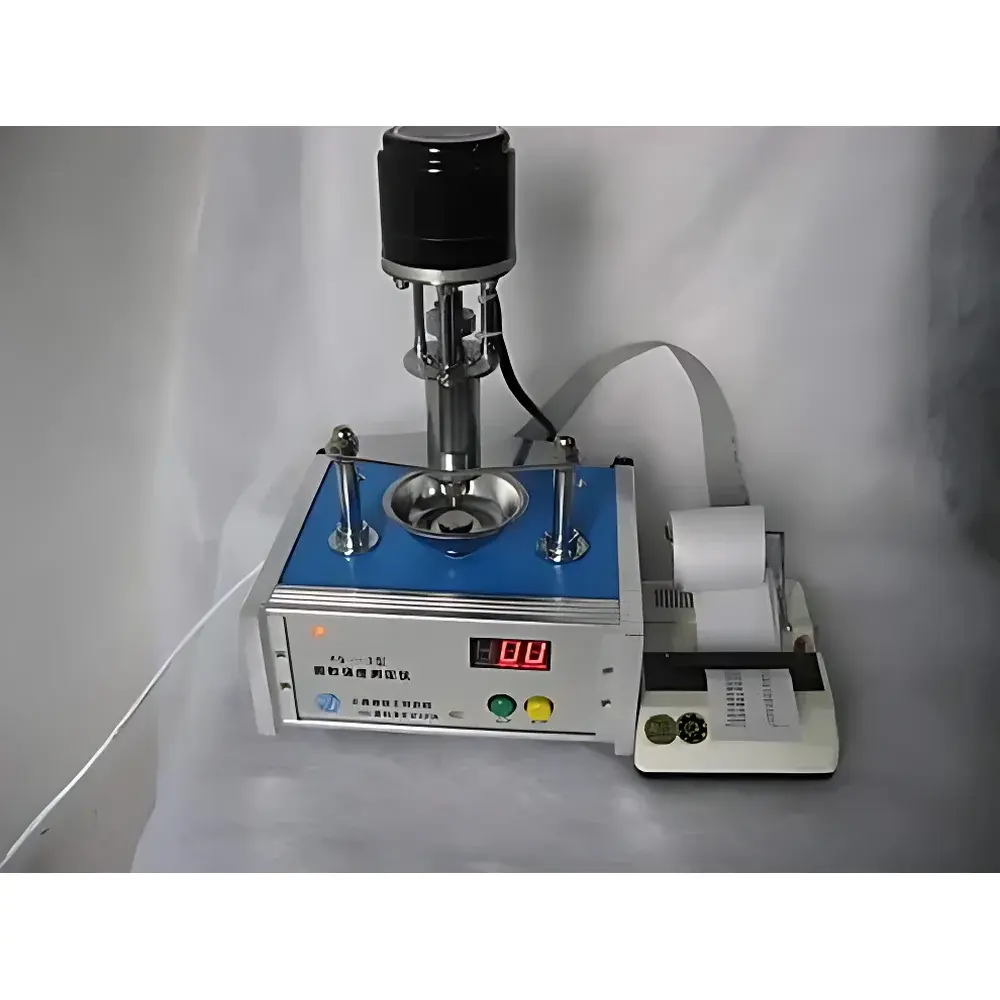
KQ-3 Particle Strength Tester
| Origin | Beijing |
|---|---|
| Manufacturer Type | Distributor |
| Origin Category | Domestic (China) |
| Model | KQ-3 |
| Price | Upon Request |
| Measurement Range | 0–1000 N / 0–1500 N (dual-range) |
| Max. Particle Diameter | <25 mm |
| Resolution | 0.1 N |
| Load Cell Accuracy | ≤±0.05% F.S. |
| Operating Humidity | ≤85% RH |
| Operating Temperature | 0–50 °C |
| Power Supply | AC 220 V ±10% |
| Dimensions | 260 mm × 170 mm × 260 mm |
Overview
The KQ-3 Particle Strength Tester is a compact, microprocessor-controlled mechanical testing instrument engineered for the quantitative evaluation of mechanical integrity in brittle or semi-brittle granular materials. It operates on the principle of uniaxial compressive force application—where a calibrated load cell measures the peak normal force required to fracture or deform a single particle under controlled quasi-static loading. Unlike elemental analyzers or spectroscopic instruments, the KQ-3 does not perform chemical composition analysis; rather, it delivers mechanically traceable strength metrics critical for quality control, formulation optimization, and regulatory documentation in solid-dosage and catalyst manufacturing. Its design conforms to fundamental mechanical testing conventions referenced in ASTM D4179 (Standard Test Method for Determination of Friability of Catalysts and Catalyst Carriers) and ISO 3915 (Electrical Resistance of Conductive Polymer Materials), where applicable to physical robustness assessment.
Key Features
- Two selectable measurement ranges (0–1000 N and 0–1500 N) accommodate diverse material classes—from low-strength agglomerates to high-density ceramic catalyst pellets.
- High-resolution digital display with four-digit LED readout ensures immediate visibility of real-time and peak-hold force values under ambient laboratory lighting.
- Integrated auto-zero function eliminates manual potentiometer adjustment, reducing operator-induced drift and enhancing sensor longevity.
- Programmable peak-hold mode captures maximum compressive load without data logging hardware—ideal for rapid pass/fail screening in production environments.
- Acoustic overload alert triggers upon approach to upper range limit, preventing mechanical overtravel and protecting both transducer and sample stage.
- Compact footprint (260 × 170 × 260 mm) enables deployment on benchtops, QC stations, or mobile testing carts without dedicated floor space.
Sample Compatibility & Compliance
The KQ-3 accepts discrete particles with diameters under 25 mm, including cylindrical extrudates, spherical beads, irregularly shaped catalysts, pharmaceutical tablets, fertilizer granules, molecular sieve pellets, and animal feed crumbles. Sample placement is manual but standardized via adjustable anvil alignment—ensuring repeatable axial loading orientation per ASTM D6116 (Standard Test Method for Measuring Compressive Strength of Solid Propellants). While the instrument itself is not certified to GLP or GMP, its output data—including timestamped peak force values—can be recorded manually or integrated into validated electronic lab notebooks compliant with FDA 21 CFR Part 11 when paired with approved external capture systems. All electrical components meet IEC 61010-1 safety standards for laboratory equipment.
Software & Data Management
The KQ-3 operates as a standalone hardware unit with no embedded software or USB/Bluetooth connectivity. Force data is displayed and retained locally only during active measurement cycles. For traceable recordkeeping, users are advised to implement external documentation protocols—such as CSV export from connected digital calipers or integration with LIMS platforms via RS-232 (optional adapter required). The absence of onboard memory or firmware updates simplifies validation efforts in regulated environments, minimizing cybersecurity risk surfaces and reducing qualification burden during audit preparation.
Applications
- Quality assurance of nitrogen-phosphorus-potassium (NPK) fertilizer granules prior to bulk packaging.
- Evaluation of crush strength in fluid catalytic cracking (FCC) catalysts and hydrodesulfurization (HDS) supports.
- Batch release testing of sustained-release pharmaceutical pellets and coated mini-tablets.
- Formulation development for animal feed pellets where mechanical durability affects transport stability and feeding efficiency.
- Pre-screening of zeolite and silica-alumina molecular sieve integrity after calcination or ion exchange.
- Research-grade mechanical characterization of biomass-derived biochar granules in energy applications.
FAQ
Is the KQ-3 suitable for measuring tensile strength?
No—the KQ-3 performs uniaxial compression only and is not configured for tensile, shear, or bending tests.
Does it support automatic data export to Excel or LIMS?
Not natively; data must be manually transcribed or captured externally using optional serial interface adapters.
Can it be calibrated in-house using standard weights?
Yes—calibration follows standard dead-weight procedures traceable to national metrology institutes, with verification points at 20%, 50%, and 100% of selected range.
What maintenance is required for long-term accuracy?
Annual verification of load cell linearity and zero stability is recommended; no routine lubrication or consumable replacement is needed.
Is the device compatible with ISO/IEC 17025 accredited laboratories?
Yes—as a Class III mechanical testing device, it may be included in scope when used with documented calibration certificates, uncertainty budgets, and operator competency records.





