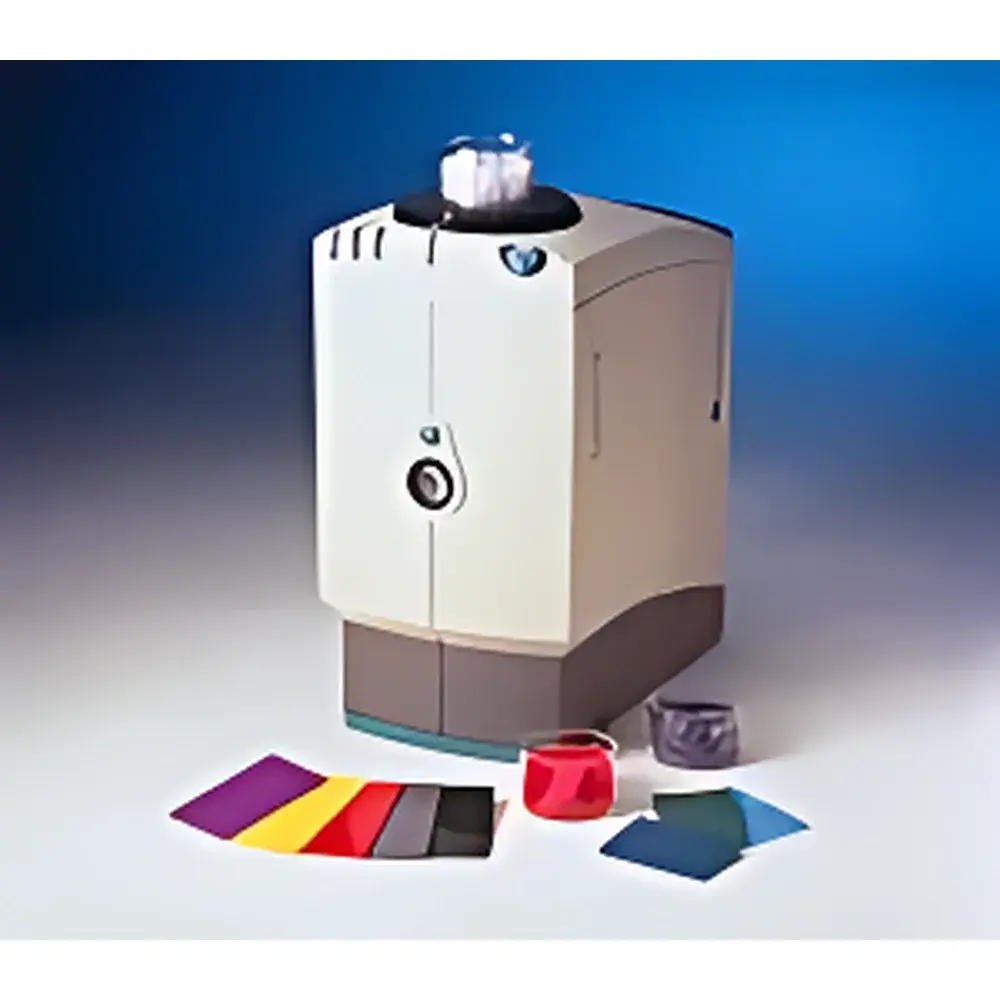
HunterLab LabScan XE 0/45° Reflectance Spectrophotometer
| Brand | HunterLab |
|---|---|
| Origin | USA |
| Model | LabScan-XE |
| Product Type | Benchtop Spectrophotometric Colorimeter |
| Optical Geometry | 0°/45° Annular Illumination with 15-Fiber Ring Detection |
| Light Source | Pulsed Xenon Lamp |
| Spectral Range | 400–700 nm |
| Wavelength Interval | 10 nm |
| Repeatability (ΔE*ab) | ≤ 0.09 |
| Measurement Aperture | Standard 44 mm (1.75″), Optional Variable Sample Illumination (VSI) with 5 apertures (44, 25, 13, 6, 3 mm) |
| Detector | 256-element Silicon Photodiode Array |
| Monochromator | Holographic Diffraction Grating |
| UV Control | Automatic UV-absorbing filter (cut-on ~420 nm) |
| Lamp Lifetime | ≥ 1 billion flashes |
| Communication Interface | RS-232C (DB9) |
Overview
The HunterLab LabScan XE is a benchtop spectrophotometric colorimeter engineered for high-fidelity color measurement under standardized 0°/45° annular geometry. Unlike diffuse/8° sphere-based instruments, the LabScan XE replicates human visual perception of color by emulating the directional illumination and viewing conditions used in industrial color evaluation—particularly where surface texture, gloss, and microstructure significantly influence perceived hue and chroma. Its optical architecture employs a pulsed xenon lamp coupled with a holographic diffraction grating monochromator and a 256-element silicon photodiode array detector, delivering full spectral reflectance data from 400 to 700 nm at 10 nm intervals. The instrument’s defining feature is its 15-fiber ring detection system, which captures reflected light simultaneously at 15 discrete azimuthal positions around the 45° viewing cone and computes an averaged spectral response—effectively mitigating bias introduced by sample heterogeneity, directional texture, or localized gloss variation. This design ensures metrological consistency across diverse material classes without requiring manual repositioning or multiple readings.
Key Features
- Benchtop form factor with integrated power supply—no external transformer or rack-mount hardware required.
- True 0°/45° annular illumination and detection geometry compliant with ASTM E308, ISO 5-4, and CIE Publication No. 15:2018 for non-diffuse surface assessment.
- Automatic UV-filtering system (420 nm cut-on) enables precise D65-simulated daylight measurements with traceable UV component control—critical for fluorescent whitening agent (FWA) evaluation in textiles, paper, and plastics.
- Variable Sample Illumination (VSI) option supports five selectable apertures (44, 25, 13, 6, and 3 mm), enabling consistent color assessment across macro- and micro-scale features—from large painted panels to printed halftone dots or granular powders.
- Dual-beam optical path design provides real-time reference compensation, minimizing drift due to lamp aging or thermal fluctuation and sustaining long-term repeatability (ΔE*ab ≤ 0.09 over 24 h per NIST-traceable verification protocols).
- Front- or top-access sample port accommodates solids, translucent liquids (in cuvettes), powders, pastes, and textured substrates without reconfiguration—no moving parts or motorized stages required.
- Dedicated measurement trigger button located adjacent to the sample port allows operator-initiated acquisition independent of PC connectivity—essential for production-floor environments with restricted IT infrastructure.
Sample Compatibility & Compliance
The LabScan XE is validated for use across regulated and industrial quality control workflows requiring adherence to international color standards. Its optical configuration meets the geometric requirements of ASTM D2244 (standard practice for calculation of color tolerances), ASTM D3134 (for plastic color matching), and ISO 11664-4 (colorimetry — CIE 1976 L*a*b* color space). For pharmaceutical and cosmetic applications, the instrument supports audit-ready data capture when paired with optional software modules compliant with FDA 21 CFR Part 11 (electronic records and signatures), including electronic signature enforcement, user role-based access control, and immutable audit trails. All spectral data are stored in vendor-neutral, ASCII-based .csv or CIE-standard .cie formats, ensuring interoperability with third-party LIMS, ERP, and statistical process control (SPC) platforms. Calibration is traceable to NIST SRM 2010 and SRM 1004a via factory-certified calibration tiles, with documented uncertainty budgets provided per ISO/IEC 17025 guidelines.
Software & Data Management
HunterLab’s Universal Software Suite (v7.x or later) provides comprehensive instrument control, spectral analysis, and reporting functionality. The platform supports multi-instrument fleet management, customizable pass/fail tolerancing (including ΔL*, Δa*, Δb*, ΔC*, ΔH*, and CMC 2:1), and advanced scatter correction algorithms for semi-transparent or layered samples. Raw spectral data are timestamped, geotagged (if network-enabled), and archived with full metadata—including operator ID, calibration status, aperture selection, UV filter state, and ambient temperature/humidity logs. Data export options include XML for integration with SAP QM modules, PDF reports with embedded spectral plots and tolerance overlays, and direct SQL database writes for enterprise-level analytics. Optional Qualification Package includes Installation Qualification (IQ), Operational Qualification (OQ), and Performance Qualification (PQ) documentation aligned with GLP and GMP expectations.
Applications
- Paint & coatings: Batch-to-batch color consistency verification on metallic, pearlescent, and matte finishes where gonio-apparent effects dominate visual assessment.
- Plastics & polymers: In-line QC of injection-molded components, extruded profiles, and recycled resin blends exhibiting surface roughness or crystallinity-induced scattering.
- Food & agriculture: Objective quantification of fruit skin color (e.g., tomato ripeness), meat surface oxidation, and cereal grain uniformity—without interference from moisture or specular highlights.
- Textiles & apparel: Evaluation of dye lot conformity across woven, knitted, and nonwoven fabrics, including stretchable or brushed surfaces where traditional sphere geometry yields inconsistent results.
- Printing & packaging: Spot color verification on flexographic, gravure, and digital prints—especially critical for brand-critical assets requiring CMYK-to-Pantone® translation with minimal metamerism risk.
- Pharmaceuticals: Tablet coating uniformity assessment, capsule shell color stability testing, and excipient batch release per USP and ICH Q5C guidelines.
FAQ
What distinguishes the LabScan XE’s 0°/45° geometry from integrating sphere instruments?
The 0°/45° configuration eliminates inter-reflection artifacts inherent in sphere systems, making it ideal for measuring directional appearance attributes—such as orange peel, mottle, or directional gloss—that directly impact visual color match acceptance.
Is the LabScan XE suitable for measuring transparent or translucent liquids?
Yes—when used with optional liquid transmission cells and front-access orientation, it measures absorbance spectra and derived CIELAB values for clear and slightly turbid solutions per ASTM D1209 and ISO 6271.
How is calibration traceability maintained?
Each unit ships with NIST-traceable ceramic calibration tiles (white and black), and annual recalibration services include full spectral validation against SRM 2010 and uncertainty reporting per ISO/IEC 17025.
Can the instrument operate without a connected computer?
Yes—the front-panel trigger button initiates measurement and displays ΔE*ab deviation from master in real time; full spectral data are stored internally and synced upon next PC connection.
Does the LabScan XE support Good Manufacturing Practice (GMP) compliance?
With the optional Qualification Package and validated software modules, it fulfills core requirements for electronic records, audit trail generation, and user access control per FDA 21 CFR Part 11 and EU Annex 11.