
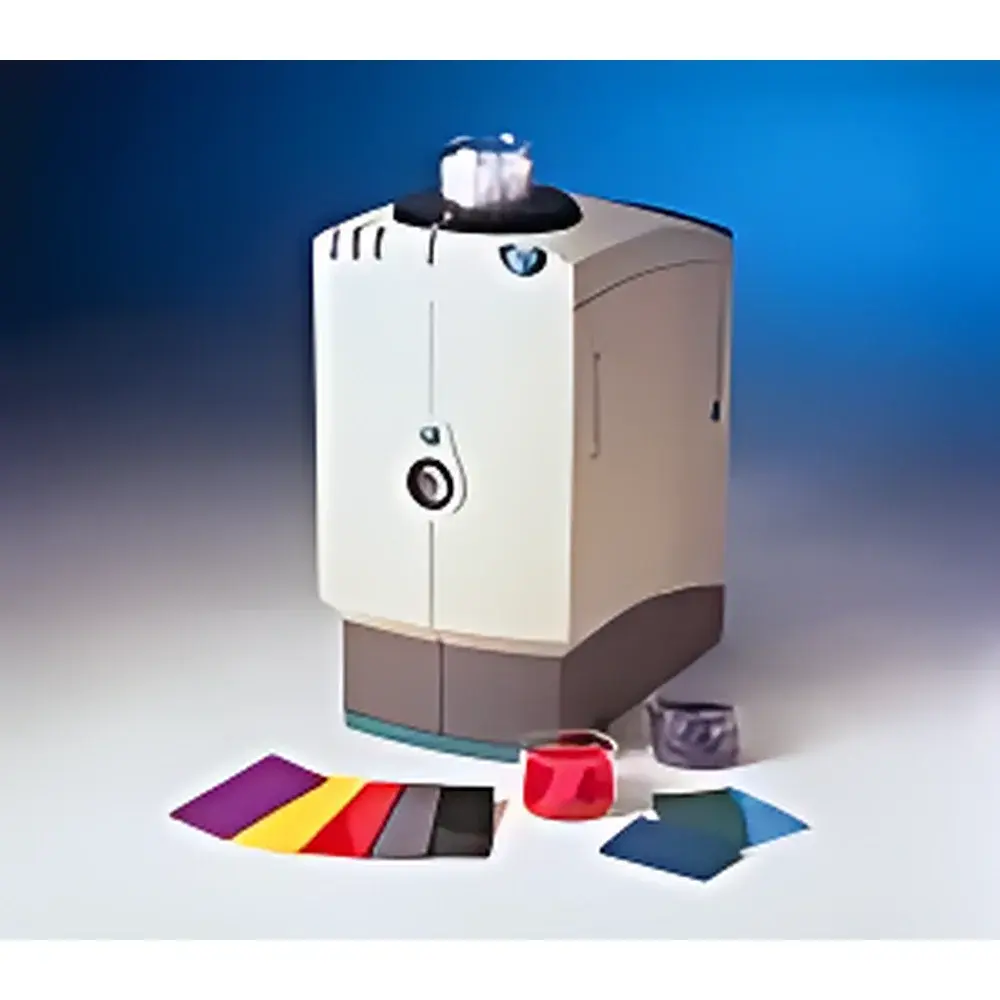
HunterLab LabScan XE Spectrophotometer
| Brand | HunterLab |
|---|---|
| Origin | USA |
| Model | LabScan XE |
| Product Type | Spectrophotometric Colorimeter |
| Instrument Type | Benchtop |
| Optical Geometry | 0°/45° Integrating Sphere |
| Light Source | Pulsed Xenon Lamp |
| Spectral Range | 400 nm – 700 nm |
| Wavelength Interval | 10 nm |
| Repeatability | ΔE*ab ≤ 0.09 |
| Aperture Size | 44 mm (LAV) |
| Measurement Time | ≤ 3 s |
| Photometric Range | 0–150% Reflectance |
| Detector | 256-element Silicon Photodiode Array with Diffraction Grating |
| Illuminant Simulation | D65 (Xenon + Filter) |
| Operating Voltage | 100–240 VAC, 47–63 Hz |
| Operating Temperature | 10–40 °C |
| Storage Temperature | −20–70 °C |
| Relative Humidity | 10–90% RH (non-condensing) |
| Interface | RS-232C |
Overview
The HunterLab LabScan XE is a high-precision benchtop spectrophotometer engineered for rigorous color measurement in industrial quality control and R&D environments. It employs a dual-beam 0°/45° optical geometry—distinct from d/8° sphere-based instruments—to emulate human visual perception under standardized viewing conditions while delivering superior metrological stability. This geometry ensures that surface texture, directional reflectance, and micro-structural effects (e.g., orange peel, weave patterns, or particle orientation) are captured consistently without angular averaging artifacts. As a result, the LabScan XE provides higher correlation with visual assessments for textured, structured, or directional surfaces—particularly critical in industries where appearance tolerances reside at the perceptual threshold. Its pulsed xenon light source, filtered to closely match CIE Standard Illuminant D65, delivers stable spectral output across its full 400–700 nm range, with 10 nm reporting intervals and 256-channel diode array detection enabling high-resolution spectral capture and robust inter-instrument agreement.
Key Features
- Dual-beam 0°/45° optical architecture with integrating sphere for enhanced signal stability and reduced lamp drift sensitivity
- 44 mm large-area viewing port (LAV) optimized for heterogeneous or granular samples including PET flakes, polymer pellets, textile swatches, and coated metal panels
- Pulsed xenon lamp with ≥1 million flash cycles lifetime—eliminates thermal drift and enables consistent D65 simulation without warm-up delay
- Diffraction grating monochromator coupled with 256-element silicon photodiode array for high signal-to-noise ratio and low inter-channel crosstalk
- Reflectance measurement range of 0–150%, supporting both opaque and semi-transparent materials (e.g., fluorescent additives, pigmented films)
- Measurement cycle completed in ≤3 seconds—including auto-calibration, spectral acquisition, and CIE L*a*b*, ΔE*ab, and custom index computation
- Front-panel status LEDs and tactile top-mounted trigger button for intuitive operator workflow in production-line settings
- RS-232C serial interface compliant with ANSI/TIA/EIA-232-F standards for integration into legacy SCADA or MES systems
Sample Compatibility & Compliance
The LabScan XE accommodates a broad spectrum of physical sample forms: solid sheets (plastic, coil-coated steel), loose particulates (PP, ABS, EVA pellets), powders (pharmaceutical excipients, pigment dispersions), woven fabrics (denim, technical textiles), and liquid suspensions (when used with optional transmission cell holders). Its 0°/45° geometry inherently minimizes interference from surface gloss and directional scattering—making it preferred for ASTM D2244 (Standard Practice for Calculating Color Tolerances), ISO 11664-4 (Colorimetry – CIE 1976 L*a*b*), and AATCC Evaluation Procedure 1 (Color Difference Assessment). The instrument meets IEC 61000-4 electromagnetic compatibility requirements and is designed for operation within GLP/GMP-regulated environments; audit trails, user access controls, and data integrity features are fully supported when paired with EasyMatch-QC software compliant with FDA 21 CFR Part 11.
Software & Data Management
The LabScan XE operates natively with HunterLab’s EasyMatch-QC platform—a validated, multi-user color management system supporting full traceability, statistical process control (SPC), and automated pass/fail decision logic. Optional modules include EasyMatch-QC Coatings for formulation matching and spectral correction of metallic or effect pigments. All spectral data are stored in vendor-neutral .qtx format (XML-based), enabling interoperability with third-party LIMS and ERP systems via ODBC or RESTful API extensions. Software-generated reports include full spectral curves, CIE XYZ, L*a*b*, L*C*h°, Yellowness Index (ASTM E313), Whiteness Index (CIE/ISO 11475), and custom user-defined metrics—all timestamped with operator ID, calibration history, and environmental metadata.
Applications
- Plastics manufacturing: batch-to-batch color consistency verification for PET bottle resin, PP automotive trim, and flame-retardant compounds
- Coil coating & architectural metals: real-time color deviation monitoring on continuous lines using calibrated reference standards
- Textile dyeing: objective assessment of shade depth and metamerism across fiber types (cotton, polyester, elastane blends)
- Pharmaceutical solid dosage: color uniformity testing of tablets and capsules per USP <1061> guidelines
- Food ingredient processing: quantitative evaluation of natural pigment stability in dried fruits, dairy powders, and confectionery coatings
- Fluorescent material development: UV-excited emission quantification via spectral subtraction when used with optional UV-filter kits
FAQ
What distinguishes the 0°/45° geometry of the LabScan XE from d/8° sphere instruments?
The 0°/45° configuration isolates directional reflectance, making it more sensitive to surface texture and less influenced by diffuse scattering—ideal for evaluating appearance-critical parts where visual judgment dominates specification.
Can the LabScan XE measure fluorescent or phosphorescent samples?
Yes—when equipped with optional UV-enhanced optics and calibrated against NIST-traceable fluorescent standards, it supports quantitative fluorescence correction per ASTM E308 Annex A4.
Is instrument-to-instrument agreement validated across global manufacturing sites?
HunterLab maintains an Inter-Instrument Agreement (IIA) program with published tolerances (ΔE*ab ≤ 0.15 for CR-10 standard tiles); each LabScan XE ships with factory IIA certification and optional site-specific validation kits.
Does the LabScan XE support regulatory compliance for pharmaceutical or food applications?
When deployed with EasyMatch-QC v5.0+ and configured with electronic signatures, audit trail logging, and 21 CFR Part 11-compliant user roles, it satisfies GxP data integrity requirements for QC release testing.
How often must the instrument be recalibrated?
Daily white tile verification is recommended; full calibration using certified standards is required after lamp replacement, major firmware updates, or if verification fails per internal SOPs—typically every 6–12 months under normal use.





