
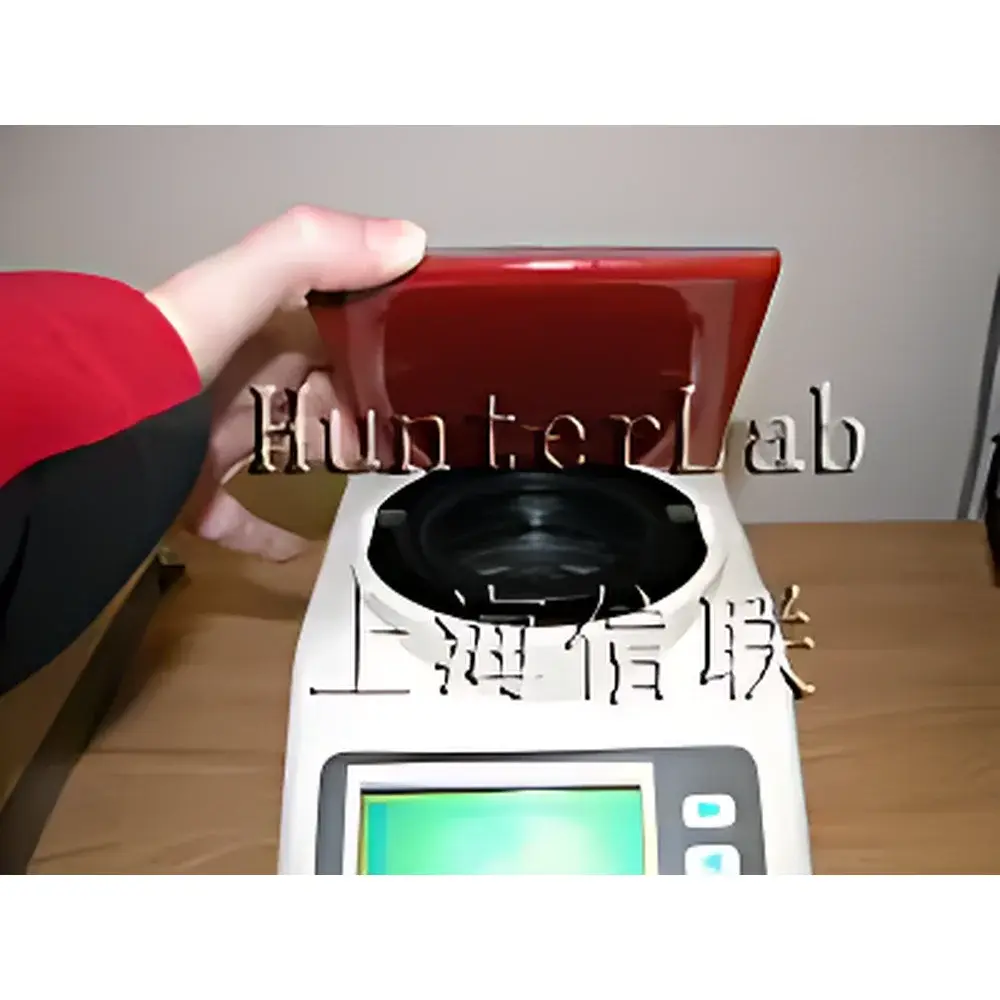
HunterLab LabScan XE Tomato Color Spectrophotometer
| Brand | HunterLab |
|---|---|
| Origin | USA |
| Product Type | Benchtop Spectrophotometer |
| Optical Geometry | 0/45° (annular illumination, 45° viewing) |
| Light Source | Pulsed Xenon Lamp |
| Spectral Range | 400–700 nm |
| Repeatability | ΔE*ab ≤ 0.09 |
| Aperture Size | 44 mm |
| Compliant Standards | ASTM E313-96, USDA-recognized for tomato product evaluation |
| Built-in Tomato-Specific Indices | Tomato A/B Ratio, Lycopene Estimate (Hunter LAB), Tomato Juice Score, Tomato Catsup Score, Tomato Paste Score, Tomato Sauce Score, 457-nm Brightness, C/2° and D65/10° Yellowness Index |
Overview
The HunterLab LabScan XE Tomato Color Spectrophotometer is a benchtop, 0/45° geometry spectrophotometer engineered specifically for objective color measurement of tomato-based food products—including fresh tomatoes, tomato paste, ketchup, sauce, juice, and puree. Its optical architecture employs annular 0° illumination with 45° circumferential viewing—optimized to minimize directional bias from surface texture and gloss common in viscous or semi-solid tomato matrices. Unlike diffuse/8° instruments, the 0/45° configuration delivers high reproducibility for opaque, heterogeneous food samples where specular reflection must be excluded. The pulsed xenon light source ensures stable, flash-based illumination across the full visible spectrum (400–700 nm), eliminating thermal drift and enabling rapid, repeatable measurements without lamp warm-up or aging effects. This instrument serves as the reference-grade platform adopted by the U.S. Department of Agriculture (USDA) for official tomato color assessment, fulfilling regulatory and quality control requirements in global food manufacturing, third-party testing laboratories, and academic research.
Key Features
- 44-mm large-area aperture designed for representative sampling of viscous, particulate-laden tomato products—reducing sampling variability and improving statistical robustness.
- Built-in tomato-specific color indices compliant with industry-recognized protocols: Tomato A/B Ratio (a measure of ripeness and lycopene maturity), Tomato Juice Score, Tomato Catsup Score, Tomato Paste Score, and Tomato Sauce Score—calculated directly from spectral data without external software or manual conversion.
- Integrated lycopene estimation algorithm (Hunter LAB-based) derived from empirical correlations validated against HPLC reference methods—enabling rapid, non-destructive screening of carotenoid content.
- 457-nm brightness measurement aligned with ISO 2470-1 and TAPPI T452 for whiteness-related assessment in processed tomato solids.
- Compliance with ASTM E313-96 for yellowness index calculation under both C/2° and D65/10° illuminant/observer conditions—supporting multi-standard reporting for international trade documentation.
- Rugged, temperature-stabilized optical bench with factory-calibrated ceramic tile standards and NIST-traceable verification protocols.
Sample Compatibility & Compliance
The LabScan XE accommodates a wide range of physical sample forms: liquid suspensions (tomato juice), semi-solids (ketchup, paste), and homogenized slurries (fresh tomato pulp). Optional sample holders—including rotating cup fixtures and heated sample cells—are available for viscosity-controlled flow analysis and thermal stability studies. All measurements adhere to Good Laboratory Practice (GLP) and support 21 CFR Part 11-compliant audit trails when paired with HunterLab’s EasyMatch QC software. Instrument qualification documentation—including IQ/OQ/PQ templates—is provided to facilitate GMP-aligned validation in food safety management systems (e.g., SQF, BRCGS, FSSC 22000).
Software & Data Management
Controlled via HunterLab’s EasyMatch QC v5.x platform, the LabScan XE supports automated pass/fail tolerancing, statistical process control (SPC) charting, and batch trend analysis. Raw spectral data (10-nm intervals) is exportable in CSV and XML formats for integration into LIMS environments. The software includes pre-configured method templates for USDA tomato grading, AOAC Official Methods, and internal QC specifications. Multi-user role-based access, electronic signature capability, and encrypted database logging ensure compliance with FDA 21 CFR Part 11 and EU Annex 11 requirements.
Applications
- Objective ripeness grading of field-harvested tomatoes using A/B ratio and lycopene estimates.
- Batch-to-batch consistency monitoring in tomato processing facilities—ensuring adherence to brand-specific color targets across paste, sauce, and ketchup lines.
- Raw material acceptance testing for imported tomato concentrates, verifying compliance with contractual color specifications (e.g., USDA Grade A paste).
- Research into thermal degradation kinetics of lycopene during canning, drying, or concentration processes.
- Regulatory submission support for FDA GRAS dossiers and EFSA scientific opinions requiring instrumental color characterization.
- Calibration transfer between production-floor handheld units (e.g., MiniScan EZ) and lab-reference instrumentation.
FAQ
Is the LabScan XE validated for USDA tomato grading programs?
Yes—the instrument is formally recognized by the USDA Agricultural Marketing Service (AMS) as the reference method for color evaluation in the U.S. Standards for Grades of Tomato Products.
Does the lycopene estimation require chemical extraction or HPLC correlation?
No—the built-in algorithm uses multivariate regression models trained on spectrophotometric and HPLC-validated reference datasets; no wet chemistry is required for routine screening.
Can the instrument measure opaque tomato paste without grinding or dilution?
Yes—its 44-mm aperture and 0/45° geometry are optimized for direct measurement of undiluted, high-viscosity pastes; optional rotating cup accessories further enhance repeatability.
What spectral resolution does the LabScan XE provide?
It acquires reflectance/transmittance data at 10-nm intervals across 400–700 nm, with interpolated 1-nm output for high-fidelity spectral analysis.
Is remote calibration verification supported?
Yes—via HunterLab’s CloudConnect service, users can schedule automated spectral verification using onboard ceramic standards and receive PDF-certified reports traceable to NIST SRM 2035.




