
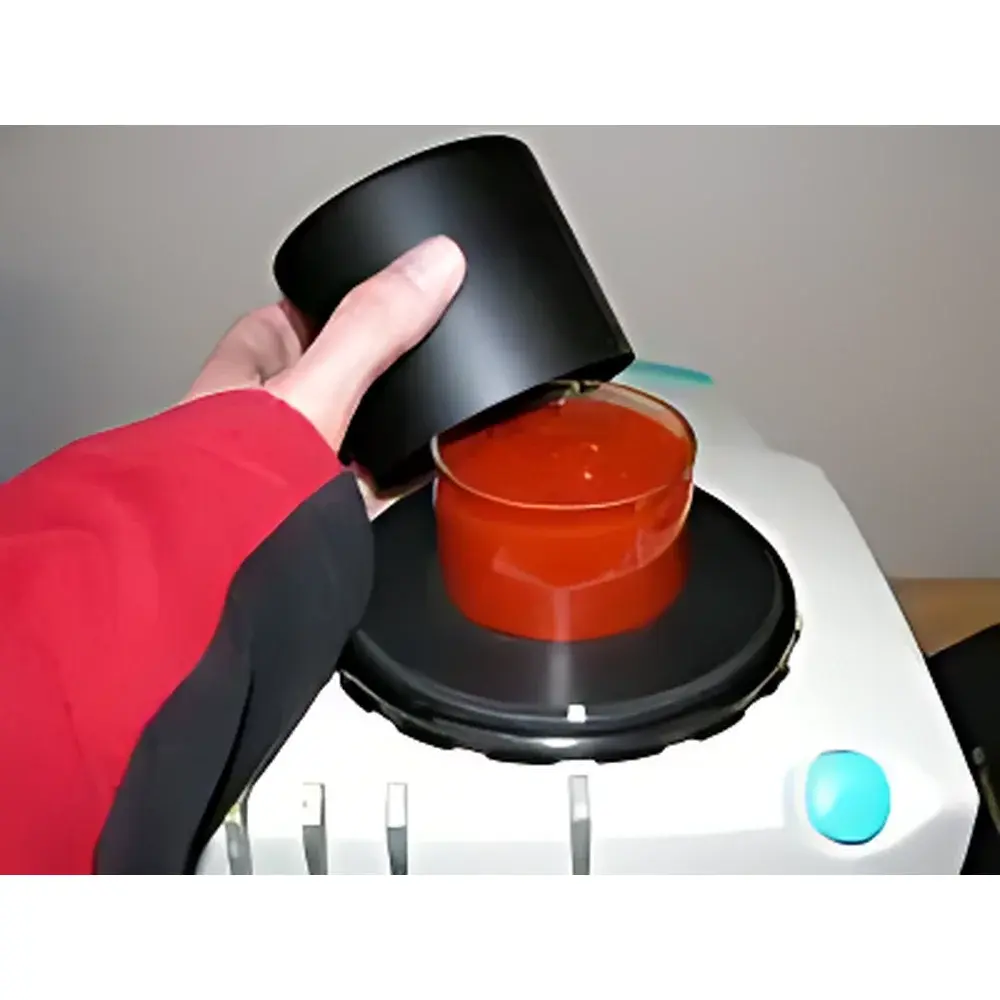
HunterLab LabScan XE Tomato Colorimeter
| Brand | HunterLab |
|---|---|
| Origin | USA |
| Manufacturer Type | Authorized Distributor |
| Origin Category | Imported |
| Model | LabScan XE Tomato |
| Product Type | Spectrophotometric Colorimeter |
| Instrument Type | Benchtop |
| Optical Geometry | 0°/45° Integrating Sphere |
| Light Source | Xenon Flash Lamp |
| Spectral Range | 400–700 nm |
| Repeatability | ΔE*ab ≤ 0.09 (mean, CIE 1976) |
| Aperture Size | 44 mm (LAV) |
| Measurement Time | ≤ 3 s |
| Wavelength Interval | 10 nm |
| Detector | 256-element Silicon Photodiode Array |
| Spectral Separation | Holographic Diffraction Grating |
| Reflectance Range | 0–150% |
| Illuminant Approximation | D65 |
| Lamp Lifetime | > 1 million flashes |
| Compliance | ASTM E308, ISO/CIE 11664-4, USP <1061>, FDA 21 CFR Part 11 (with EasyMatch-QC v4.5+) |
Overview
The HunterLab LabScan XE Tomato is a purpose-engineered benchtop spectrophotometric colorimeter optimized for objective, repeatable, and traceable color measurement in tomato-based food products—including whole tomatoes, tomato paste, ketchup, purée, juice, and seasoned sauces. Built upon a dual-beam 0°/45° optical geometry with an integrating sphere, the instrument eliminates directional bias and minimizes surface texture effects, ensuring high reproducibility across heterogeneous, semi-opaque, or viscous samples. Its xenon flash lamp delivers stable, pulse-synchronized illumination closely approximating the CIE standard illuminant D65—critical for compliance with industry-specific color indices such as the UC Davis Tomato Color Scale (TCS), L*a*b*, a/b ratio, and proprietary tomato pigment metrics (e.g., lycopene-correlated hue angles). The 44 mm large-area viewing port (LAV) enables representative sampling of bulk or particulate matrices without grinding or dilution, while the 400–700 nm spectral range with 10 nm reporting intervals supports full CIE-compliant tristimulus calculation per ASTM E308 and ISO/CIE 11664-4.
Key Features
- Dual-beam 0°/45° optical architecture with integrating sphere for high inter-instrument agreement and minimal sample positioning sensitivity
- Xenon flash lamp with >1 million operational cycles and D65 spectral match certified per CIE Publication 15:2018
- 256-channel silicon photodiode array with holographic diffraction grating for high signal-to-noise spectral acquisition
- 44 mm large-area aperture (LAV) optimized for whole-fruit, paste, and sauce measurements without homogenization
- Onboard color quality control logic enabling real-time pass/fail evaluation against stored product standards and tolerances
- Front-panel measurement trigger and status LEDs for intuitive operator guidance in production environments
- RS232C interface supporting integration into factory SCADA systems and automated data logging protocols
- Compliance-ready firmware architecture compatible with 21 CFR Part 11 audit trails when paired with EasyMatch-QC v4.5 or later
Sample Compatibility & Compliance
The LabScan XE Tomato accommodates diverse physical forms common in tomato processing: intact fruit (via optional cradle fixture), semi-solid pastes, fluid juices, and stabilized sauces. Its reflectance mode operates across 0–150% relative reflectance—accommodating both highly scattering (e.g., raw tomato pulp) and low-reflectance (e.g., dark concentrates) materials. Regulatory alignment includes full support for USDA-FSIS color specification workflows, UC Davis TCS calibration traceability, and GLP/GMP documentation requirements. When deployed with validated SOPs, the system meets analytical rigor thresholds defined in ISO 8587 (sensory analysis — general guidance on instrumental methods) and ASTM D2244 (standard practice for calculation of color tolerances). All spectral data are exportable in .csv and .qtx formats for third-party statistical process control (SPC) platforms.
Software & Data Management
The instrument operates natively with HunterLab EasyMatch-QC software (v4.5+), providing validated color formulation, tolerance mapping, batch trending, and electronic signature functionality compliant with FDA 21 CFR Part 11. Customizable dashboards allow direct visualization of UC Davis Tomato Index, a/b ratio drift, and ΔE*ab deviation from master standards. Data integrity safeguards include user-level access controls, immutable audit logs, and automatic timestamped backups. Optional API integration enables bidirectional communication with MES systems (e.g., Siemens Opcenter, Rockwell FactoryTalk) for closed-loop color correction in blending and thermal processing lines. All spectral scans are stored with metadata including operator ID, environmental conditions (temperature/humidity), and calibration verification timestamps.
Applications
- Quantitative monitoring of lycopene-driven redness development during tomato ripening and post-harvest storage
- Batch-to-batch consistency validation for ketchup and pasta sauce production against brand-specific color gates
- Raw material acceptance testing of tomato concentrate shipments using UC Davis TCS reference tiles
- Process deviation detection in thermal concentration units via real-time a*-value tracking
- QC release testing for retail-ready products under ISO 22000 and BRCGS Food Safety Standard v9
- Development of color-stable formulations resistant to pH- or heat-induced hue shifts
FAQ
Does the LabScan XE Tomato comply with UC Davis Tomato Color Scale protocols?
Yes—the instrument ships pre-configured with UC Davis TCS calibration files and supports direct reporting of TCS units alongside CIE L*a*b* and Hunter L,a,b values.
Can it measure liquid tomato juice without dilution?
Yes—its 44 mm LAV aperture and optimized 0°/45° geometry enable accurate transmission-free reflectance measurement of opaque liquids at native viscosity.
Is spectral data export supported for external SPC analysis?
Yes—all raw spectra (400–700 nm @ 10 nm intervals) and calculated color indices are exportable in ASCII-compliant .csv and HunterLab .qtx formats.
What regulatory documentation is provided for GMP validation?
HunterLab supplies IQ/OQ documentation templates, DQ rationale, and 21 CFR Part 11 configuration guides—validated under ISO/IEC 17025-accredited internal procedures.
How frequently must the instrument be recalibrated?
Annual factory recalibration is recommended; daily verification using supplied white and black tile standards ensures ongoing measurement fidelity per ASTM E1761.




