
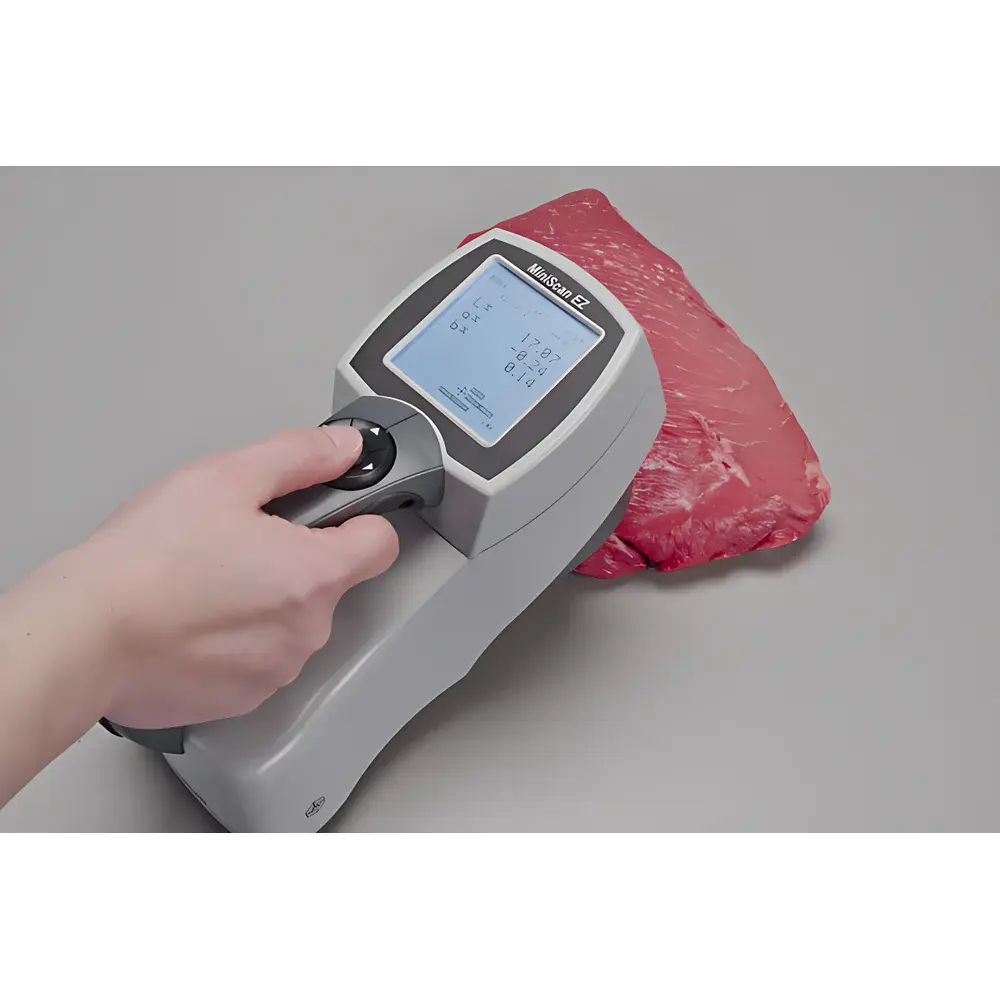
HunterLab MiniScan EZ Fruit Colorimeter
| Brand | HunterLab |
|---|---|
| Origin | USA |
| Model | MiniScan EZ Fruit Colorimeter |
| Type | Portable Color Difference Meter |
| Optical Geometry | 0°/45° Integrating Sphere |
| Light Source | Pulsed Xenon Lamp |
| Spectral Range | 400–700 nm |
| Repeatability | ΔE*ab ≤ 0.05 (mean, BCRA II tiles) |
| Large Area View (LAV) Aperture | 31.8 mm (25.0 mm measurement area) |
| Small Area View (SAV) Aperture | 6.0 mm (5.0 mm measurement area) |
| Compliance | ASTM E308, ISO 11664-4 (CIE Lab), CIE 15:2018, USP <1061>, FDA 21 CFR Part 11 (software-enabled audit trail) |
Overview
The HunterLab MiniScan EZ Fruit Colorimeter is a purpose-engineered portable spectrophotometer designed for rapid, field-deployable color measurement of fresh and processed fruits—optimized for harvest assessment, ripeness grading, post-harvest quality control, and supply chain consistency verification. Operating on the CIE 1931 standard observer model and calibrated to CIELAB (L*a*b*) color space, it employs a pulsed xenon lamp and a precision 0°/45° integrating sphere optical geometry to deliver metrologically traceable reflectance measurements across the visible spectrum (400–700 nm). Unlike diffuse d/8° instruments, the 0°/45° configuration minimizes texture-induced scatter errors—critical for heterogeneous, non-uniform fruit surfaces such as citrus rinds, apple skins, or berry clusters. Its ruggedized industrial housing, IP54-rated enclosure, and battery-powered operation enable reliable use in ambient outdoor conditions, cold storage facilities, packing houses, and dockside inspection zones without dependency on AC power or climate-controlled labs.
Key Features
- Integrated probe-and-processor architecture eliminates cable coupling failure points and ensures signal integrity across temperature gradients typical in agricultural environments.
- Dual-aperture capability: LAV (31.8 mm) for macro-scale surface averaging on whole fruits or large cut sections; SAV (6.0 mm) for targeted spot analysis of blemishes, variegation, or localized color shifts.
- Onboard white and green tile calibration—traceable to NIST-certified standards—maintains long-term photometric stability under repeated thermal cycling and mechanical shock.
- Ergonomic design: <1.5 kg mass, 254 mm length, overmolded rubber grip, and four-directional display orientation (0°/90°/180°/270°) support single-hand operation in constrained or elevated workspaces.
- Fluorescence compensation algorithm corrects for natural chlorophyll fluorescence interference common in green-skinned fruits (e.g., kiwifruit, unripe bananas) and anthocyanin-rich tissues (e.g., red grapes, plums).
- Real-time pass/fail evaluation against user-defined color tolerances (ΔE*ab, ΔL*, Δa*, Δb*) with audible and visual alerts—enabling immediate sorting decisions at line speed.
Sample Compatibility & Compliance
The MiniScan EZ is validated for non-destructive reflectance measurement of opaque solid fruits (whole or halved), fruit pulp, purees, jams, and dried fruit slices. It accommodates curved, textured, and moderately glossy surfaces—including waxed apples, fuzzy peaches, and dimpled citrus—without requiring contact pressure or vacuum fixation. Instrument performance conforms to ASTM E308 (computing tristimulus values from spectral data), ISO 11664-4 (CIE Lab color space definition), and CIE 15:2018 (requirements for colorimetric instruments). When paired with HunterLab’s EasyMatch QC software, it supports GLP/GMP-compliant workflows, including electronic signatures, audit trails, and 21 CFR Part 11–enabled data integrity controls for regulated food manufacturing and research applications.
Software & Data Management
The MiniScan EZ interfaces seamlessly with HunterLab’s EasyMatch QC v5.x platform via USB or Bluetooth. This validated software enables method-driven measurement protocols, statistical process control (SPC) charting (X-bar/R, Cp/Cpk), batch reporting, and export to CSV, PDF, or LIMS-compatible XML formats. All measurement metadata—including instrument ID, operator ID, timestamp, aperture selection, calibration history, and environmental temperature—is embedded in each data record. Secure user-role management (admin/operator/auditor) and encrypted database storage ensure compliance with internal quality systems and external regulatory audits.
Applications
- Ripeness monitoring: Quantifying chromatic shift from green (high a* negative) to yellow/red (positive a*, b*) during banana, mango, or tomato maturation.
- Harvest timing optimization: Correlating L* (lightness) and hue angle (h°) with sugar content (Brix) or firmness in stone fruits and pome fruits.
- Post-harvest quality assurance: Detecting chilling injury in avocados (surface browning) or enzymatic browning in sliced apples and pears.
- Grading & sorting: Enforcing USDA, UNECE, or private label color specifications for export-grade citrus, berries, and tropical fruits.
- Process validation: Verifying color consistency across drying, blanching, or pasteurization steps in fruit-based ingredient production.
- Research & breeding programs: High-throughput phenotyping of color traits in horticultural cultivars under controlled or field trials.
FAQ
Does the MiniScan EZ require annual recalibration by an accredited lab?
No—its xenon lamp stability and dual-tile (white + green) self-validation protocol enable in-house calibration verification per ASTM D2244. Full recalibration is recommended only after physical impact or exposure to >85% RH for >72 hours.
Can it measure through transparent packaging films?
No—it is optimized for direct surface reflectance. Polyethylene or PET overwrap introduces specular reflection artifacts and must be removed prior to measurement.
Is firmware upgradable in the field?
Yes—via USB-connected EasyMatch QC software. Updates include spectral correction patches, new tolerance algorithms, and regulatory compliance enhancements.
What sample preparation is required for whole fruits?
None beyond cleaning surface debris. Position the aperture perpendicular to the measurement site; avoid stems, calyxes, or bruised areas unless specifically targeted.
How does it handle high-moisture or sticky samples like mango pulp?
Use the optional silicone gasket accessory to maintain consistent aperture contact distance and prevent residue buildup on the lens.




