
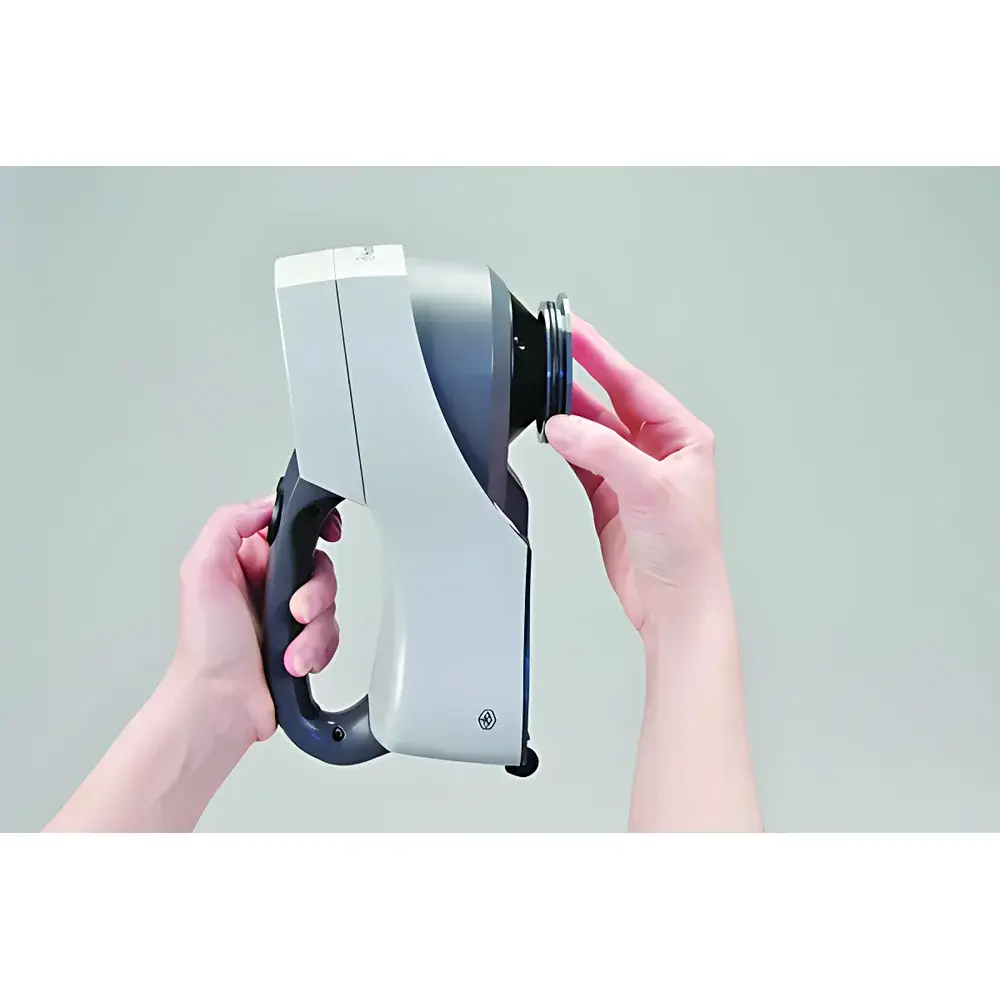
HunterLab MiniScan EZ Meat Colorimeter
| Brand | HunterLab |
|---|---|
| Origin | USA |
| Model | MiniScan EZ Meat Colorimeter |
| Instrument Type | Portable |
| Optical Geometry | 45°/0° Integrating Sphere |
| Light Source | Pulsed Xenon Lamp |
| Spectral Range | 400–700 nm |
| Spectral Resolution | 10 nm |
| Bandwidth | <12 nm |
| Wavelength Accuracy | ±1 nm |
| Repeatability (ΔE* in CIE L*a*b*, BCRA II Tile Set) | 0.05 (LAV), 0.25 (SAV) |
| Aperture Options | LAV 31.8 mm (25.0 mm measurement area), SAV 6.0 mm (5.0 mm area), Integral Sphere LAV 25.0 mm (20.0 mm area), Integral Sphere SAV 14.3 mm (8.0 mm area) |
| Sample Types | Opaque solids, powders, pastes, fluorescent materials, metals, transparent & translucent solids |
| Power Supply | Rechargeable NiCd battery pack or 120/220 V AC adapter |
| Dimensions (W×H×L) | 10.2 × 12.7 × 25.4 cm |
| Weight | 1.3 kg (3 lbs) |
| Color Spaces | CIE L*a*b*, L*C*h°, XYZ, Yxy, Hunter L, a, b |
| Color Difference Metrics | ΔE*, ΔE(CMC), ΔE(ISO 11664-4), ΔL*, Δa*, Δb*, ΔC*, ΔH*, FMC-II, MI (Metamerism Index), ISO Gray Scale (5–5–5), Shade Classification Code |
| Illuminants | A, C, D65, F2, F7, F11 (TL84), F12 |
| Observer Angles | 2°, 10° |
Overview
The HunterLab MiniScan EZ Meat Colorimeter is a portable, high-precision color measurement instrument engineered for rigorous industrial color quality control—specifically optimized for meat and food product evaluation. It operates on the 45°/0° optical geometry principle, where illumination is delivered at 45° to the sample surface and reflected light is collected perpendicularly (0°) via an integrating sphere. This geometry minimizes directional bias and ensures consistent, geometry-independent color data—critical for evaluating heterogeneous, textured, or semi-opaque surfaces such as fresh or processed meat cuts, ground patties, cured sausages, and marinated proteins. Unlike diffuse d/8° instruments, the 45°/0° configuration closely mimics human visual assessment under controlled lighting, making it the preferred method for meat color grading per USDA, ASTM D2244, and ISO 11664-4 compliance frameworks. The pulsed xenon lamp delivers full-spectrum illumination (400–700 nm) with exceptional stability over >500,000 flashes, eliminating thermal drift and enabling reliable measurements across ambient temperature fluctuations common in slaughterhouses, processing lines, cold storage, and loading docks.
Key Features
- Integrated probe-and-processor architecture eliminates cable dependency and signal loss—ensuring metrological integrity in field conditions.
- Dual-aperture capability: Selectable Large Area View (LAV, 31.8 mm) for bulk meat surface averaging or Small Area View (SAV, 6.0 mm) for localized fat streaking, discoloration, or bruise assessment.
- Four display orientation modes (0°, 90°, 180°, 270°) accommodate ergonomic use on vertical carcass sides, horizontal conveyor belts, or overhead inspection stations.
- Onboard white and green tile calibration routines maintain long-term photometric stability—essential for multi-shift operations and inter-instrument correlation.
- Rubberized ergonomic grip and sub-1.3 kg mass enable single-hand operation during extended production line audits or warehouse sampling.
- Rechargeable NiCd battery supports >8 hours of continuous measurement without AC power—validated for USDA-inspected facilities with limited outlet access.
Sample Compatibility & Compliance
The MiniScan EZ meets critical regulatory and industry-specific requirements for food color assessment. It accommodates raw, cooked, cured, and frozen meat specimens—including whole cuts, ground formulations, emulsified sausages, and vacuum-packaged products—without requiring sample preparation beyond standard surface conditioning (e.g., bloom time for beef). Its ability to measure fluorescent-enhanced samples enables accurate evaluation of phosphates or nitrite-treated products. The instrument complies with ASTM E308 (standard practice for computing color tolerances), ISO 11664-4 (CIE colorimetric observers), and supports GLP-compliant audit trails when paired with optional HunterLab EasyMatch QC software. Data output conforms to FDA 21 CFR Part 11 requirements for electronic records and signatures when configured with user authentication and instrument calibration logging.
Software & Data Management
While fully functional as a standalone device, the MiniScan EZ integrates seamlessly with HunterLab’s EasyMatch QC software suite. This platform enables centralized method management, statistical process control (SPC) charting (X-bar/R, Cp/Cpk), tolerance zone definition per USDA color standards (e.g., USDA Beef Color Scale 1–7), and automated report generation compliant with internal QA protocols. All measurements include embedded metadata: timestamp, operator ID, illuminant/observer selection, aperture mode, and calibration verification status. Raw spectral data (10 nm intervals) is exportable in CSV or XML format for third-party analysis or integration into enterprise MES/QMS systems (e.g., SAP QM, Siemens Opcenter).
Applications
- Real-time color grading of beef, pork, lamb, and poultry at slaughter, fabrication, and packaging stages.
- Monitoring myoglobin oxidation kinetics during refrigerated storage to predict shelf life and detect premature browning.
- Validating color consistency of marinades, seasonings, and curing agents across batch production.
- Quantifying pigment migration in layered products (e.g., smoked sausages, restructured meats).
- Supporting HACCP Critical Control Point documentation for visual quality attributes.
- Enabling supplier qualification through objective, instrument-based color specifications instead of subjective pass/fail visual checks.
FAQ
Is the MiniScan EZ validated for USDA meat color grading?
Yes—the 45°/0° geometry and CIE L*a*b* output align with USDA Agricultural Marketing Service (AMS) guidelines for instrumental meat color assessment, particularly for lean color scoring and marbling estimation.
Can it measure wet or chilled meat surfaces?
Yes—its sealed optical path and xenon flash design prevent condensation interference; however, surface moisture should be gently blotted to avoid specular reflection artifacts.
Does it support traceable calibration to NIST standards?
All factory calibrations are traceable to NIST SRM 2001 series ceramic tiles; users may perform on-site verification using certified BCRA II reference tiles.
How is measurement repeatability maintained across multiple operators?
Standardized aperture placement guides, tactile feedback on trigger actuation, and built-in pass/fail tone alerts ensure procedural consistency independent of operator experience level.
Is firmware upgradable in the field?
Yes—firmware updates are delivered via USB and preserve all user-defined methods, tolerances, and historical calibration records.




