
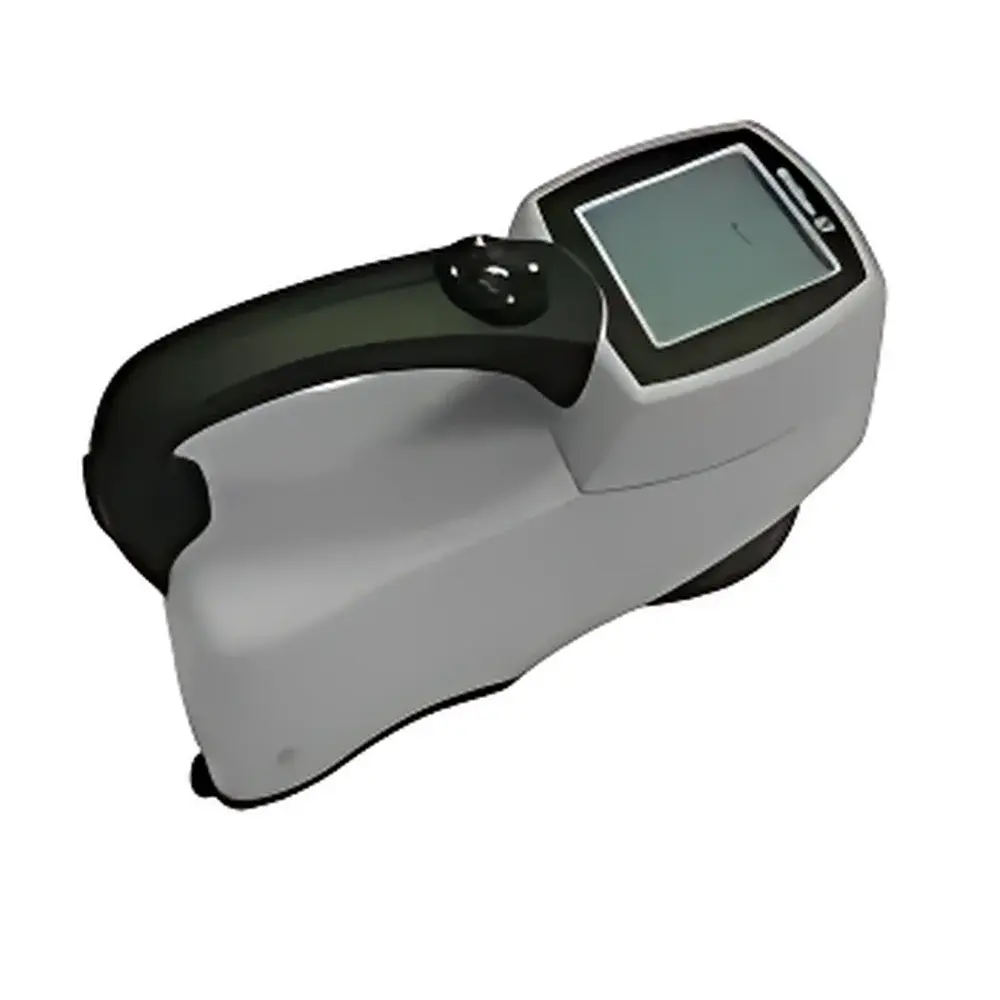
HunterLab MiniScan EZ Portable Colorimeter with Green Tile Calibration
| Brand | HunterLab |
|---|---|
| Origin | USA |
| Model | MiniScan EZ |
| Product Type | Spectrophotometric Colorimeter |
| Instrument Type | Portable |
| Optical Geometry | d/8° Integrating Sphere |
| Light Source | Pulsed Xenon Lamp |
| Spectral Range | 400–700 nm |
| Repeatability | ΔE* ≤ 0.05 (CIE Lab, 20 measurements on standard white tile) |
| Aperture Options | LAV 31.8 mm (25.0 mm measurement area), SAV 6.0 mm (5.0 mm), Integral Sphere LAV 25.0 mm (20.0 mm), SAV 14.3 mm (8.0 mm), VSAV 6.0 mm (4.0 mm) |
| Display | 6.4 cm × 6.4 cm LCD, 4-orientation (0°/90°/180°/270°) |
| Power | Rechargeable battery pack or 120/220 VAC adapter |
| Lamp Lifetime | > 500,000 flashes |
| Compliance | ASTM E308, ISO 7724, CIE No. 15, USP <1061>, FDA 21 CFR Part 11 (via optional software module) |
Overview
The HunterLab MiniScan EZ Portable Colorimeter is a spectrophotometric color measurement instrument engineered for precision, portability, and field-deployable reliability in industrial quality control environments. Based on the d/8° integrating sphere optical geometry with pulsed xenon illumination, it delivers true spectral reflectance data across the visible spectrum (400–700 nm), enabling accurate calculation of CIE L*a*b*, L*C*h°, XYZ, Yxy, and other standardized color spaces under multiple illuminants (A, C, D65, F2, TL84) and observer angles (2° and 10°). Unlike filter-based tristimulus meters, its full-spectrum acquisition ensures high fidelity in measuring metamerism-sensitive materials—including fluorescent, metallic, translucent, and textured surfaces—while maintaining traceable calibration integrity through built-in reference standards. The inclusion of a proprietary green ceramic calibration tile enables real-time monitoring of wavelength drift—a critical diagnostic function unique to the MiniScan EZ platform—ensuring long-term photometric stability without requiring recalibration at a service center.
Key Features
- Integrated probe-and-processor architecture eliminates cable dependency and reduces mechanical failure points common in modular handheld systems.
- Ergonomic rubberized handle and sub-1.5 kg mass enable single-hand operation—even during extended shifts on production lines or warehouse floors.
- Four-display orientation modes (0°, 90°, 180°, 270°) accommodate diverse measurement positions, including overhead, inverted, or confined-space applications.
- Multiple interchangeable apertures (LAV, SAV, VSAV) support flexible sampling strategies—from large-area batch verification to small-feature spot analysis—without sacrificing repeatability.
- Pulsed xenon lamp provides flash-to-flash spectral consistency and >500,000 operational cycles, eliminating warm-up drift and thermal aging effects typical of tungsten-halogen sources.
- Onboard calculation of advanced metrics including CMC (l:c) ΔE, FMC-II, MI (metamerism index), and Z% gloss correction—enabling compliance with ASTM D2244, ISO 11664-4, and textile-specific color tolerance specifications.
Sample Compatibility & Compliance
The MiniScan EZ accommodates opaque solids, transparent films, powders, pastes, metallic finishes, and optically brightened materials—including those exhibiting fluorescence under UV-augmented illuminants. Its robust optical design meets ASTM E308-23 for spectral data interpolation, ISO 7724-1:2017 for colorimetric performance validation, and CIE Publication 15:2018 for spectral irradiance characterization. When used with HunterLab’s EasyMatch QC software (v5.0+), the system supports audit-trail logging, electronic signatures, and user-access controls compliant with FDA 21 CFR Part 11 and EU Annex 11 requirements. Routine calibration verification using the integrated green tile satisfies internal GLP/GMP instrument qualification protocols per USP and ICH Q2(R2) guidelines.
Software & Data Management
Data acquisition, analysis, and reporting are managed via HunterLab’s EasyMatch QC software suite, which supports seamless synchronization with the MiniScan EZ over Bluetooth or USB. The software provides customizable pass/fail tolerancing per product line, statistical process control (SPC) charting, batch trend analysis, and export to CSV, PDF, or XML formats for ERP/LIMS integration. All measurement sessions include timestamped metadata (operator ID, location tag, aperture selection, illuminant/observer, calibration status), and optional 21 CFR Part 11 modules enforce role-based permissions, electronic signature capture, and immutable audit logs. Firmware updates are delivered via secure HTTPS channels and validated through cryptographic checksums prior to installation.
Applications
The MiniScan EZ serves as a primary color verification tool across regulated and high-volume manufacturing sectors. In plastics compounding, it validates masterbatch dispersion uniformity and detects pigment migration during extrusion trials. Within food processing, it quantifies surface browning (e.g., Maillard reaction in baked goods) and monitors freshness indicators in meat and produce. Textile mills rely on its SAV/VSAV apertures to assess dye lot consistency across woven, knitted, and nonwoven substrates—even under variable ambient lighting. Coatings manufacturers use its LAV mode for spray-applied finish evaluation on automotive panels and architectural cladding, while packaging converters leverage its translucency mode to verify ink opacity and substrate whiteness in flexible film lamination. Its portability makes it indispensable for supplier audits, incoming inspection at receiving docks, and real-time line clearance verification.
FAQ
What is the purpose of the green calibration tile?
The green ceramic tile serves as an in-situ wavelength stability monitor. By periodically measuring its spectral reflectance profile, the instrument detects subtle shifts in grating alignment or detector response—triggering alerts before drift exceeds ±0.2 nm, ensuring metrological continuity between lab and field calibrations.
Does the MiniScan EZ support measurement of fluorescent materials?
Yes. Its pulsed xenon source emits broad-spectrum output including near-UV components (down to 400 nm), enabling excitation of optical brighteners. Fluorescent compensation algorithms are applied automatically when F2 or D65 illuminants are selected, aligning with ISO 11664-7:2022 requirements for fluorescent sample assessment.
How is traceability maintained across global facilities?
Each unit ships with NIST-traceable calibration certificates for reflectance and wavelength. Cross-site correlation studies can be conducted using BCRA Series II tiles, and inter-instrument agreement is typically ΔE* < 0.15 when operated under identical settings and environmental conditions (23 ± 2°C, 50 ± 5% RH).
Can the MiniScan EZ connect to enterprise quality management systems?
Yes. Through EasyMatch QC’s ODBC-compliant database interface and RESTful API endpoints, raw spectral data, color coordinates, and pass/fail outcomes integrate directly with SAP QM, Oracle Quality, or custom MES platforms—supporting automated nonconformance workflows and CAPA initiation.
Is battery life sufficient for full-shift operation?
A fully charged lithium-ion battery supports ≥8 hours of continuous measurement (approx. 1,200 readings), with low-power sleep mode extending standby time to 72 hours. Battery health diagnostics and remaining capacity indicators are displayed in real time on the LCD interface.






