
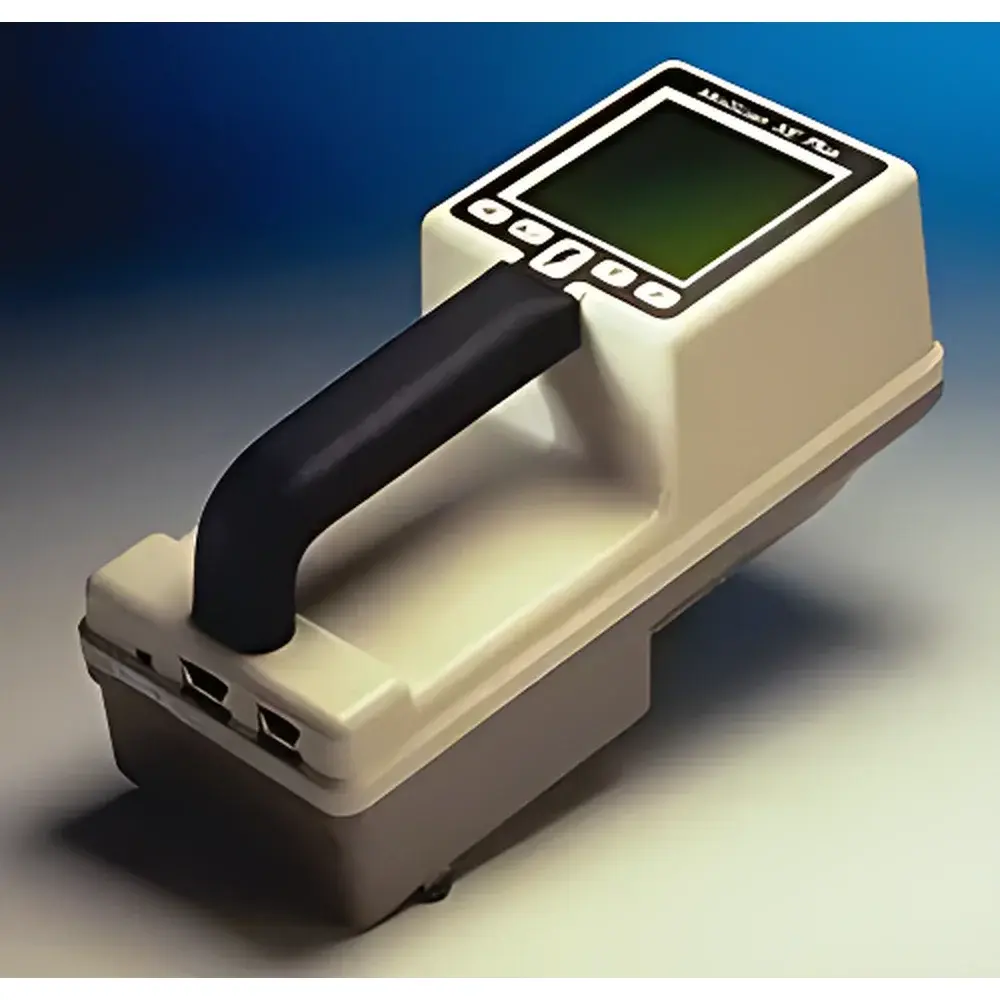
HunterLab MiniScan XE Plus Portable Colorimeter
| Origin | USA |
|---|---|
| Manufacturer Type | Authorized Distributor |
| Origin Category | Imported |
| Model | MiniScan XE Plus |
| Pricing | Upon Request |
| Geometry | 45°/0° and Integrating Sphere |
| LAV Aperture (mm) | 31.8 / 25.0 |
| SAV Aperture (mm) | 6.0 / 14.3 / 6.0 (VSAV) |
| Observation Area (mm) | 25.0 / 5.0 / 20.0 / 8.0 / 4.0 |
| Repeatability (ΔE* on BCRA II) | 0.05 / 0.25 / 0.15 / 0.15 / 0.15 |
| Spectral Range | 400–700 nm |
| Wavelength Resolution | <3 nm |
| Effective Bandpass | <12 nm (Triangular) |
| Reporting Interval | 10 nm |
| Photometric Range | 0–150% |
| Light Source | Pulsed Xenon Lamp |
| Lamp Lifetime | >500,000 flashes |
| Display | 6.4 cm × 6.4 cm LCD |
| Display Orientation | 0°, 90°, 180°, 270° |
| Power | Rechargeable NiCd Battery or 120/220 VAC Adapter |
| Dimensions (W×H×L) | 10.2 cm × 12.7 cm × 25.4 cm |
| Weight | 1.3 kg (3.0 lb) |
| Color Spaces | CIE L*a*b*, L*C*h°, XYZ, Yxy, Hunter Lab, FMC II |
| Color Difference Metrics | ΔE*, ΔE(CMC), ΔE(ISO 11664-4), ΔL*, ΔC*, ΔH*, ΔZ%, Lightness, Metamerism Index (MI), ISO Gray Scale (Method 5-5-5), Hue Classification Code |
| Illuminants | A, C, D65, F2, F7, F11 (TL84), F12 |
| Observers | 2° and 10° Standard Observer |
Overview
The HunterLab MiniScan XE Plus is a high-precision portable colorimeter engineered for rapid, repeatable color measurement in production environments, quality control laboratories, and field applications. Utilizing dual optical geometries—45°/0° reflectance and integrating sphere configurations—the instrument delivers metrologically traceable color data across diverse sample types, including opaque solids, powders, pastes, translucent films, metallic finishes, and fluorescent materials. Its design adheres to CIE 15:2018 and ISO 7724-1 standards for colorimetric measurement geometry, spectral bandwidth, and illuminant/observer definitions. The pulsed xenon light source ensures stable, flash-to-flash spectral output without thermal drift, eliminating the need for warm-up time and supporting consistent inter-instrument agreement per ASTM E308 and ISO 13655. With a compact footprint and ergonomic rubberized grip, the MiniScan XE Plus enables one-handed operation while maintaining laboratory-grade repeatability (ΔE* ≤ 0.05 for LAV mode on BCRA II tiles), making it suitable for both routine pass/fail verification and advanced color formulation workflows.
Key Features
- Integrated probe-and-processor architecture eliminates cable dependency and signal degradation common in modular handheld systems
- Five interchangeable aperture configurations: LAV (31.8 mm), SAV (6.0 mm and 14.3 mm), integrating sphere LAV (25.0 mm), and VSAV (6.0 mm) — each calibrated to NIST-traceable standards
- High-resolution spectral engine with <3 nm wavelength resolution and <12 nm effective bandpass (triangular), compliant with CIE 13.3 and ISO/DIS 13655 for spectral accuracy
- Four-display orientation modes (0°, 90°, 180°, 270°) accommodate varied operator positioning and fixture integration in constrained workspaces
- Rechargeable NiCd battery system supports >8 hours of continuous operation; optional AC adapter enables benchtop use without battery cycling
- Robust industrial housing rated IP54 for dust and splash resistance, validated per IEC 60529 for durability in manufacturing floor conditions
- Real-time pass/fail evaluation against user-defined tolerances using multiple difference metrics (ΔE*, ΔE(CMC), ΔE(ISO), ΔL*C*H*)
Sample Compatibility & Compliance
The MiniScan XE Plus accommodates heterogeneous material classes without mechanical modification: non-fluorescent and fluorescent solids (plastics, textiles, painted panels), granular media (food powders, pigments), viscous dispersions (coatings, inks), and semi-transparent substrates (films, glass). Its integrating sphere geometry supports transmission measurements on clear and hazy samples, while the 45°/0° configuration minimizes texture-induced variability in structured surfaces. All measurement modes comply with ISO 11664-4 (color difference evaluation), ISO 11664-6 (fluorescent material handling), and ASTM D2244 (instrumental color difference calculation). For regulated industries, the device supports audit-ready data logging—including timestamped spectra, operator ID, and calibration history—aligned with FDA 21 CFR Part 11 requirements when paired with HunterLab’s QualiCheck software suite.
Software & Data Management
HunterLab’s EasyMatch QC software provides full instrument control, spectral visualization, statistical process monitoring (SPC), and report generation (PDF, CSV, XML). Raw spectral data (10 nm intervals from 400–700 nm) is exportable for third-party analysis or integration into LIMS and MES platforms via ODBC or REST API. Firmware updates preserve backward compatibility with legacy calibration files and ensure alignment with evolving CIE technical reports. The system maintains full GLP/GMP traceability: all measurements record instrument serial number, calibration date, illuminant/observer selection, aperture used, and environmental metadata (if connected to optional ambient sensor). Audit trails are immutable and timestamped to UTC, satisfying ISO/IEC 17025 clause 7.7 and EU Annex 11 requirements for analytical instrumentation.
Applications
- Plastics: Batch-to-batch color consistency verification for injection-molded parts and extruded profiles
- Textiles: Shade matching across dye lots and fiber blends under multiple illuminants (D65, TL84, A)
- Coatings & Inks: Quantitative assessment of metamerism index (MI) and hue classification for automotive OEM specifications
- Food & Beverage: Objective evaluation of natural pigment variation in powders, sauces, and baked goods
- Building Materials: Color stability testing of ceramic tiles, laminates, and architectural coatings under accelerated aging protocols
- Pharmaceuticals: Excipient color uniformity per USP and EP 2.2.57 for solid dosage forms
FAQ
What calibration standards are supported?
The MiniScan XE Plus ships with NIST-traceable white and black tile calibrations; optional BCRA II ceramic tiles and fluorescence calibration standards are available for enhanced validation.
Can the instrument measure transparent or translucent samples?
Yes—integrating sphere geometry enables transmission measurements on clear liquids, films, and glass; optional transmission cell accessories support standardized pathlength control.
Is remote firmware update capability available?
Firmware updates are performed locally via USB or SD card; no cloud connectivity is required, ensuring compliance with air-gapped network policies in regulated facilities.
How is inter-instrument agreement maintained across a fleet?
HunterLab’s Inter-Instrument Agreement (IIA) protocol uses proprietary spectral correction algorithms and shared reference tiles to achieve ΔE* < 0.15 between units, documented per ASTM E2539.
Does the device support Good Manufacturing Practice (GMP) documentation requirements?
When used with EasyMatch QC and QualiCheck, the system generates 21 CFR Part 11–compliant electronic records, including full audit trails, electronic signatures, and calibration certificate archives.




