
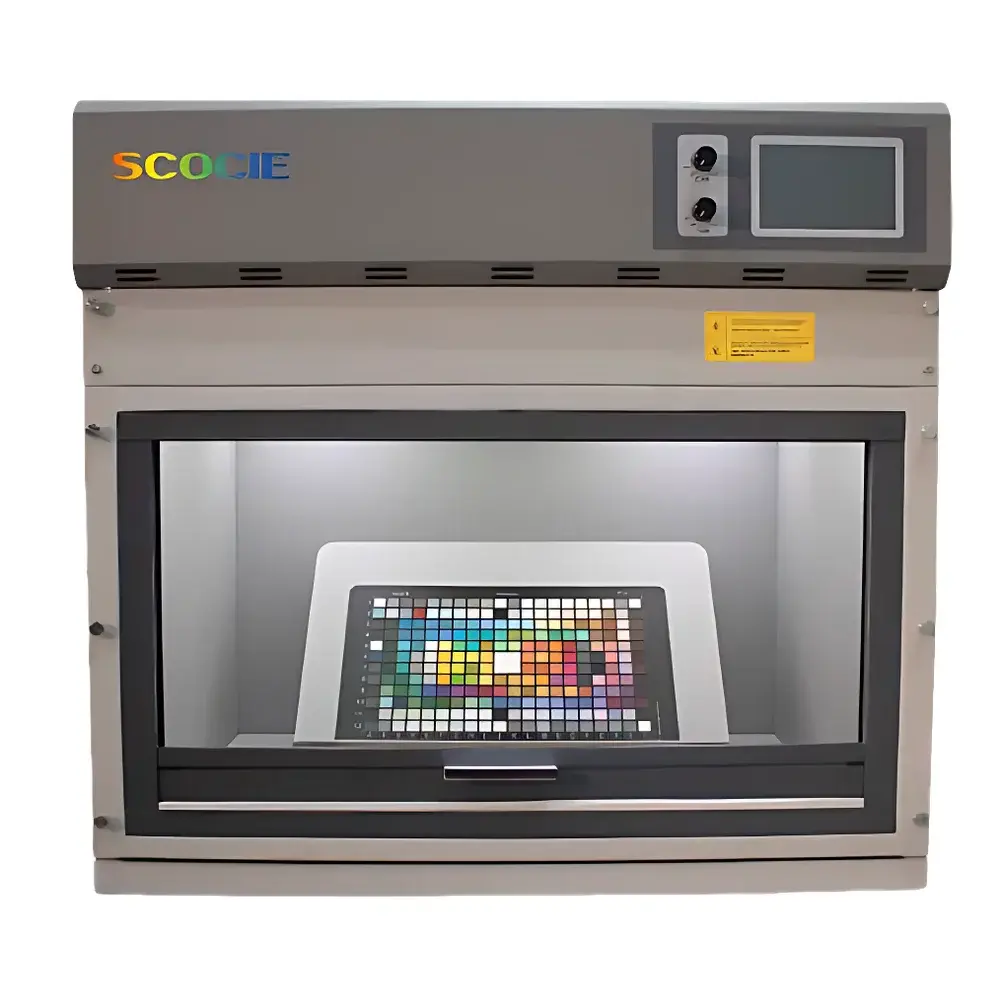
HunterLab SCOCIE FastnessGrade Color Fastness Analyzer
| Brand | HunterLab |
|---|---|
| Origin | Shanghai, China |
| Model | SCOCIE FastnessGrade |
| Product Type | Spectrophotometric Color Difference Meter |
| Instrument Type | Benchtop |
| Optical Geometry | 0/45° Integrating Sphere |
| Light Source | LED Array |
| Spectral Range | 350–700 nm |
| Repeatability | ΔE*ab ≤ 0.03 |
Overview
The HunterLab SCOCIE FastnessGrade Color Fastness Analyzer is a benchtop spectrophotometric imaging system engineered for objective, quantitative assessment of textile and material color fastness properties. Unlike conventional visual evaluation methods relying on human observers under standard illuminants, the FastnessGrade integrates high-fidelity RGB imaging with calibrated spectral measurement (350–700 nm) and advanced image-based algorithmic analysis to deliver ISO-compliant digital grading across multiple fastness categories—including color change (ΔE*ab), staining, lightfastness, crocking (dry/wet rubbing), and pilling resistance. Its 0/45° integrating sphere optical architecture ensures consistent illumination and diffuse reflectance capture, minimizing directional bias and enabling robust inter-laboratory reproducibility. Designed for integration into quality control workflows in regulated environments, the system supports traceable calibration, audit-ready data logging, and compliance with ASTM D2244, ISO 105-A02, ISO 105-B02, ISO 105-X12, and AATCC Test Methods 8, 16, 20, and 165.
Key Features
- Multi-modal fastness evaluation: Simultaneous digital grading of color change, staining, lightfastness (via blue wool scale correlation), dry/wet crocking, and pilling—eliminating reliance on subjective visual comparison.
- Integrated spectral + spatial analysis: Combines CIE-compliant spectral reflectance measurement (LED-based, 350–700 nm) with high-resolution RGB imaging to quantify both global color shift and localized surface defects (e.g., uneven staining, pilling distribution).
- Benchtop 0/45° geometry: Ensures uniform sample illumination and eliminates gloss-related artifacts; optimized for flat, textured, and multi-fiber test fabrics per ISO 105-A04 and ASTM D1729.
- Standard illuminant simulation: Built-in LED array replicates D65, A, F2, F7, and U30 spectra with CCT stability ±100 K and Ra ≥ 95—meeting ISO/CIE requirements for visual color assessment.
- Automated multi-sample imaging: Captures up to six standardized specimens in a single frame, enabling batch processing and reducing throughput time by >60% versus sequential manual evaluation.
- GLP/GMP-ready software architecture: Supports user access levels, electronic signatures, audit trails, and 21 CFR Part 11–compliant data integrity controls.
Sample Compatibility & Compliance
The FastnessGrade accommodates standard textile test specimens per ISO 105-A01 (100 × 40 mm), AATCC TM16 (150 × 75 mm), and ISO 105-X12 (pilling specimens). It accepts woven, knitted, nonwoven, and coated substrates—including denim, technical textiles, and leather alternatives—without requiring sample flattening or masking. The instrument’s spectral response is validated against NIST-traceable ceramic standards and certified per ISO/IEC 17025-accredited calibration protocols. All fastness grading algorithms are aligned with ISO 105-A02 (gray scale for staining), ISO 105-B02 (blue wool scale for lightfastness), and ISO 105-X12 (pilling rating scale), ensuring direct comparability with reference laboratories and third-party certification bodies.
Software & Data Management
The FastnessGrade operates via FastnessSuite™ v3.2—a Windows-based application supporting real-time image acquisition, spectral analysis, and automated pass/fail reporting. Raw spectral data (10 nm intervals), CIE XYZ/L*a*b*, ΔE*ab/ΔE00, and annotated grading images are stored in vendor-neutral .csv and .tiff formats. Software modules include: (1) Fastness Grading Engine (with configurable thresholds per ISO/AATCC grade bands); (2) Multi-Site Synchronization (enabling distributed labs to share reference libraries and grading templates); (3) Audit Trail Manager (logging all user actions, parameter changes, and report exports with timestamps and digital signatures); and (4) Export Module compliant with LIMS/ERP systems via HL7 and ASTM E1384 interfaces. Data encryption at rest and in transit meets ISO 27001 requirements.
Applications
The FastnessGrade serves as a primary color fastness verification tool across vertically integrated supply chains—from fiber producers and dye houses to brand QA labs and contract testing facilities. In textile manufacturing, it validates wash-fastness before bulk production and monitors batch-to-batch consistency of reactive dyes on cotton. In automotive interiors, it assesses lightfastness of upholstery fabrics under ISO 105-B02 accelerated exposure. In food packaging R&D, it quantifies color migration from printed films onto simulated food simulants. In pharmaceutical packaging, it verifies label print durability under ISO 11664-4–based UV exposure protocols. Its ability to generate machine-readable fastness reports enables automated quality gate decisions in Industry 4.0 production lines.
FAQ
Does the FastnessGrade require annual recalibration?
Yes—HunterLab recommends annual factory recalibration using NIST-traceable standards, supplemented by daily user verification with supplied white and black tiles per ISO 13655.
Can it replace traditional gray scale and blue wool references?
It does not eliminate physical standards but provides digital equivalents traceable to them; final certification-grade reports still require correlation to ISO 105-A02 and ISO 105-B02 reference materials.
Is remote operation supported for multi-site deployments?
Yes—FastnessSuite™ supports secure remote desktop access and cloud-synced reference libraries via TLS 1.2–encrypted connections.
What sample preparation is required?
Minimal: Specimens must be mounted flat on the stage without wrinkles or folds; no chemical treatment or mounting media is needed.
How is pilling grade determined algorithmically?
By comparing texture variance, surface roughness metrics, and cluster density in the captured image against a calibrated set of ISO 105-X12 reference pilling standards, using convolutional neural network–enhanced segmentation.




