
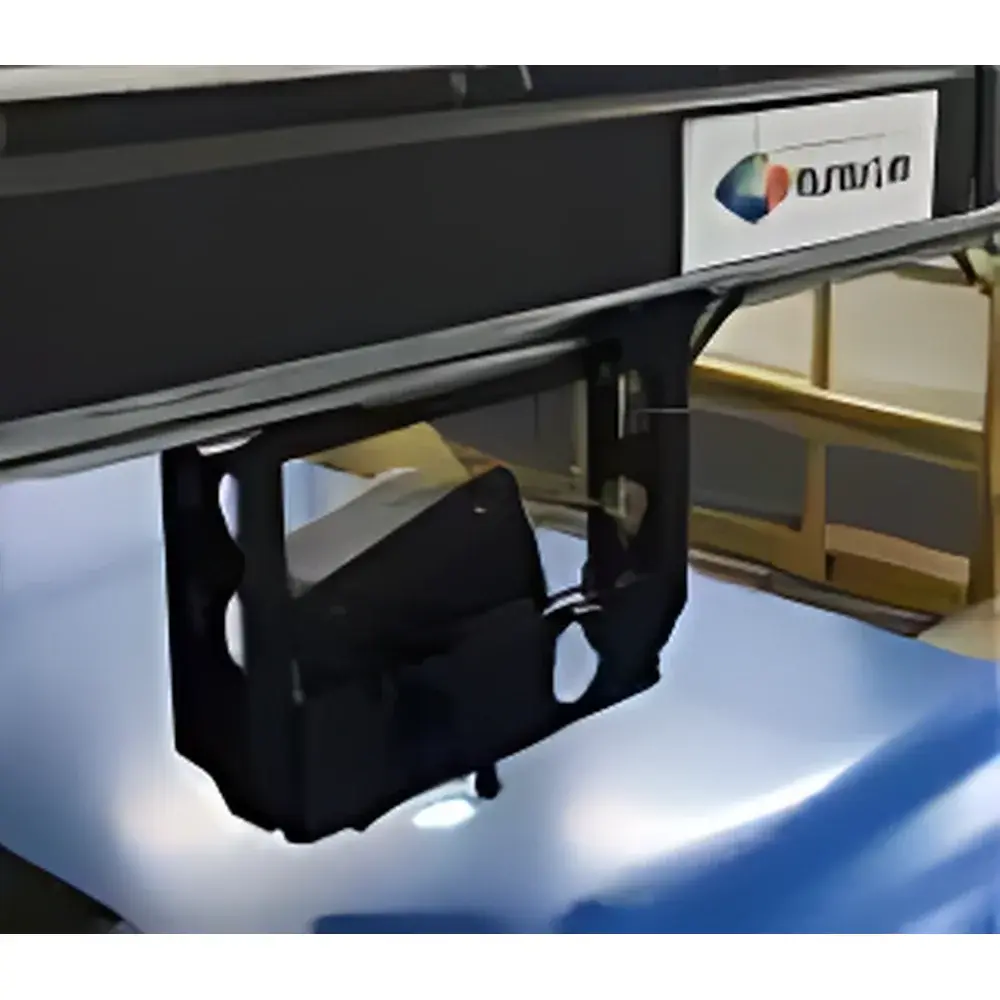
HunterLab STOL-S1 Online Leather Color Measurement System
| Brand | HunterLab |
|---|---|
| Origin | USA |
| Manufacturer Type | Authorized Distributor |
| Import Status | Imported |
| Model | STOL-S1 |
| Product Category | Spectrophotometric Colorimeter |
| Instrument Type | In-line |
| Optical Geometry | 0°/45° Integrating Sphere |
| Light Source | Full-spectrum LED |
| Spectral Range | 400–700 nm |
| Repeatability | ΔE*ab ≤ 0.03 |
Overview
The HunterLab STOL-S1 Online Leather Color Measurement System is an industrial-grade, in-line spectrophotometer engineered for continuous, non-contact color monitoring of leather substrates during wet-blue, crust, and finished tanning stages. Based on the CIE 0°/45° optical geometry with an integrating sphere detector, it employs full-spectrum LED illumination (400–700 nm) to capture reflectance data across the visible spectrum at high photometric stability. Unlike benchtop or handheld instruments, the STOL-S1 integrates directly into conveyor-based production lines—enabling real-time spectral acquisition, ΔE*ab computation, and deviation flagging without interrupting throughput. Its measurement principle conforms to CIE Publication No. 15:2018 and ASTM D2244–22 for color difference evaluation, ensuring metrological traceability to NIST-traceable standards. Designed specifically for the mechanical, chemical, and thermal variability inherent in leather manufacturing, the system delivers consistent performance under ambient temperature fluctuations (15–40 °C), humidity up to 85% RH (non-condensing), and typical factory particulate exposure.
Key Features
- In-line scanning architecture with fully automated transverse probe movement across full belt width (customizable up to 2.2 m), eliminating manual positioning errors and enabling representative spatial averaging.
- Self-calibrating optical path: integrated white tile and black trap references enable scheduled auto-calibration at user-defined intervals (e.g., every 15 min, per shift, or pre-cycle), reducing reliance on operator intervention and minimizing process downtime.
- Real-time anomaly detection: software-triggered logging of out-of-spec color zones—including timestamp, GPS-aligned line position (via encoder sync), and spectral reflectance curves—supports root-cause analysis and corrective action tracking.
- Probe collision avoidance system with dual-mode safety response: proximity sensing initiates audible/visual alerts and automatic retraction, compliant with ISO 13857 mechanical safety clearance requirements.
- Optical head sealed to IP65 rating, featuring quartz window protection and passive thermal management for stable operation near dyeing tanks, drying ovens, and spray booths.
- Inter-instrument agreement ≤ 0.15 ΔE*ab (avg.) against laboratory-grade HunterLab UltraScan VIS units when measuring identical leather samples under controlled conditions—validated per ASTM E308–22 Annex A3.
Sample Compatibility & Compliance
The STOL-S1 accommodates heterogeneous leather surfaces including grain-side, flesh-side, embossed, suede, and metallic-finished substrates. It handles variable thickness (0.5–5.0 mm), surface texture (Ra 0.8–12 µm), and moisture content (12–25% w/w) without requiring physical contact or sample conditioning. All firmware and data handling modules comply with FDA 21 CFR Part 11 requirements for electronic records and signatures, including audit trail generation, role-based access control, and immutable data archiving. System validation documentation supports IQ/OQ/PQ protocols aligned with ISO/IEC 17025 and GLP frameworks. Electrical design meets UL 61010-1 and CE Machinery Directive 2006/42/EC.
Software & Data Management
Controlled via HunterLab’s proprietary EasyMatch QC Enterprise v5.x platform, the STOL-S1 supports OPC UA and Modbus TCP integration for bidirectional communication with MES (e.g., Siemens Opcenter, Rockwell FactoryTalk) and PLC systems. Color data—including L*a*b*, CMC(2:1), DIN99d, and custom tolerancing sets—are exported in CSV, XML, or SQL formats. Historical datasets are indexed by batch ID, shift, operator, and process parameter tags (e.g., pH, temperature, dwell time), enabling multivariate correlation analysis. The software includes built-in SPC charts (X̄–R, Cpk), trend forecasting, and automated report generation compliant with ISO 9001 clause 8.5.2.
Applications
- Real-time color consistency verification during drum dyeing and spray finishing operations.
- Early detection of pigment dispersion anomalies or cross-contamination between dye lots.
- Quantitative assessment of color shift induced by post-tanning processes (fatliquoring, buffing, staking).
- Correlation of online measurements with lab-scale QC results for statistical process control (SPC) deployment.
- Supporting sustainability initiatives through reduced rework, scrap minimization, and closed-loop feedback to formulation systems.
FAQ
What spectral resolution does the STOL-S1 provide?
The instrument reports reflectance at 10-nm intervals across 400–700 nm, with interpolation to 1-nm resolution for CIE tristimulus calculation per CIE 15:2018.
Can the system be retrofitted onto existing conveyor lines?
Yes—modular mounting brackets, adjustable height rails, and configurable encoder interfaces support integration with legacy belt speeds (0.1–30 m/min) and frame geometries.
Is remote diagnostics supported?
All units include embedded Ethernet connectivity with TLS 1.2-secured remote access for firmware updates, log retrieval, and supervised troubleshooting by HunterLab Field Application Engineers.
How is measurement uncertainty quantified?
Type A uncertainty (repeatability) is ≤ 0.03 ΔE*ab (k = 1); Type B (calibration, geometry, spectral bandwidth) contributes ≤ 0.08 ΔE*ab; combined standard uncertainty is ≤ 0.09 ΔE*ab (k = 2).
Does the system meet automotive OEM color specifications (e.g., GMW14872, Ford CETP)?
Yes—configurable tolerancing engines support industry-specific pass/fail criteria, including multi-angle gloss-corrected metrics and batch-to-batch delta-L* drift limits per OEM color release protocols.




