
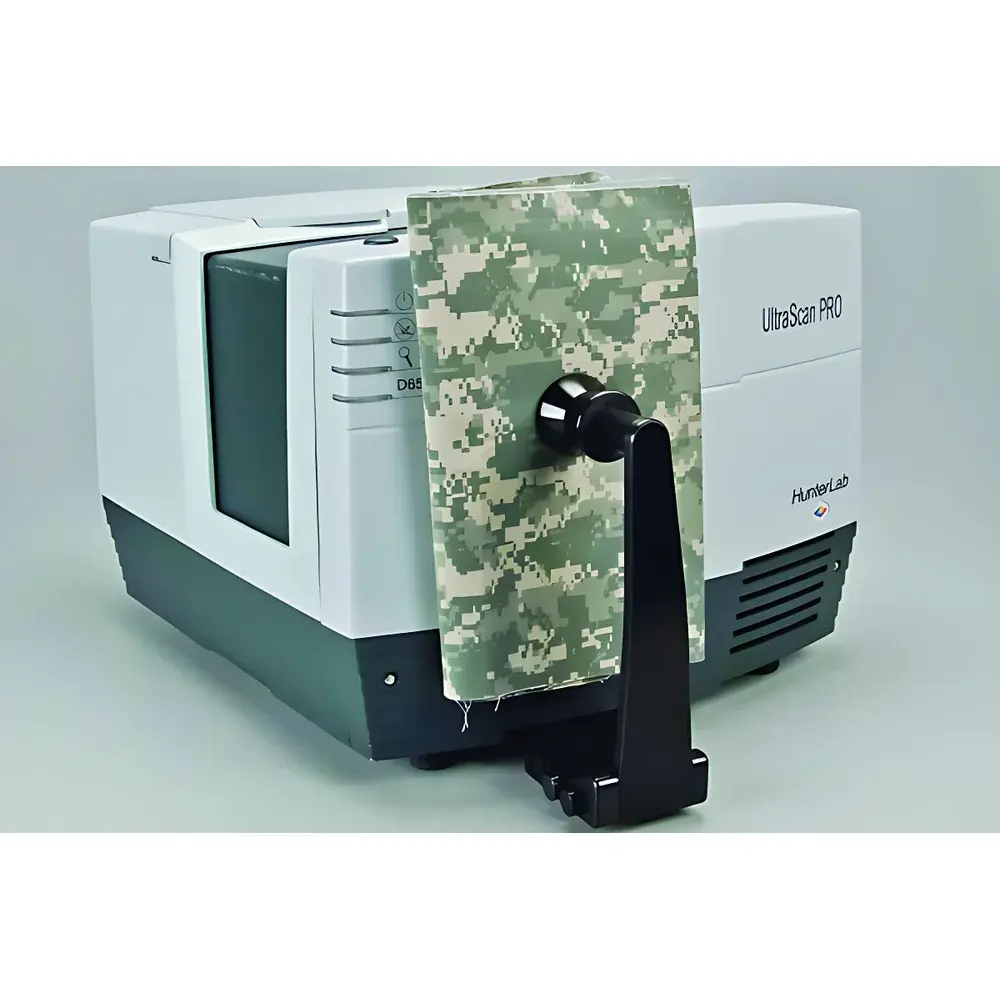
HunterLab UltraScan PRO Short-Fiber Color Measurement Spectrophotometer
| Brand | HunterLab |
|---|---|
| Origin | USA |
| Manufacturer Type | Authorized Distributor |
| Origin Category | Imported |
| Model | UltraScan PRO Short-Fiber |
| Product Type | Color Difference Meter |
| Instrument Type | Benchtop |
| Optical Geometry | d/8° Integrating Sphere |
| Light Source | Xenon Flash Lamp |
| Spectral Range | 350–1050 nm |
| Repeatability | ΔE*ab ≤ 0.03 (average, CIE Lab) |
Overview
The HunterLab UltraScan PRO Short-Fiber Color Measurement Spectrophotometer is a high-precision, dual-beam benchtop spectrophotometer engineered for rigorous color and appearance analysis across research, quality control, and regulatory-compliant environments. It operates on the principle of diffuse illumination and 8° viewing geometry (d/8°), conforming to ISO 7724-1, CIE 15:2004, ASTM E308, and ASTM D2244. Its extended spectral coverage—from ultraviolet (350 nm) through visible to near-infrared (1050 nm)—enables quantitative characterization of optical properties beyond standard tristimulus colorimetry, including fluorescence, NIR reflectance/transmittance, whiteness, yellowness, haze, opacity, APHA/Pt-Co/Gardner/Saybolt indices, K/S values, metamerism, and spectral scattering/absorption ratios. Designed specifically for short-fiber samples—including spunbond nonwovens, staple fiber blends, and textile yarns—the instrument integrates optimized sample presentation hardware and spectral correction algorithms to minimize orientation bias and packing-density artifacts inherent in fibrous matrices.
Key Features
- Dual-beam d/8° optical architecture with automatic specular component included/excluded (SCI/SCE) via motorized mirror assembly
- 152-mm (6-inch) integrating sphere coated with Spectraflect®, a barium sulfate–based material certified for long-term photostability and resistance to yellowing under UV exposure
- Xenon flash lamp with spectral filtering to accurately simulate CIE Illuminant D65 across 350–1050 nm, including controlled UV output to minimize spurious fluorescence excitation
- High-resolution diffraction grating monochromator with 512-element silicon photodiode array detector; spectral bandwidth ≤ 5 nm (FWHM), wavelength resolution 1.37 nm, wavelength accuracy ±0.1 nm
- Three selectable measurement apertures: 19 mm (LAV), 9 mm (MAV), and 4 mm (SAV), each calibrated per CIE TR 150 for geometric consistency
- Large transmission compartment accommodating up to 80 mm path-length cuvettes; triple-hinged access for unobstructed sample placement
- Integrated sample-viewing lamp with adjustable mirror for visual assessment under standardized illumination conditions
- Measurement cycle ≤ 2 seconds per reading; photometric range 0–200%, photometric resolution 0.003% (displayed to 0.01%)
Sample Compatibility & Compliance
The UltraScan PRO Short-Fiber variant includes fiber-specific sample holders, compression plates, and alignment guides to ensure reproducible packing density and surface orientation—critical for accurate color measurement of loose or loosely packed short fibers. It complies with ASTM D629 (textile fiber content), ASTM D2244 (color difference calculation), ISO 11475 (paper and board color), ISO 11664-4 (CIE colorimetric observers), and FDA 21 CFR Part 11 requirements when paired with validated EasyMatch-QC software. Its spectral data meets CIE Technical Report No. 51 (TC-1.3) for high-end spectrophotometers and has received CIE Rating Test classification AB—indicating top-tier performance in spectral accuracy and inter-instrument agreement. The system supports GLP/GMP audit trails, electronic signatures, and secure user role management.
Software & Data Management
Controlled via HunterLab’s EasyMatch-QC v5.x or EasyMatch-Coatings software, the UltraScan PRO enables full spectral data capture, customizable pass/fail tolerancing, statistical process control (SPC), and automated report generation compliant with ISO/IEC 17025 documentation standards. Raw spectral data (350–1050 nm at 5-nm intervals) is exportable in CSV, XML, or CIE 15:2004-compliant .cie formats. Software modules support advanced analyses including Kubelka-Munk transformation, spectral derivative mapping, NIR band ratio quantification, and multi-angle metamerism index (MI) calculation. All software installations include built-in calibration verification routines traceable to NIST SRM 2035 and SRM 930e.
Applications
This instrument serves as a primary reference tool in fiber R&D labs evaluating dye uptake kinetics, pigment dispersion stability, UV stabilizer efficacy, and NIR camouflage performance. In QC environments, it validates batch-to-batch consistency of polyester, nylon, acrylic, and cellulose-based short fibers used in filtration media, geotextiles, battery separators, and medical nonwovens. Regulatory applications include FDA color release testing for pharmaceutical excipients, USP appearance evaluation of injectable suspensions, and ASTM D313 white/yellow index certification for insulation materials. Academic users apply its full-spectrum capability to study light-scattering mechanisms in hierarchical fibrous structures and develop predictive models for spectral rendering in digital twin workflows.
FAQ
Does the UltraScan PRO Short-Fiber model support fluorescence correction for optical brighteners?
Yes—it includes built-in UV-adjusted D65 simulation and optional 400 nm cutoff filters to isolate and quantify fluorescent emission without overexcitation.
Can it measure both reflectance and transmittance of fiber mats simultaneously?
No—measurements are mode-specific; however, rapid switching between reflectance (with backing tile) and transmittance (using custom fiber-mount cuvettes) is supported within the same session.
Is spectral data compatible with third-party chemometric platforms like Unscrambler or MATLAB?
Yes—CSV exports contain wavelength-indexed absorbance/reflectance values and can be directly imported for PCA, PLS regression, or clustering analysis.
What maintenance is required to sustain CIE AB rating over time?
Annual recalibration using HunterLab-certified standards and biannual sphere coating inspection are recommended; full validation per ASTM E2591 is advised for regulated environments.
Does the system meet MIL-STD-810G for field-deployable ruggedness?
No—it is designed for controlled laboratory use only; environmental specifications (10–40 °C, 10–90% RH non-condensing) align with ISO 17025 Clause 5.3 requirements.




