
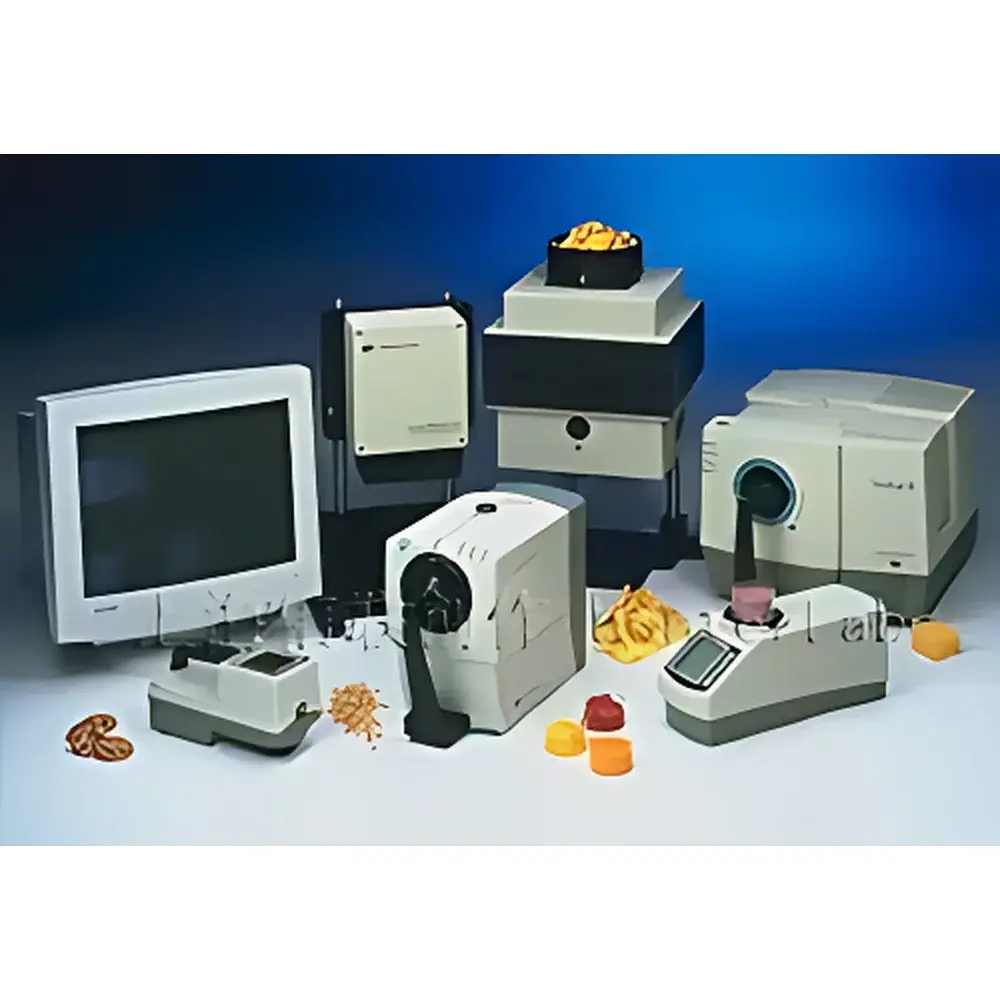
HunterLab UltraScan VIS Spectrophotometer
| Brand | HunterLab |
|---|---|
| Origin | USA |
| Instrument Type | Benchtop |
| Optical Geometry | d/8° integrating sphere |
| Light Source | Pulsed Xenon Lamp |
| Spectral Range | 400–700 nm |
| Repeatability | ΔE*₀₀ ≤ 0.03 |
| Color Spaces | CIELAB, CIELCh, Hunter Lab, XYZ, Yxy, ANLAB, Rdab |
| Color Difference Formulas | ΔE*₂₀₀₀, ΔE*₉₄, ΔE*CIE76, ΔE*CMC(2:1), ΔE*CMC(1:1), ΔE*FMC2, ΔH*, ΔC*, ΔL* |
| Indices | APHA, Gardner, Saybolt, Whiteness (CIE, Ganz, ASTM E313), Yellowness (ASTM D1925, E313), Opacity, Haze, Tint, TPS/TCS/TJS/TSS (Tomato/Citrus), ASBC/EBC, ASTM D6290 (Infrared Reflectance), Fluorescent Whitening Agent (FWA) Compensation |
| Data Output | Reflectance (%), Absorbance, Transmittance (%), K/S, Color Strength, Optical Density |
| Illuminants | A, C, D50, D65, D75, F2, F7, F11, TL84, U3000, U3500, ULTRALUME |
| Compliance | ISO 7724-1, ISO 11664, ASTM E308, ASTM D2244, ASTM D313, ASTM E2539, CIE No. 15, FDA 21 CFR Part 11 (via optional software module), GLP/GMP audit trail capable |
Overview
The HunterLab UltraScan VIS is a high-precision benchtop spectrophotometer engineered for absolute color measurement consistency across research, quality control, and regulatory-compliant manufacturing environments. Operating on the principle of diffuse/8° (d/8°) geometry with a calibrated integrating sphere, it captures total reflectance or transmittance from opaque, translucent, and transparent samples under controlled illumination conditions. Its pulsed xenon lamp delivers stable, flash-based spectral output across the full visible range (400–700 nm) without thermal drift—eliminating lamp aging artifacts common in continuous-source instruments. The system implements NIST-traceable calibration standards and adheres to ISO 7724-1 for geometric accuracy and ASTM E308 for spectral data conversion. Designed for traceability in regulated industries—including food & beverage, pharmaceuticals, plastics, textiles, and coatings—the UltraScan VIS supports full spectral acquisition at 10 nm intervals (with interpolation to 1 nm), enabling rigorous analysis beyond tristimulus values alone.
Key Features
- True d/8° optical configuration with dual-beam compensation and sphere coating optimized for low-fluorescence error and minimal inter-reflection bias
- Pulsed xenon light source providing >1 million flashes lifetime, zero warm-up delay, and immunity to spectral shift over time
- Integrated UV filter and optional UV calibration kit for accurate fluorescent whitening agent (FWA) quantification per ISO 105-J03 and ASTM E313
- Motorized sample port with auto-aperture detection and programmable measurement height adjustment for repeatable positioning of irregular or thick specimens
- Real-time spectral validation: built-in diagnostic checks for lamp energy, sphere cleanliness, and detector linearity prior to each measurement cycle
- Multi-illuminant support including D65 (standard daylight), D50 (graphic arts), TL84 (retail lighting), and U3500 (UV-enhanced), all preloaded with CIE-defined SPDs
- Comprehensive color difference engine supporting 18 industry-standard formulas—including ΔE*₂₀₀₀ (CIEDE2000), ΔE*CMC(2:1), and ΔE*FMC2—with user-definable tolerances and pass/fail logic
Sample Compatibility & Compliance
The UltraScan VIS accommodates solid, liquid, powder, paste, and film samples via configurable accessories: 25 mm and 50 mm port inserts, liquid transmission cells (10–50 mm pathlength), powder cups with pressure plates, and transmission holders for clear films. It meets ISO 11664 requirements for spectral data reporting and complies with ASTM D2244 for color difference acceptability in industrial QC. For regulated sectors, the instrument—when paired with Vision® QC software—supports 21 CFR Part 11 compliance through electronic signatures, audit trails, role-based access control, and immutable raw spectral storage. All calibrations are documented against NIST-traceable ceramic standards; annual verification protocols align with ISO/IEC 17025 laboratory accreditation criteria.
Software & Data Management
Vision® QC software provides a validated platform for method creation, instrument qualification (IQ/OQ), and routine operation. It enables spectral library management with version-controlled references, statistical process control (SPC) charting per ASTM E2709, and automated report generation compliant with ISO 9001 and IATF 16949. Raw spectral data (.spc files) are stored in ASCII format for third-party analysis. Batch processing supports up to 500 samples per run with automatic outlier detection based on spectral residual analysis. Data export options include CSV, PDF, XML, and direct integration into LIMS via ODBC or HL7 interfaces. Software updates follow a formal change control process documented per ISO 13485 Annex C.
Applications
- Plastics & Polymers: Quantifying yellowness index (YI) per ASTM D1925 for thermal stability assessment; measuring infrared reflectance of camouflage fabrics per MIL-STD-3009
- Food & Beverage: Validating tomato pigment ratios (TPS/TCS) and citrus color grading per ASTM D6290; monitoring beer color (ASBC/EBC units) with temperature-compensated cuvette holders
- Pharmaceuticals: Verifying tablet coating uniformity using CIELAB ΔE*₂₀₀₀ thresholds; quantifying whiteness of excipients per USP
- Paints & Coatings: Calculating hiding power (opacity) per ASTM D2805; evaluating metamerism via multi-illuminant comparison and MI (Metamerism Index) calculation
- Textiles & Apparel: Assessing colorfastness metrics—including grey scale ratings for staining and fading—aligned with AATCC TM16 and ISO 105-B02
FAQ
What spectral resolution does the UltraScan VIS provide?
The instrument acquires data at 10 nm intervals from 400–700 nm, with interpolated 1 nm spectra generated mathematically using cubic spline algorithms conforming to CIE 15:2018 Annex E.
Can it measure fluorescent samples accurately?
Yes—using its built-in UV-adjustable mode and optional UV calibration standard, it performs FWA-corrected measurements per ISO 105-J03 and ASTM E313, with spectral correction applied during reflectance calculation.
Is the d/8° geometry compatible with M0/M1/M2/M3 measurement modes?
The UltraScan VIS operates in M2 (UV-excluded) by default; M0 (UV-included), M1 (UV-adjusted), and M3 (polarized) modes require optional hardware modules and are validated per ISO 17321-1.
How is instrument performance verified between calibrations?
Users perform daily verification using supplied ceramic tile standards; results are logged automatically and compared against historical baselines with trend alerts triggered at ±0.02 ΔE*₂₀₀₀ deviation.
Does it support GLP-compliant data archiving?
When configured with Vision® QC’s Audit Trail module, all spectral acquisitions, parameter changes, and user actions are timestamped, digitally signed, and stored in tamper-evident format meeting OECD GLP Principles Section 5.2.12.




