
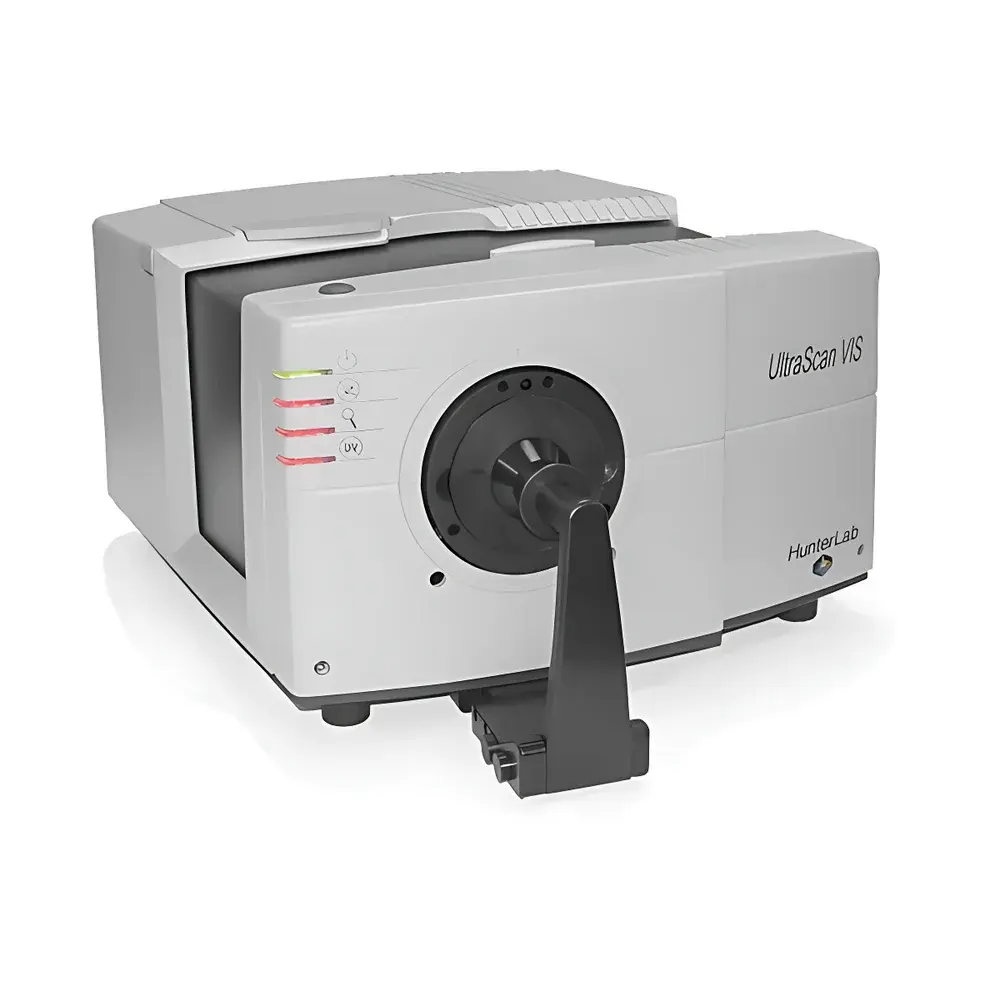
HunterLab UltraScan VIS Spectrophotometer
| Brand | HunterLab |
|---|---|
| Origin | USA |
| Manufacturer Type | Authorized Distributor |
| Origin Category | Imported |
| Model | HunterLab UltraScan VIS |
| Product Type | Spectrophotometric Colorimeter |
| Instrument Type | Benchtop |
| Optical Geometry | d/8° Integrating Sphere |
| Light Source | Pulsed Xenon Lamp |
| Spectral Range | 360–780 nm |
| Wavelength Interval | 10 nm |
| Spectral Bandwidth | 10 nm (Effective Equivalent Triangular) |
| Wavelength Accuracy | Verified with Nd/Pr Oxide Filter |
| Repeatability | ≤0.03 ΔE* (CIE L*a*b*, avg. of 10 readings on white tile) |
| Photometric Range | 0–150% |
| Photometric Resolution | 0.003% (displayed as 0.01%) |
| Measurement Time | ≤5 s |
| Aperture Options | 19 mm and 6.3 mm |
| Transmission Chamber | Triple-side open, accommodates up to 80 mm cuvettes |
| UV Correction | Yes, D65 UV-adjustable |
| Compliance | CIE, ASTM E308, ISO 7724, ISO 11664, DIN 5033, JIS Z 8722, USP <631> |
Overview
The HunterLab UltraScan VIS is a high-precision benchtop spectrophotometer engineered for quantitative color measurement and spectral analysis across the full visible and near-UV spectrum (360–780 nm). It operates on the principle of double-beam d/8° integrating sphere spectroscopy, enabling simultaneous capture of diffuse and specular-reflected components—configurable via an automated gloss-exclusion port. Its optical architecture conforms to CIE Publication 15:2018 and supports all major color spaces (CIE L*a*b*, L*C*h°, Yxy, XYZ), as well as specialized indices including Whiteness (CIE, Ganz, ASTM E313), Yellowness (ASTM D1925, E313), APHA/Pt-Co, Gardner, Saybolt, Haze (ASTM D1003), and Turbidity (ISO 7027). Designed for traceable metrology in regulated environments, each unit is factory-calibrated using NIST-traceable standards and includes a certified Nd/Pr oxide filter for ongoing wavelength validation.
Key Features
- Double-beam d/8° optical geometry with motorized specular component exclusion (SCI/SCE modes), ensuring consistent measurement of textured, glossy, or hazy surfaces.
- 6-inch (152 mm) integrating sphere coated with Spectraflect®, a barium sulfate-based material engineered for long-term reflectance stability (>98% @ 400–700 nm) and resistance to yellowing—even under prolonged UV exposure.
- Pulsed xenon lamp system delivering flash illumination without thermal loading; eliminates sample heating artifacts critical for heat-sensitive polymers, pharmaceuticals, and biological fluids.
- Full-spectrum coverage from 360 nm enables quantification of UV-absorbing additives, optical brighteners, and photostability indicators—essential for compliance with USP and ISO 11664-3.
- D65 illuminant simulation with programmable UV energy control, allowing precise matching of daylight conditions while minimizing overexcitation of fluorescent materials.
- High-fidelity spectral acquisition: 256-element silicon photodiode array with diffraction grating monochromator, spectral resolution <2 nm, and 10 nm reporting interval per CIE 15:2018 recommendations.
- Large transmission chamber with triple-side access accommodates standard 10 mm, 50 mm, and 80 mm pathlength cuvettes—ideal for liquid, gel, and suspension analysis in QC laboratories.
Sample Compatibility & Compliance
The UltraScan VIS accepts opaque, translucent, transparent, and reflective samples—including powders, granules, films, molded plastics, coatings, textiles, pharmaceutical tablets, food emulsions, and optical filters. Its dual-aperture design (19 mm and 6.3 mm) supports both macro-scale batch verification and micro-area spot analysis. The instrument meets international regulatory requirements for color and appearance testing: ASTM D2244, D313, D6290; ISO 7724-1, 7724-2, 11664-4; DIN 6174; JIS Z 8722; and USP for pharmaceutical solutions. All firmware and calibration routines are designed to support GLP/GMP audit readiness, including user-accessible calibration logs, timestamped measurement records, and optional 21 CFR Part 11-compliant software modules.
Software & Data Management
The UltraScan VIS interfaces via USB or RS-232C and is fully compatible with HunterLab EasyMatch QC software—a validated platform supporting method-driven workflows, statistical process control (SPC), tolerance setting (ΔE*, ΔL*, Δa*, Δb*), and cross-instrument data harmonization. EasyMatch QC provides built-in report templates aligned with ISO/IEC 17025 documentation requirements, including instrument identification, operator ID, environmental conditions (temperature/humidity), and calibration verification timestamps. Optional modules enable integration with LIMS systems, SPC dashboards, and industry-specific formulation tools (e.g., paint tinting, plastic masterbatch, cosmetic shade matching). All spectral data are stored in vendor-neutral ASCII format for third-party analysis.
Applications
This spectrophotometer serves as a primary color measurement tool in quality control laboratories across diverse sectors: polymer compounders validating pigment dispersion in polyolefins and engineering resins; pharmaceutical manufacturers verifying solution clarity and excipient consistency per USP ; food and beverage producers monitoring browning index (BI) and Maillard reaction progression; textile mills ensuring dye lot uniformity across fiber types; and solar panel manufacturers assessing anti-reflective coating performance via spectral transmittance curves. Its ability to quantify haze, yellowness, and whiteness makes it indispensable for glass, packaging film, and medical device transparency validation.
FAQ
Does the UltraScan VIS support both SCI and SCE measurement modes?
Yes—motorized gloss trap enables automatic switching between Specular Component Included (SCI) and Specular Component Excluded (SCE) geometries without manual intervention.
Is wavelength calibration traceable to NIST standards?
Each instrument ships with a certified Nd/Pr oxide filter for user-performed wavelength verification; factory calibration is performed against NIST-traceable reference standards.
Can the UltraScan VIS measure APHA/Pt-Co and Gardner color scales directly?
Yes—EasyMatch QC includes preconfigured methods compliant with ASTM D1209 (APHA), D5386 (Gardner), and D1500 (Saybolt), with automatic index calculation and pass/fail evaluation.
What is the operating temperature range and humidity tolerance?
Rated for continuous operation at 10–40°C ambient temperature and 10–90% relative humidity (non-condensing); storage range extends from −20°C to +70°C.
Is UV correction adjustable for different daylight illuminants?
Yes—the UV energy output is programmable to match D65, C, or custom UV-weighted spectra, supporting fluorescence compensation per CIE 15:2018 Annex D.




