
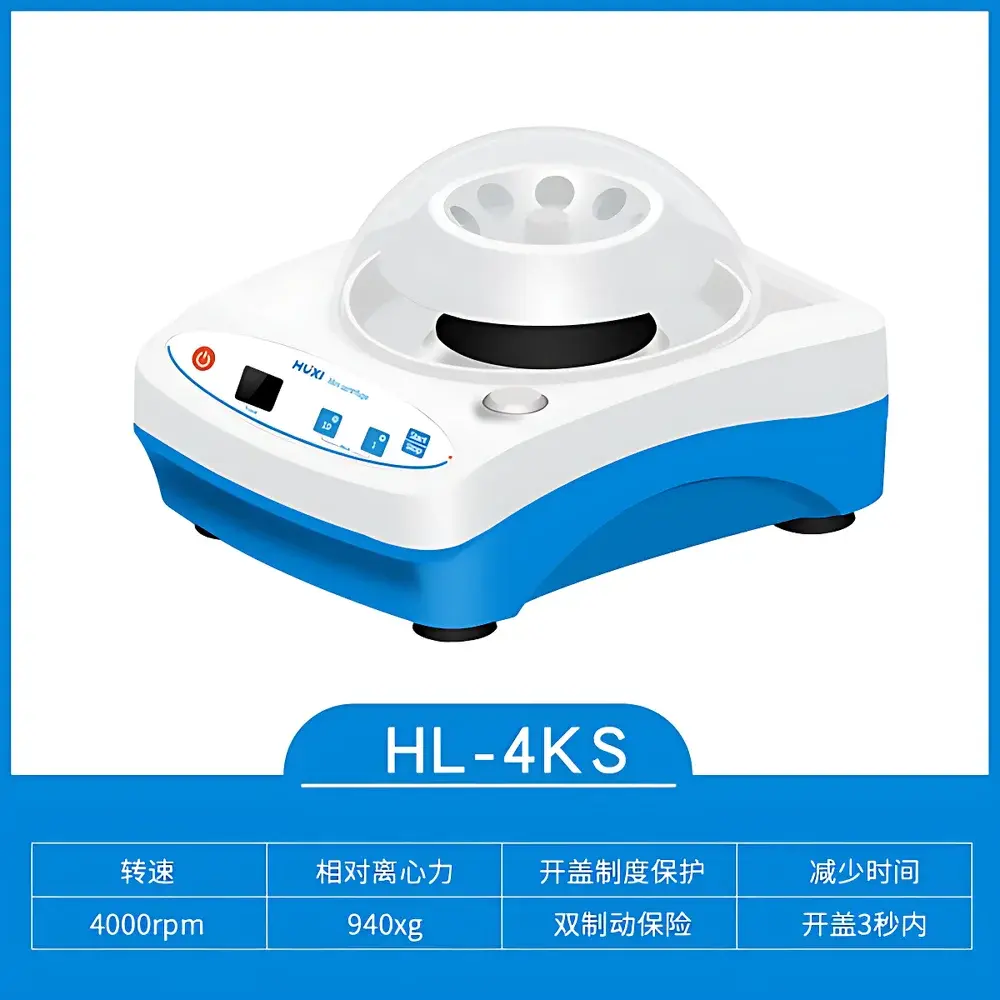
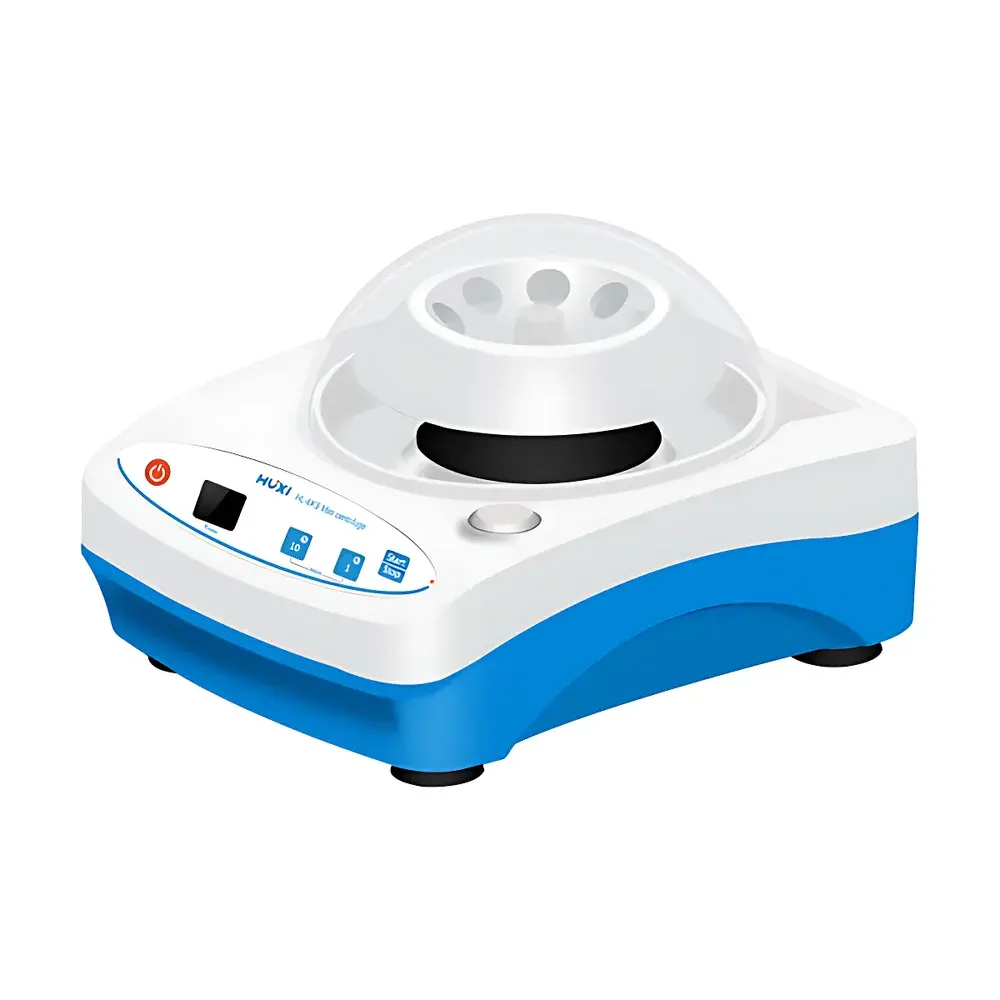
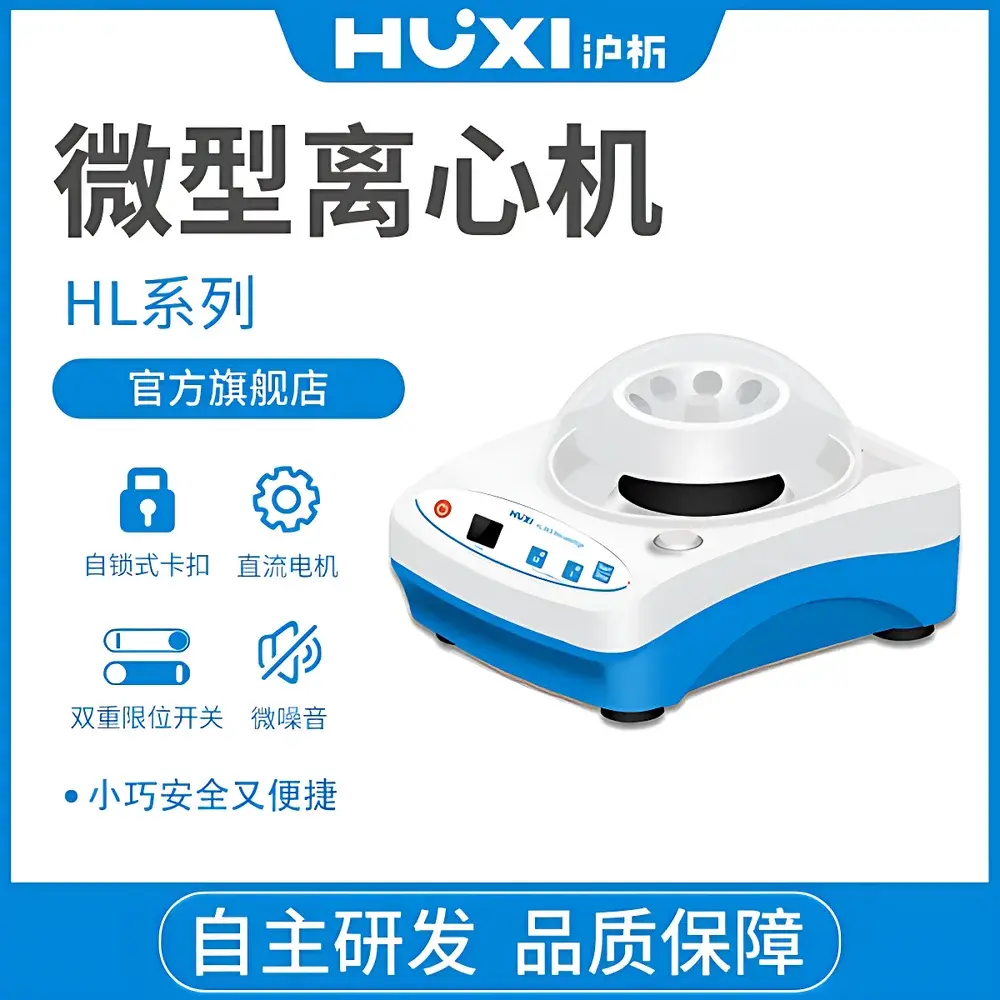
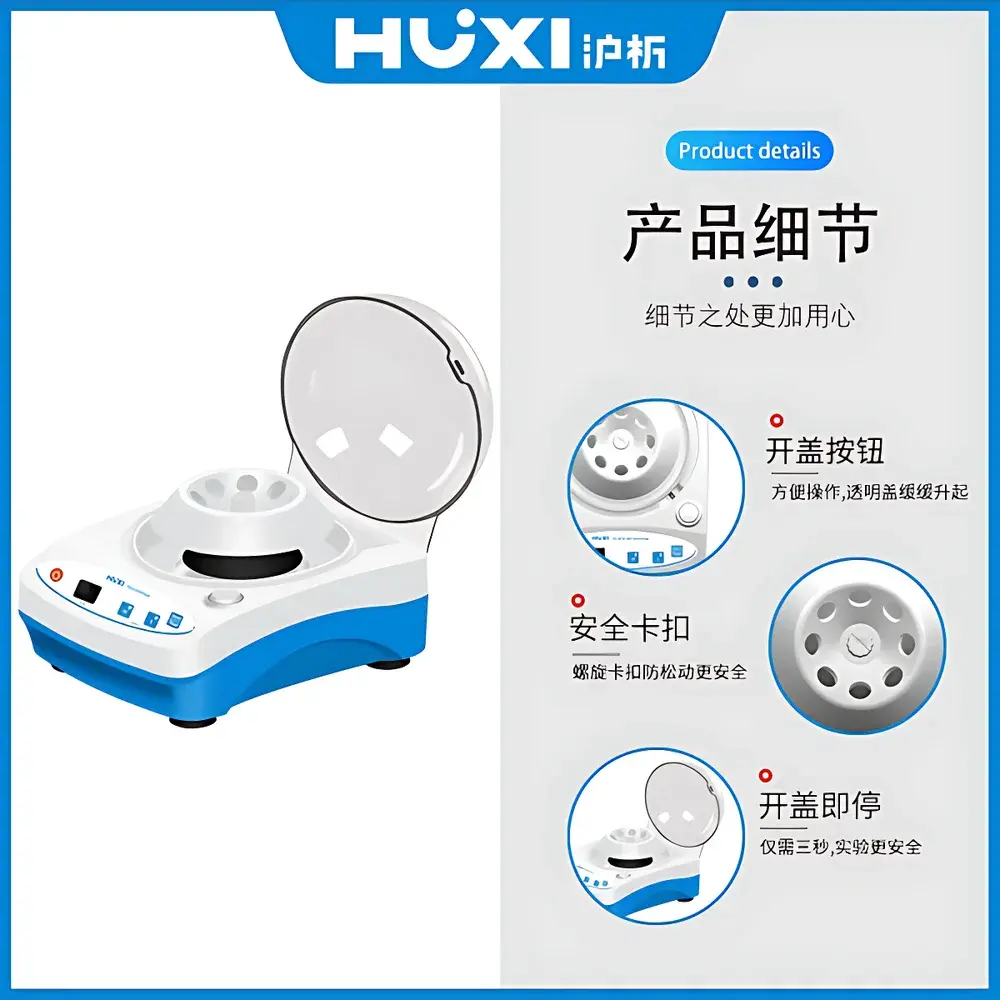
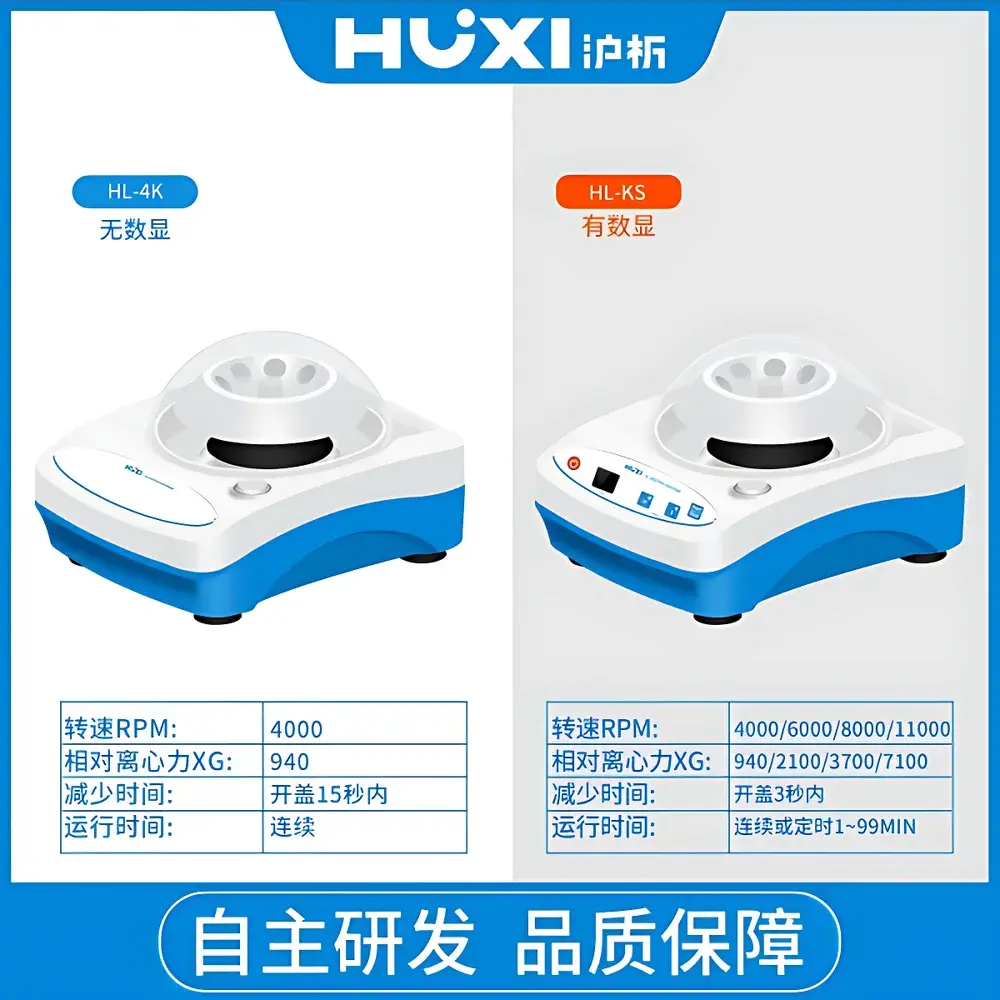
HUXI HL-4KS Mini Benchtop Centrifuge
| Brand | HUXI |
|---|---|
| Origin | Shanghai, China |
| Manufacturer Type | Original Equipment Manufacturer (OEM) |
| Product Category | Domestic |
| Model | HL-4KS |
| Instrument Type | Palm-Sized Centrifuge |
| Speed Range | 0–4000 rpm |
| Max RCF | 940 × g |
| Max Capacity | 8 × 2.0 mL or 8 × 1.5 mL tubes |
| Rotor Type | Fixed-angle rotor |
| Application Class | Biomolecular separation (e.g., DNA, RNA, proteins, cell pellets) |
| Power Input | AC 100–240 V, 50/60 Hz |
| Noise Level | ≤45 dB(A) |
| Dimensions (W×D×H) | 175 × 135 × 120 mm |
| Weight | 1.5 kg |
| Acceleration Time to 90% Rated Speed | 5 s |
| Deceleration (Braking) Time after Lid Opening | ≤3 s |
| Safety Features | Dual-brake interlock, auto-stop on lid opening, transparent polycarbonate dome lid |
| Motor Type | Brushless DC motor |
| Timer Range | 1–99 min or continuous mode |
Overview
The HUXI HL-4KS Mini Benchtop Centrifuge is an engineered solution for rapid, low-force sedimentation tasks in resource-constrained or space-limited laboratory environments. Designed around the principles of fixed-angle centrifugation, it generates a consistent radial acceleration field to separate particles—such as cellular debris, precipitated nucleic acids, or protein aggregates—based on differences in density and sedimentation coefficient. Operating at a maximum speed of 4000 rpm and delivering up to 940 × g, the HL-4KS falls within the low-speed centrifuge classification per ISO 15195:2018 and aligns with routine pre-analytical preparation steps defined in CLSI GP45-A5 and USP . Its compact footprint (175 × 135 × 120 mm) and lightweight construction (1.5 kg) make it suitable for biosafety cabinets, laminar flow hoods, cold rooms, and point-of-use benchtop workflows in QC labs, academic teaching facilities, and field-deployable diagnostic units.
Key Features
- Brushless DC motor architecture ensures stable rotational output, extended service life (>10,000 hr MTBF), and minimal electromagnetic interference—critical for integration near sensitive instrumentation such as qPCR thermocyclers or microplate readers.
- Fixed-angle rotor configuration optimized for microcentrifuge tube formats: accommodates eight 1.5 mL or 2.0 mL Eppendorf-style tubes simultaneously, or eight 4-strip PCR plates (each holding four 0.2 mL tubes), supporting high-throughput sample prep without cross-contamination risk.
- Dual mechanical and electronic braking system engages automatically upon lid opening, halting rotation within ≤3 seconds—a safety requirement compliant with IEC 61010-2-020 for laboratory centrifuges.
- Wide-input switching power supply (AC 100–240 V, 50/60 Hz) eliminates need for voltage converters during international deployment or multi-site lab standardization.
- Transparent polycarbonate dome lid provides full visual monitoring during operation while meeting EN 61010-1 impact resistance requirements; integrated latch mechanism enables one-handed access without tooling.
- Noise emission ≤45 dB(A) at 1 m distance meets ISO 7779 and EU Directive 2000/14/EC noise labeling thresholds for office-adjacent laboratory zones.
Sample Compatibility & Compliance
The HL-4KS supports standard polypropylene and polyethylene microcentrifuge tubes (1.5 mL and 2.0 mL) and thin-walled PCR strip tubes (0.2 mL), including those certified for autoclaving (121°C, 20 min). It is validated for use with common biological matrices: clarified lysates, serum supernatants, bacterial culture pellets, and ethanol-precipitated nucleic acid solutions. Device compliance includes CE marking under the EU Machinery Directive 2006/42/EC and Low Voltage Directive 2014/35/EU. While not classified as a medical device per MDR 2017/745, its operational parameters conform to GLP-relevant procedural controls when used in non-clinical study support per OECD Principles of Good Laboratory Practice (ENV/MC/CHEM(98)17).
Software & Data Management
The HL-4KS operates via tactile membrane keypad with LED status indicators—no embedded software or firmware update capability. All operational parameters (time, speed, lid state) are recorded manually per user logbook practice. For laboratories requiring audit trails, integration into electronic lab notebooks (ELNs) such as LabArchives or Benchling is supported via manual entry. The unit satisfies FDA 21 CFR Part 11 foundational requirements for “non-electronic records” when operated in conjunction with documented SOPs and handwritten run logs signed by analysts.
Applications
- Routine pelleting of mammalian cells (e.g., HEK293, CHO) prior to lysis in molecular biology workflows.
- Clarification of enzymatic reaction mixtures before HPLC or capillary electrophoresis analysis.
- Separation of phase-separated organic/aqueous extracts in small-scale natural product isolation.
- Quick spin-down of adhesive reagents (e.g., Taq polymerase, restriction enzymes) to tube bottom prior to pipetting.
- Pre-centrifugation of whole blood microsamples (≤200 µL) in decentralized clinical screening protocols.
FAQ
Is the HL-4KS suitable for centrifuging infectious samples?
Yes, provided users follow BSL-2 containment practices—including use of sealed tube caps, secondary containment vessels, and post-run decontamination with 70% ethanol or 0.5% sodium hypochlorite.
Can the rotor be autoclaved?
No—the fixed-angle rotor is constructed from aluminum alloy and is not autoclavable. Sterilization must be performed using chemical disinfectants compatible with aluminum surfaces.
Does the device support variable speed ramping profiles?
No—it offers only fixed acceleration (reaches 90% rated speed in 5 s) and deceleration (full stop ≤3 s on lid open); no programmable gradient control is available.
What is the recommended maintenance interval?
Visual inspection and cleaning of rotor chamber and lid seal should occur after every 50 operating hours or weekly, whichever comes first; annual calibration verification of speed and timer accuracy is advised per ISO/IEC 17025 Clause 6.5.2.
Is rotor imbalance detection built-in?
No—imbalance protection relies on mechanical vibration damping and automatic shutdown triggered by excessive oscillation amplitude, per IEC 61010-2-020 Clause 7.3.2. Users must manually balance loads symmetrically before operation.
Related Products



