
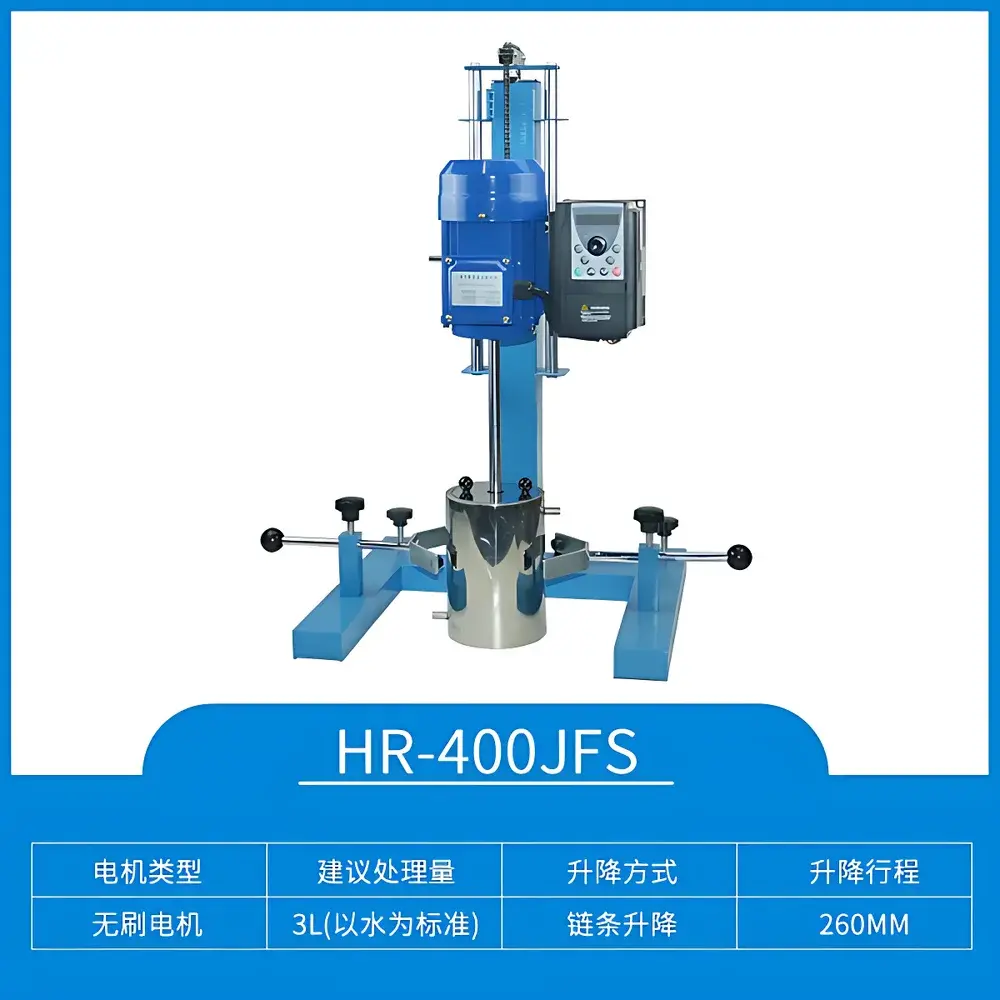
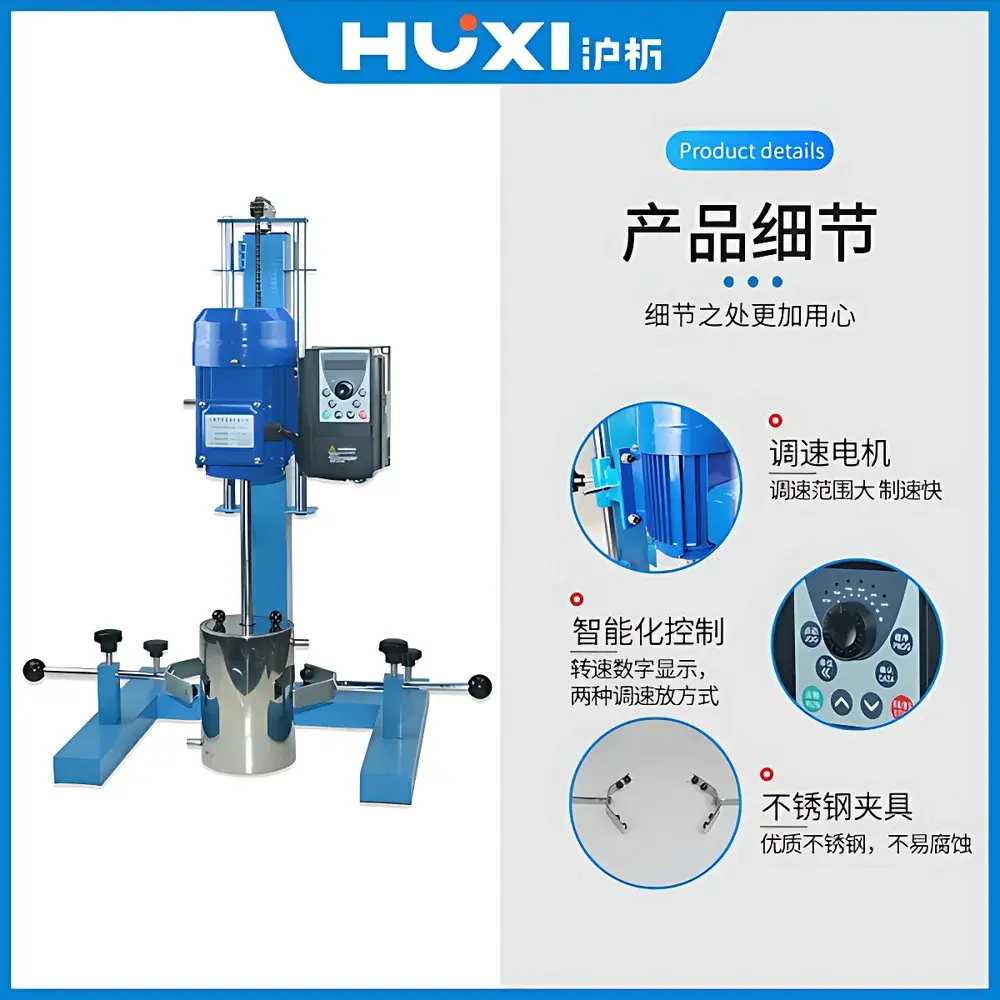
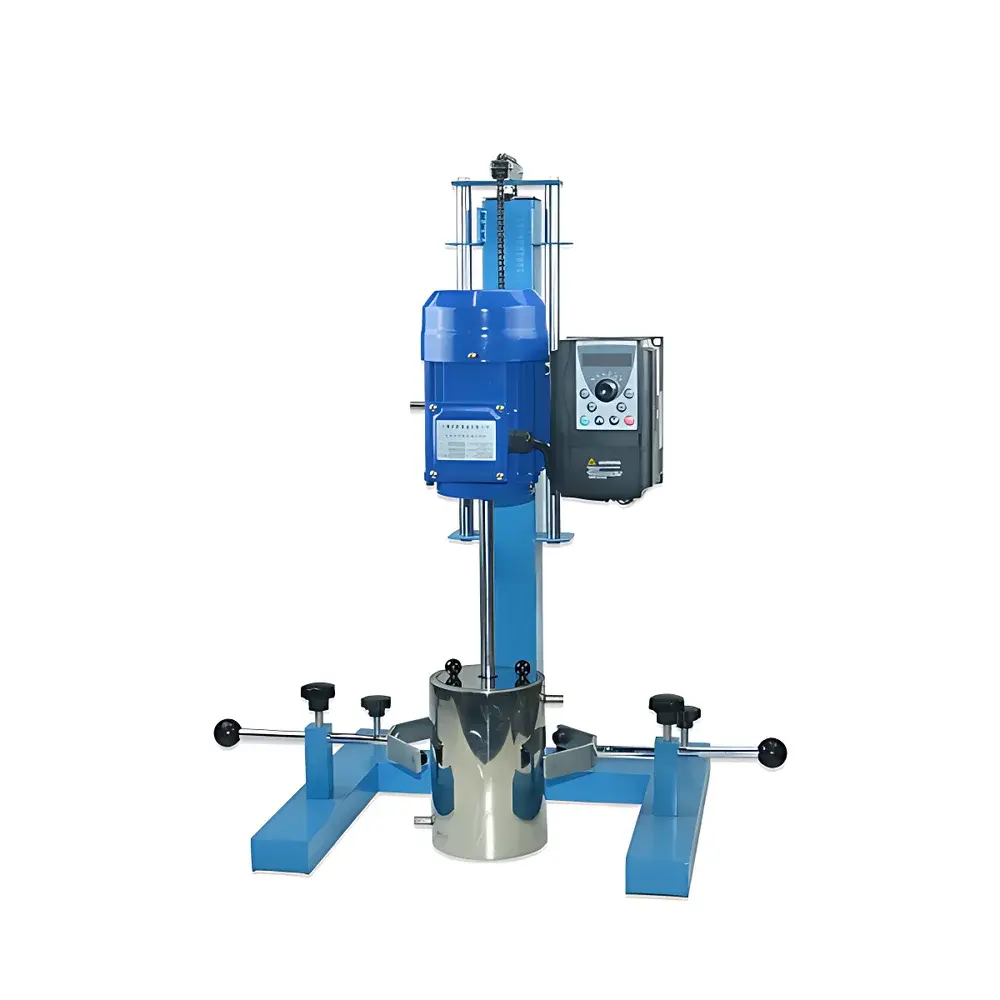
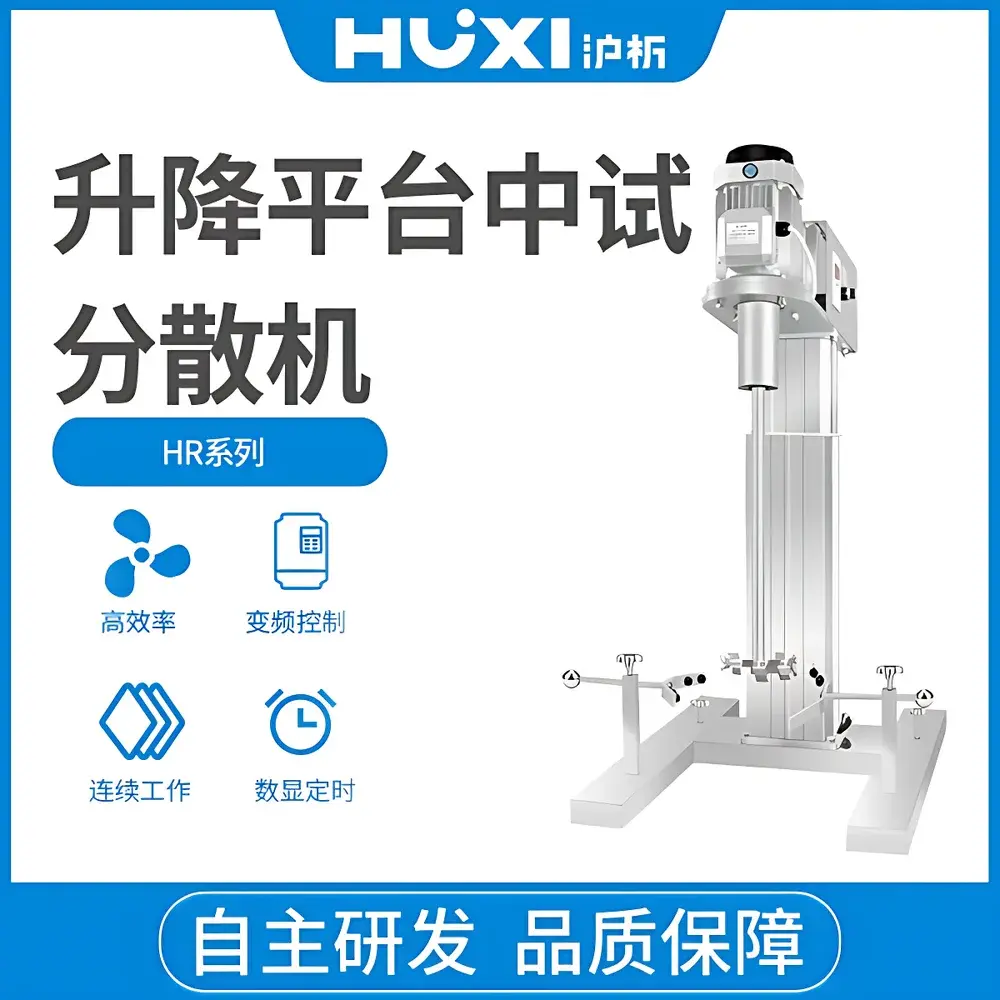
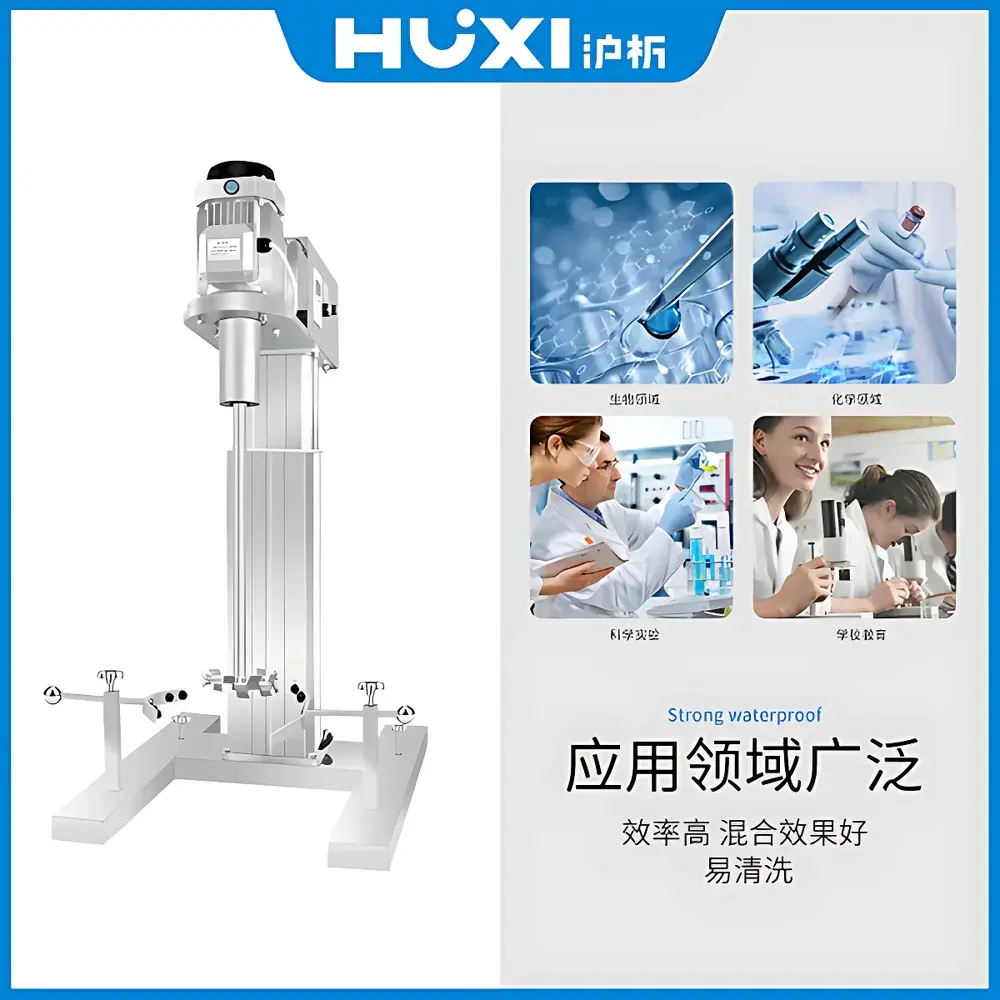
HUXI HR-400JFS Variable-Frequency High-Shear Homogenizer
| Brand | HUXI |
|---|---|
| Origin | Shanghai, China |
| Manufacturer Type | Direct Manufacturer |
| Instrument Type | Probe-Type Rotor-Stator Homogenizer |
| Model | HR-400JFS |
| Dimensions (W×D×H) | 450 × 420 × 750 mm |
| Recommended Sample Volume | 3 L |
| Motor Type | Brushless DC Motor |
| Power | 400 W |
| Speed Range | 0–8000 rpm |
| Maximum Viscosity Handling | 15,000 cP |
| Lift Mechanism | Manual Chain-Driven Vertical Adjustment |
| Lift Stroke | 260 mm |
| Shaft Length | 210 mm |
| Shaft Diameter | 16 mm |
| Shaft-to-Bracket Distance | 130 mm |
| Dispersion Disk Height Above Base | 30 mm |
| Base Footprint | 275 × 330 mm |
| Voltage | 220 V AC |
Overview
The HUXI HR-400JFS is a benchtop variable-frequency high-shear homogenizer engineered for reproducible, scalable dispersion and emulsification in research laboratories and quality control environments. It operates on the rotor-stator principle—where a rapidly rotating probe (rotor) shears fluid against a stationary sleeve (stator)—generating intense hydrodynamic forces, turbulent flow, and cavitation to achieve sub-micron particle size reduction and uniform phase distribution. Designed for routine use with low-to-medium viscosity samples up to 15,000 cP, the system delivers consistent mechanical energy input across its full 0–8000 rpm speed range. Its brushless DC motor eliminates carbon brush wear, electrical arcing, and particulate generation—critical for cleanroom-compatible operation and long-term stability in regulated settings such as pharmaceutical formulation development or polymer nanocomposite synthesis.
Key Features
- Brushless DC motor with integrated frequency converter: enables precise, stepless speed control from 0 to 8000 rpm; ensures thermal stability, low acoustic emission (<65 dB at 1 m), and maintenance-free operation over extended duty cycles.
- Stainless steel dispersion head (AISI 304): chemically resistant, autoclavable, and precision-machined for tight rotor-stator clearance—optimized for efficient energy transfer and minimal dead volume.
- Modular probe assembly: secured via hex-key fastening to the drive shaft; allows rapid interchange of standard 16 mm diameter shafts and compatible dispersion disks without tools or realignment.
- Manually actuated chain-driven vertical lift: provides 260 mm of repeatable height adjustment with mechanical locking at discrete positions; accommodates vessels from 50 mL beakers to 3 L jacketed reactors.
- Rigid square-tube support frame: constructed from powder-coated carbon steel; offers lateral rigidity during high-torque operation and integrates seamlessly with standard lab stands and temperature-controlled baths.
- Front-panel digital display with rotary encoder: shows real-time rpm, elapsed run time, and motor load feedback; supports user-defined preset speeds for method reproducibility.
Sample Compatibility & Compliance
The HR-400JFS is validated for processing aqueous, organic, and semi-viscous suspensions—including pigment dispersions, nanoemulsions, liposome formulations, ceramic slurries, and polymer solutions. It complies with IEC 61000-6-2 (immunity) and IEC 61000-6-4 (emission) standards for laboratory electromagnetic compatibility. While not certified to ISO/IEC 17025 or FDA 21 CFR Part 11 out-of-the-box, its operational parameters (speed, time, torque) are fully documentable via external data logging. The unit meets general safety requirements per GB 4793.1–2007 (Chinese equivalent of IEC 61010-1), including protection against electric shock, mechanical hazards, and overheating. For GLP/GMP workflows, users may implement procedural controls—such as pre-run calibration checks, logbook entries, and periodic verification of speed accuracy using an optical tachometer—to support audit readiness.
Software & Data Management
The HR-400JFS operates as a standalone instrument with no embedded software stack or network interface. All operational parameters are set and monitored locally via its front-panel interface. For traceable process documentation, integration with third-party Lab Information Management Systems (LIMS) or electronic lab notebooks (ELN) is achieved through manual entry or optional RS-232/USB-to-serial adapters (sold separately). Users may export speed/time logs using external serial capture utilities compatible with Windows/Linux platforms. No proprietary drivers or cloud services are required—ensuring full data sovereignty and alignment with institutional IT security policies.
Applications
- Preparation of stable oil-in-water and water-in-oil emulsions for food science and cosmetic testing.
- Disintegration of aggregated nanoparticles (e.g., TiO₂, SiO₂) in aqueous colloids prior to DLS or TEM analysis.
- Homogenization of tissue lysates and bacterial cell suspensions in molecular biology protocols (complementary to ultrasonic or bead-beating methods).
- Dispersion of conductive fillers (carbon black, graphene) into polymer matrices for rheological and conductivity characterization.
- Accelerated aging studies requiring controlled shear history in coating and ink formulations.
- Batch-scale validation of dispersant efficacy under defined shear rate profiles (approximated via rpm–viscosity–geometry correlation).
FAQ
What is the maximum recommended sample volume for the HR-400JFS?
The instrument is optimized for volumes between 0.5 L and 3 L. Processing below 0.5 L risks vortexing and insufficient submergence of the dispersion head; above 3 L may exceed torque capacity and compromise homogeneity.
Can the HR-400JFS be used with corrosive solvents such as chloroform or concentrated acids?
The standard stainless steel (AISI 304) probe is suitable for mild organic solvents and neutral aqueous solutions. For aggressive media (e.g., halogenated solvents, strong oxidizers), optional AISI 316L or Hastelloy C-276 probes are recommended—and must be specified at time of order.
Is speed calibration traceable to national standards?
The unit does not include factory-calibrated speed certification. Users should verify rotational speed periodically using a NIST-traceable handheld tachometer, especially after prolonged use or mechanical maintenance.
Does the chain lift mechanism support motorized automation?
No—the lift is manually operated only. Motorized Z-axis control is not available on this model; users requiring programmable vertical movement should consider the HUXI HR-600JFS series or third-party robotic integration kits.
What maintenance intervals are recommended for continuous operation?
Under normal lab conditions (≤4 h/day), inspect shaft coupling and dispersion head integrity every 6 months; lubricate chain mechanism quarterly; replace motor cooling fan filter annually if operating in dusty environments.



