
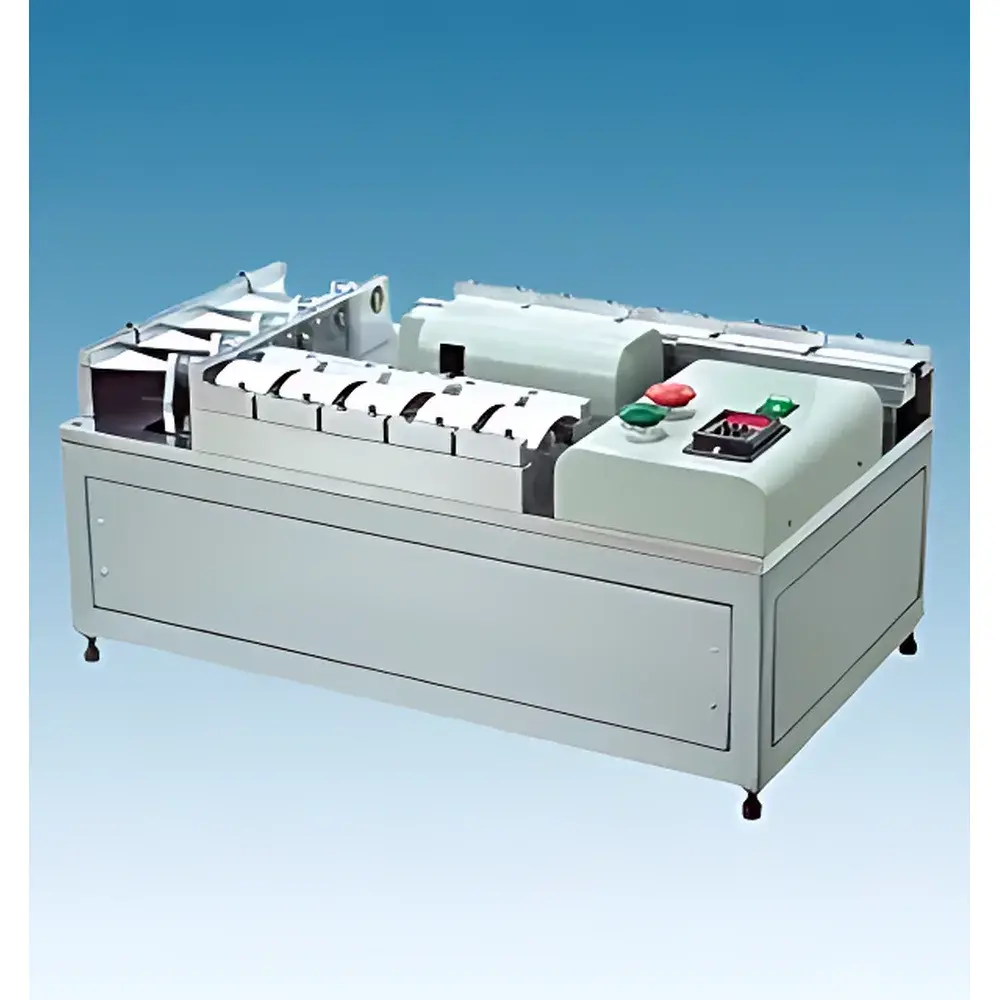
HY (IC) Intelligent Smart Card Dynamic Dual Bending-Torsion Tester
| Brand | Hengyi Test |
|---|---|
| Origin | Shanghai, China |
| Manufacturer Type | Direct Manufacturer |
| Country of Origin | China |
| Model | HY(IC)GYYUY |
| Pricing | Available Upon Request |
Overview
The HY (IC) Intelligent Smart Card Dynamic Dual Bending-Torsion Tester is an electromechanical test system engineered for precise, repeatable evaluation of mechanical durability in contact and contactless smart cards under standardized cyclic loading. It operates on the principle of controlled kinematic actuation—using synchronized stepper-driven mechanisms to impose defined bending displacements along card edges and torsional angular deflections about the card’s central axis. Designed in strict alignment with international conformance requirements—including ISO/IEC 7816-1:2013 (Physical Characteristics), ISO/IEC 10373-1:2016 (Test Methods for Identification Cards), and GB/T 16649.1–2016 (Identification Cards — Integrated Circuit(s) Cards)—this instrument delivers traceable, audit-ready performance for quality control laboratories, R&D centers, and certification bodies engaged in card validation workflows.
Key Features
- Fifteen independent test stations: five dedicated to long-edge bending, five to short-edge bending, and five to torsional deformation—enabling parallel execution of multiple test modes per cycle.
- Non-contact optical counting system with 9999-cycle capacity, eliminating mechanical switch wear and reducing failure probability to near-zero (<0.01% MTBF).
- Adjustable displacement and angular parameters: long-edge deflection range 2–20 mm (±0.5 mm tolerance); short-edge deflection 1–10 mm (±0.5 mm); torsional amplitude ±15° (±1° accuracy), bidirectional, with total twist angle up to 30° over d = 86 mm baseline.
- Precision motion control via STK AC speed-regulated motor and high-ratio gear reduction system, ensuring stable 0.5 Hz (30 rpm) operation across all test modes.
- Compliance-grade fixture geometry: all clamping dimensions conform exactly to ISO/IEC 7816-1 Annex A and GB/T 17554.1–2006 Clause 6.2 specifications.
- Low-power architecture: rated at 35 W nominal consumption; operates on standard AC220 V ±5%, suitable for integration into regulated lab environments without auxiliary power conditioning.
Sample Compatibility & Compliance
The tester accommodates standard ISO/IEC 7816-form factor cards (85.6 × 53.98 × 0.76 mm), including magnetic stripe cards, contact IC cards (e.g., EMV-compliant payment cards), contactless RFID cards (13.56 MHz), and hybrid dual-interface cards. All test protocols adhere to clause-referenced procedures in ISO/IEC 10373-1 Section 9 (Bending Resistance) and Section 10 (Torsion Resistance), as well as GB/T 16649.1 Annex B and GB/T 17554.1–2006 Clause 7. Data output supports GLP-compliant documentation: timestamped cycle logs, pass/fail flags per station, and operator ID tagging when integrated with external LIMS or ELN systems.
Software & Data Management
While the base unit operates via embedded firmware with front-panel keypad and LED display, optional RS-232 or USB-to-serial interface enables integration with host PC applications for automated reporting. Exported data includes cumulative cycle counts per station, elapsed time, and status codes—all structured in CSV format for compatibility with statistical process control (SPC) tools. The system supports 21 CFR Part 11–compliant audit trails when deployed with validated third-party software, fulfilling GMP-aligned record retention requirements for medical device or financial transaction card manufacturers undergoing FDA or CB certification audits.
Applications
- Pre-certification mechanical stress screening for EMV Level 1 and Level 2 card submissions.
- Comparative fatigue analysis of substrate materials (PVC, PET-G, polycarbonate) under repeated flexural loading.
- Validation of antenna loop integrity in contactless cards after torsional deformation cycles.
- Reliability benchmarking for chip embedding adhesives and laminate bonding strength.
- Supporting root-cause investigations of field failures linked to mechanical degradation (e.g., delamination, solder joint fracture, antenna discontinuity).
FAQ
Does this tester support automatic pass/fail judgment based on cycle count thresholds?
Yes—each station independently records completion of user-defined cycle targets (1–9999), and the system halts all motion upon reaching the set value. Visual LED indicators per station confirm termination status.
Can the bending displacement be calibrated in real time during testing?
Displacement is pre-set mechanically via precision-adjustable cam profiles; no in-situ recalibration is required. Calibration certificates for displacement and angular repeatability are provided with each unit.
Is the fixture design compatible with non-standard card sizes?
Standard fixtures comply exclusively with ISO/IEC 7816-1. Custom fixture sets for non-standard formats (e.g., mini-SIM, microSD form factors) are available under engineering services agreement.
What maintenance intervals are recommended for the optical counting system?
No scheduled maintenance is required—the solid-state photoelectric sensor has no moving parts and is rated for >10⁶ operational cycles without drift or recalibration.
How is compliance with ISO/IEC 10373-1 verified during factory acceptance testing?
Each unit undergoes full FAT per Clause 9.3 and 10.3, including traceable verification of displacement amplitude, torsional angle, cycle timing, and inter-station synchronization using NIST-traceable laser displacement sensors and rotary encoders.
Related Products



