
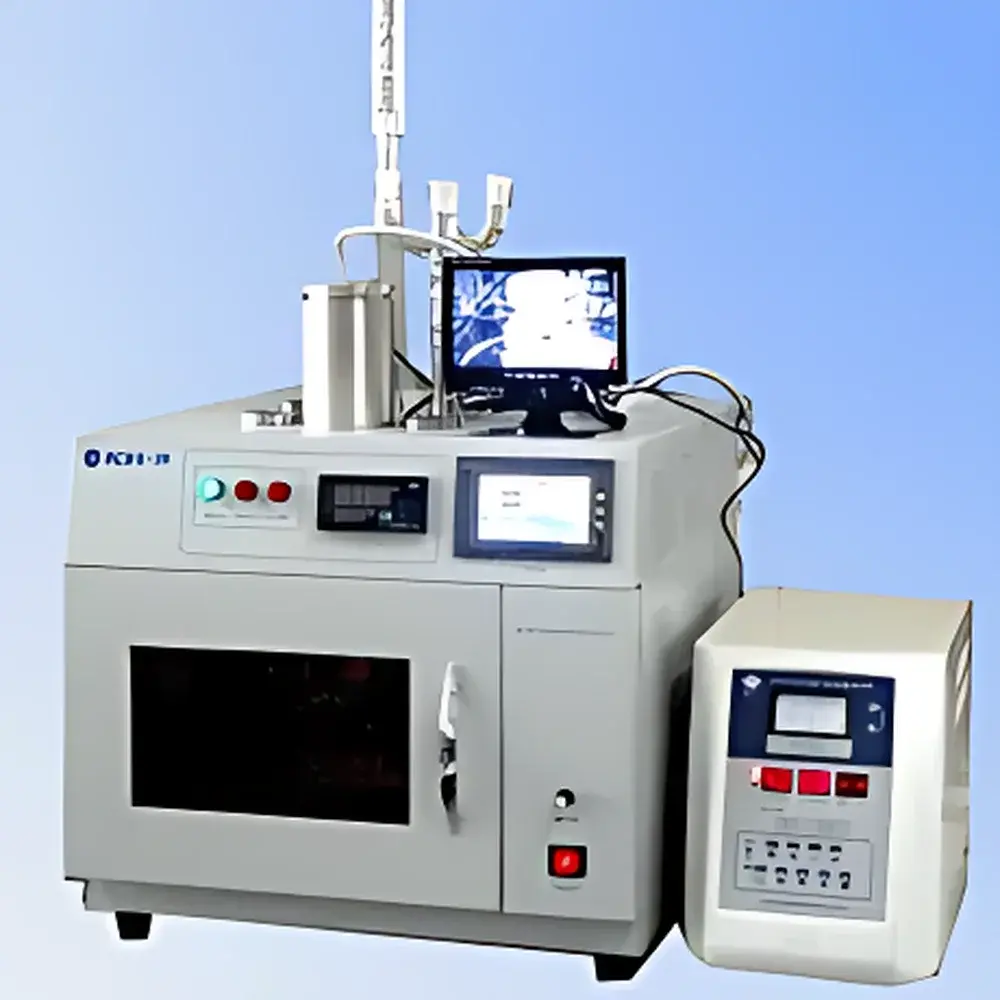
HyYan MC8S-3 Tri-Functional Microwave-Ultrasound-UV Reaction System
| Brand | HyYan |
|---|---|
| Origin | Jiangsu, China |
| Model | MC8S-3 |
| Temperature Range | 0–300 °C |
| Pressure Condition | Ambient (Open-Vessel Operation) |
| Microwave Power | 0–1000 W (continuous, linearly adjustable) |
| Microwave Frequency | 2.45 GHz ± 50 MHz |
| Ultrasonic Power | 0–900 W (submersible transducer) |
| Ultrasonic Frequency | 25 kHz (auto-frequency tracking) |
| UV Wavelength | 365 nm |
| UV Power | 250 W |
| Stirring | Adjustable Magnetic Stirring |
| Reaction Volume Capacity | 10–1000 mL |
| Cavity Material | Stainless Steel |
| Safety Compliance | Meets GB 10436 (Chinese Microwave Leakage Standard) |
| Interface | RS-485 (MODBUS RTU), VGA video output, touchscreen HMI |
Overview
The HyYan MC8S-3 Tri-Functional Microwave-Ultrasound-UV Reaction System is an integrated benchtop platform engineered for advanced synthetic chemistry, catalytic material processing, and analytical sample preparation under controlled multimodal energy input. It combines three distinct physical activation mechanisms—microwave dielectric heating (2.45 GHz), high-intensity ultrasonic cavitation (25 kHz, submersible transducer), and near-UV photonic excitation (365 nm)—within a single, open-vessel stainless steel reaction cavity. Unlike sealed-vessel microwave synthesizers, the MC8S-3 operates under ambient pressure with a fully accessible top aperture configuration, enabling direct integration of standard laboratory glassware (e.g., reflux condensers, gas inlets, thermocouple ports, or mechanical stirrers) without compromising electromagnetic safety. Its core architecture leverages real-time closed-loop temperature control via a calibrated contact-type Pt100 sensor (±1 °C accuracy over 0–300 °C), coupled with fuzzy logic–based dynamic microwave power modulation to maintain thermal stability across variable load conditions. The system is designed for reproducible, scalable method development in academic research labs, industrial R&D centers, and regulatory-compliant QA/QC environments where parallel energy coupling and operational flexibility are essential.
Key Features
- Tri-modal energy delivery: Independent or synergistic operation of microwave (0–1000 W, non-pulsed linear control), ultrasound (0–900 W, 25 kHz, auto-tracking submersible transducer), and UV irradiation (250 W, 365 nm)
- Open-cavity design with three waveguide-protected apertures on the top plate—enabling simultaneous installation of condensers, gas manifolds, cooling lines, or ultrasonic probes without microwave leakage (verified per GB 10436)
- Industrial-grade 7-inch color TFT touchscreen HMI with native Chinese interface; supports parameter programming, multi-step protocols, and real-time reaction visualization via optional external video capture
- Embedded microcontroller with MODBUS RTU over RS-485 for integration into centralized lab automation systems or SCADA networks
- Dual-safety architecture: Interlocked door switch, magnetron overtemperature cutoff, and redundant cavity shielding ensure compliance with occupational EMF exposure limits
- Magnetic stirring (0–1200 rpm, continuously adjustable) co-located within the cavity for homogeneous mixing during multimodal irradiation
Sample Compatibility & Compliance
The MC8S-3 accommodates standard borosilicate glass reaction vessels (10–1000 mL), including round-bottom flasks, jacketed reactors, and custom-fitted UV-transparent quartz cells. Its ambient-pressure configuration eliminates constraints associated with pressurized microwave digestion systems, making it suitable for volatile solvents, air-sensitive substrates (under inert gas purge), and heterogeneous slurries. The system meets national electromagnetic safety requirements (GB 10436) and conforms to general laboratory equipment standards for electrical safety (IEC 61010-1). While not certified to ISO/IEC 17025 or GLP/GMP out-of-the-box, its audit-ready data logging (via optional software), timestamped parameter records, and user-accessible calibration logs support validation pathways for regulated applications such as catalyst screening, polymer synthesis, or botanical extraction under internal SOPs.
Software & Data Management
The onboard control firmware stores up to 100 user-defined reaction methods with segmented time–power–temperature profiles. All operational parameters—including microwave output, ultrasonic amplitude, UV intensity, measured temperature, and stirring speed—are logged at 1-second intervals and exportable via USB or RS-485 to CSV or Excel-compatible formats. Optional HyYan LabLink software (Windows-based) provides remote monitoring, real-time graphing, and batch report generation compliant with basic ALCOA+ principles (Attributable, Legible, Contemporaneous, Original, Accurate). Though not FDA 21 CFR Part 11–validated, the system supports electronic signature–enabled user authentication and change-controlled method libraries when deployed behind institutional IT governance frameworks.
Applications
- Catalytic organic synthesis: Accelerated Suzuki, Heck, and Ullmann couplings under combined microwave–ultrasound activation
- Nanomaterial synthesis: Controlled nucleation and growth of metal oxides (e.g., TiO₂, ZnO) via UV-assisted photocatalytic reduction
- Natural product extraction: Enhanced mass transfer in plant matrix disruption using ultrasonic cavitation synchronized with microwave thermal penetration
- Environmental sample pretreatment: Oxidative degradation of persistent organics (e.g., phenols, dyes) via UV/H₂O₂–microwave synergy
- Materials crosslinking: Rapid curing of photo-thermo-responsive polymers in open-air configurations
- Method scouting & optimization: High-throughput parameter space mapping for reaction yield, selectivity, and byproduct formation
FAQ
Can the MC8S-3 be used for microwave-assisted digestion?
Yes—when equipped with optional temperature-controlled microwave digestion vessels (sold separately), the system supports open-vessel or semi-closed digestion protocols with automatic power modulation based on internal vessel temperature feedback.
Is UV light output adjustable?
The 365 nm UV lamp operates at fixed 250 W output; intensity modulation is achieved via duty-cycle control or external neutral density filters—not built-in dimming.
What is the maximum recommended ultrasonic probe immersion depth?
For optimal cavitation efficiency and transducer longevity, immersion depth should be maintained between 20–50 mm below the liquid surface; excessive depth may attenuate acoustic energy transmission.
Does the system support external temperature sensors?
Only the integrated Pt100 contact sensor is used for closed-loop temperature control; auxiliary thermocouples may be installed for monitoring but do not feed into the regulation algorithm.
How is microwave leakage prevented during open-aperture operation?
Each of the three top apertures incorporates a quarter-wavelength choke structure (microwave cutoff waveguide), suppressing >99.99% of 2.45 GHz radiation beyond the cavity boundary—verified by field mapping per GB 10436.



