ICDD PDF-4+ Powder Diffraction Database
| Brand | Rigaku |
|---|---|
| Origin | USA |
| Distributor Type | Authorized Distributor |
| Import Status | Imported |
| Model | PDF-4+ |
| Pricing | Available Upon Request |
Overview
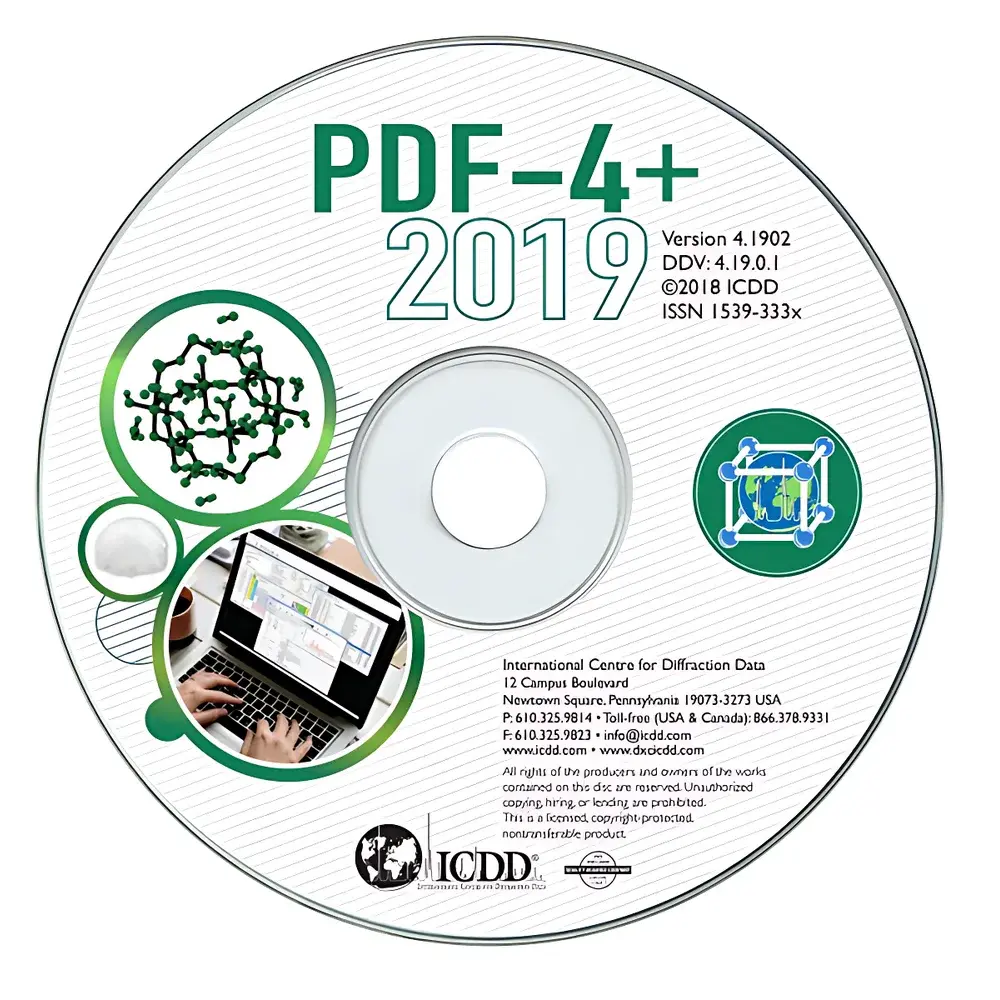
The ICDD PDF-4+ Powder Diffraction Database is a comprehensive, peer-reviewed, and continuously curated collection of experimentally measured and computationally derived X-ray powder diffraction patterns for crystalline materials. Developed and maintained by the International Centre for Diffraction Data (ICDD), a non-profit scientific organization headquartered in Newtown Square, Pennsylvania, USA, the PDF-4+ serves as the globally recognized reference standard for qualitative and semi-quantitative phase identification in X-ray diffraction (XRD) analysis. It operates on the fundamental principle that each crystalline phase produces a unique diffraction fingerprint—defined by d-spacings, relative intensities, Miller indices, crystal system, space group, and unit cell parameters—which enables unambiguous identification when matched against experimental diffractograms. As a foundational resource for materials science, geology, pharmaceuticals, catalysis, and quality control laboratories, PDF-4+ supports rigorous scientific interpretation in compliance with ASTM E1426, ISO 17853, and ICH Q5A guidelines for structural characterization.
Key Features
- Comprehensive coverage: 254,873 entries—including inorganic compounds (228,586), organics and organometallics (218,194 in PDF-4+/Organics), and minerals (17,744 in PDF-4+/Minerals)—with cross-referenced metadata and bibliographic links to original publications.
- Multi-source integration: Combines ICDD-curated data with contributions from FIZ Karlsruhe (Germany), NIST (USA), MPDS (Materials Platform for Data Science), and CCDC (Cambridge Crystallographic Data Centre), ensuring broad structural diversity and methodological traceability.
- Enhanced search functionality: Supports multi-parameter queries—including chemical formula, element composition, d-spacing ranges, intensity thresholds, symmetry constraints, and Rietveld refinement flags—enabling precise filtering for complex mixtures.
- Standardized data format: All entries conform to the ICDD’s internal validation protocol, including consistency checks for lattice parameters, systematic absences, and intensity normalization against Si NIST SRM 640e.
- Annual updates: Released each calendar year with ≥1,000 new entries, plus corrections and deprecations based on re-evaluation of legacy cards against modern measurement standards.
Sample Compatibility & Compliance
The PDF-4+ database is agnostic to instrumentation and fully compatible with all major XRD platforms—including Rigaku, PANalytical (Malvern Panalytical), Bruker AXS, and Thermo Fisher Scientific systems—when used with ICDD-licensed software interfaces. It supports both laboratory-based Cu-Kα and synchrotron-based measurements across 2θ ranges from 5° to 120°, with d-spacing resolution down to 0.001 Å. All entries are validated against international metrological standards and support GLP/GMP-compliant workflows. The database structure and metadata schema comply with ISO/IEC 17025 requirements for reference material traceability and are routinely audited during FDA 21 CFR Part 11–enabled implementations in regulated pharmaceutical environments.
Software & Data Management
PDF-4+ requires licensed ICDD software for full functionality: DDView+ (for basic search, visualization, and report generation) or DDView+Sieve (for advanced pattern matching, peak overlap resolution, and batch processing). Both applications provide audit-trail logging, user-access controls, and export options compliant with LIMS integration (CSV, CIF, XML). Data files are delivered on encrypted USB drives or via secure ICDD portal download, with SHA-256 checksum verification. Version history, update logs, and change documentation are maintained per ISO 9001:2015 configuration management protocols. No cloud-hosted or SaaS deployment is offered; local installation ensures data sovereignty and alignment with institutional IT security policies.
Applications
- Phase identification in unknown polycrystalline samples across metallurgy, ceramics, battery materials, and additive manufacturing feedstocks.
- Quantitative phase analysis (QPA) using Rietveld refinement when paired with GSAS-II or TOPAS software.
- Validation of synthetic outcomes in solid-state chemistry and MOF development.
- Regulatory submissions requiring structural confirmation (e.g., USP , EP 2.9.32) for drug substance and excipient characterization.
- Petrographic analysis of geological specimens and industrial slags via mineral-specific sub-databases.
- Failure analysis in electronics packaging, where intermetallic compound formation must be identified at trace levels.
FAQ
Is PDF-4+ compatible with my existing XRD instrument and software?
Yes—PDF-4+ is instrument-agnostic and integrates natively with all major XRD data acquisition packages via standardized .cif and .pdf file imports. Rigaku SmartLab, PANalytical Empyrean, and Bruker D2 PHASER systems support direct linkage through ICDD-certified drivers.
Does ICDD provide technical support for database usage?
ICDD offers tiered support: email-based assistance for licensing and installation, plus optional paid training workshops on advanced search strategies and Rietveld integration.
Can PDF-4+ be used for quantitative analysis without additional software?
No—while PDF-4+ provides reference intensities and structural parameters essential for quantification, full Rietveld or whole-pattern fitting requires third-party refinement software such as GSAS-II, TOPAS, or HighScore Plus.
How frequently is the database updated, and how are updates delivered?
Annual releases occur each December; subscribers receive automated notifications and downloadable update packages with version-controlled changelogs and backward-compatible file structures.
Is PDF-4+ accepted by regulatory agencies for GMP documentation?
Yes—when deployed with audit-trail-enabled software (e.g., DDView+Sieve under 21 CFR Part 11 configuration), PDF-4+ meets evidentiary requirements for phase identification in FDA, EMA, and PMDA submissions.
Related Products