
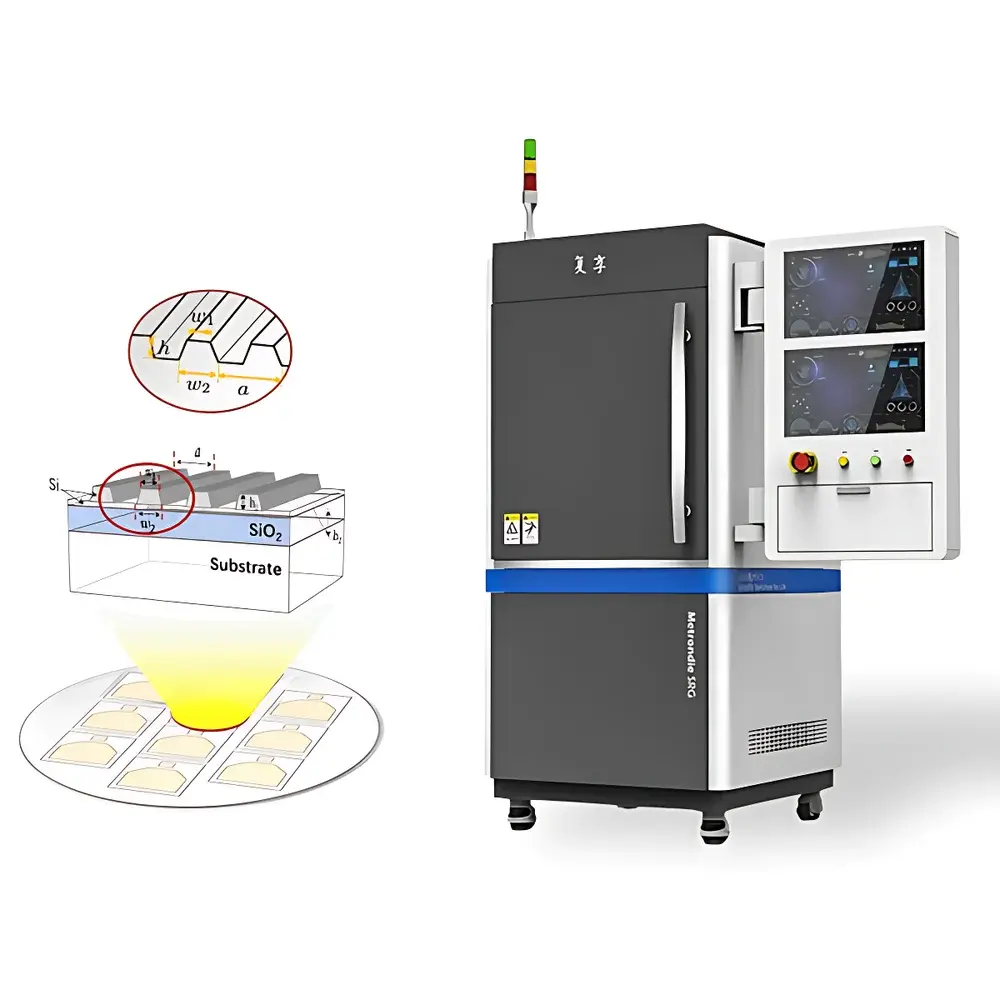
IdeaOptics Metrondie-SRG Wafer-Level Diffractive Waveguide Optical Metrology System
| Brand | IdeaOptics |
|---|---|
| Origin | Shanghai, China |
| Manufacturer Type | Original Equipment Manufacturer (OEM) |
| Country of Origin | China |
| Model | Metrondie-SRG |
| Pricing | Available upon Request |
Overview
The IdeaOptics Metrondie-SRG Wafer-Level Diffractive Waveguide Optical Metrology System is a purpose-built, non-destructive optical characterization platform engineered for high-throughput metrology of diffractive optical elements (DOEs) fabricated on silicon, glass, or polymer wafers. It operates on the physical principle of angle-resolved spectroscopic reflectometry—combining broadband spectral illumination (typically 400–1000 nm), precision goniometric angular scanning, and high-fidelity CCD detection to resolve diffraction orders as functions of both incident angle and wavelength. This enables direct quantification of key grating performance parameters—including diffraction efficiency spectra across multiple orders, pitch (period), sidewall profile, duty cycle, depth, and orientation—without physical contact or sample modification. Designed for integration into photonic device R&D labs and pilot-line manufacturing environments, the system supports traceable, repeatable measurements aligned with international standards for optical thin-film and microstructure metrology (e.g., ISO/IEC 17025, ASTM E284, and VDI/VDE 2634 Part 2).
Key Features
- Angle-resolved spectroscopic measurement capability spanning −70° to +70° incidence angle with angular resolution better than 0.02° and repeatability ≤ ±0.01°
- Wafer-scale compatibility: motorized stage supports full-field mapping of 4-inch, 6-inch, 8-inch, and 12-inch wafers with automated alignment and pattern-based ROI navigation
- Four-axis high-precision motion control: X/Y/Z translation with ≤ 1 µm spatial resolution; θ-rotation axis with ≤ 1 arcsecond angular positioning accuracy
- AI-enhanced inverse modeling engine integrating physics-based optical simulation (RCWA or FDTD-derived libraries), deep learning-assisted parameter extraction, and real-time library search for rapid profile reconstruction
- Traceable calibration architecture incorporating NIST-traceable reference gratings and certified standard artifacts for periodicity and depth verification
- Modular optical design accommodating optional polarization-resolved, time-resolved, or hyperspectral extension modules
Sample Compatibility & Compliance
The Metrondie-SRG accommodates planar and slightly curved substrates including fused silica, BK7, sapphire, silicon, and UV-curable polymer wafers with thicknesses from 0.3 mm to 2.0 mm. It supports both binary and multi-level surface-relief gratings, slanted gratings, and sub-wavelength nanostructured waveguides. Measurement protocols are compatible with GLP-compliant workflows and support audit trails, electronic signatures, and data integrity features required under FDA 21 CFR Part 11 when deployed in regulated photonic device manufacturing. All hardware and software components conform to CE, RoHS, and IEC 61000-6-3 electromagnetic compatibility directives.
Software & Data Management
The system is operated via IdeaOptics’ proprietary MetroStudio™ software suite—a Windows-based application built on Qt and Python with native support for HDF5 and TIFF export formats. MetroStudio provides full experimental scripting (via Python API), batch processing of wafer maps, statistical process control (SPC) charting, and cross-platform data exchange with MATLAB, Python (NumPy/SciPy), and industry-standard CAD tools (e.g., KLayout, L-Edit). Raw spectral-angular datasets are stored with embedded metadata (timestamp, instrument configuration, calibration ID, user credentials), enabling full traceability. Software validation documentation (IQ/OQ/PQ protocols) and source code audit logs are available for GMP-regulated deployments.
Applications
- Diffractive efficiency mapping across Littrow, blazing, and off-plane configurations for AR/VR waveguide combiners
- Pitch and overlay metrology for lithographic process control in nanoimprint and EUV patterning lines
- 3D topography reconstruction of etched grating profiles (e.g., trapezoidal, sinusoidal, blazed) without AFM or SEM cross-sectioning
- Orientation uniformity assessment across wafer fields to detect rotation drift in stepper alignment systems
- Process window qualification for reactive ion etching (RIE) and atomic layer deposition (ALD) steps in grating fabrication
- Qualification of metasurface and photonic crystal slab devices requiring sub-10 nm period stability monitoring
FAQ
What wafer sizes does the Metrondie-SRG support?
The system accommodates 4-inch, 6-inch, 8-inch, and 12-inch wafers using interchangeable vacuum chucks and auto-centering routines.
Is the system capable of measuring buried or multilayer grating structures?
Yes—through coherent interferometric analysis and phase-sensitive spectral deconvolution, it resolves effective optical thickness and interfacial roughness in stacked waveguide architectures.
How is traceability ensured for period measurements?
Calibration is performed against NIST-traceable line-scale standards and certified master gratings with certified uncertainties < ±0.15 nm (k=2), documented per ISO/IEC 17025.
Can the software integrate with factory MES or SECS/GEM interfaces?
MetroStudio supports OPC UA and RESTful API connectivity for bidirectional data exchange with MES, SPC, and CIM platforms.
Does the system require external vibration isolation?
While not mandatory, operation on an active or passive optical table is recommended for sub-arcsecond angular stability during long-duration mapping sequences.




