
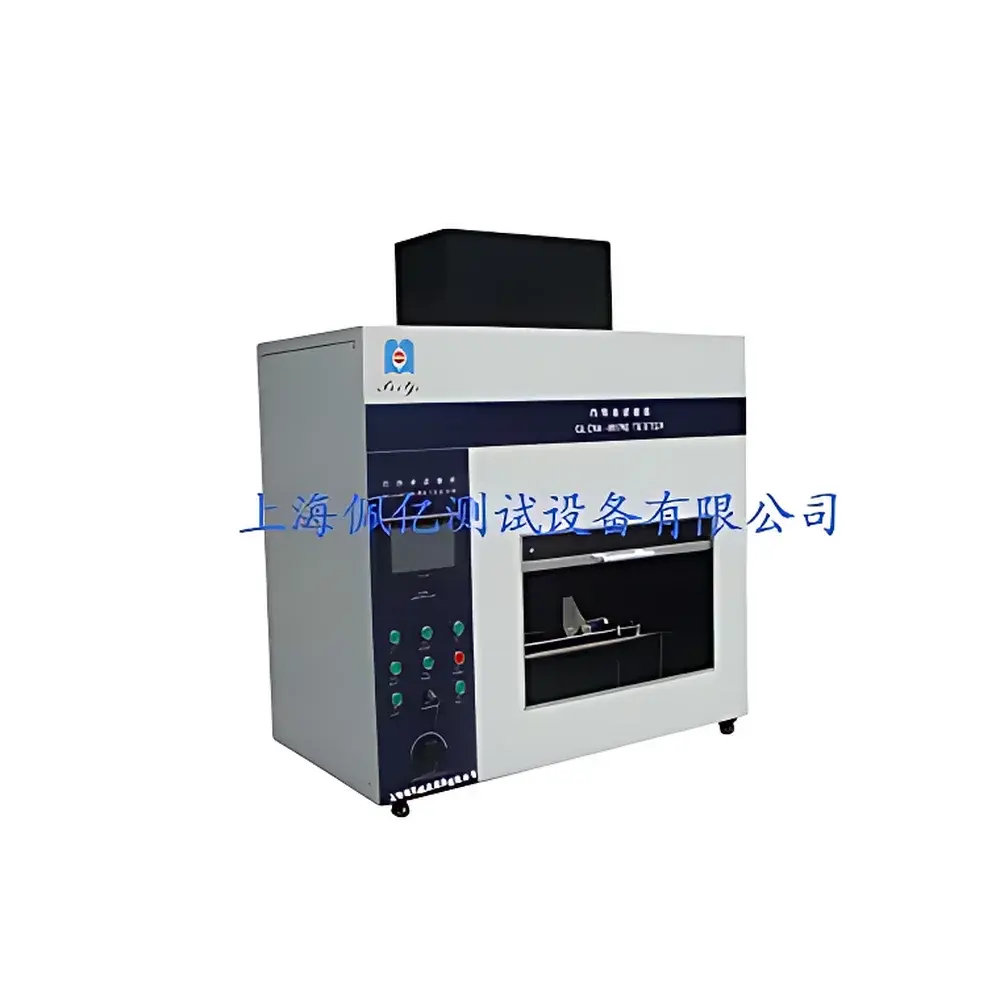
Peiyi PY-ZRS08 Glow-Wire Test Apparatus
| Brand | Peiyi |
|---|---|
| Origin | Shanghai, China |
| Manufacturer Type | Authorized Distributor |
| Country of Origin | China |
| Model | PY-ZRS08 |
| Price | USD 2,250 (FOB Shanghai) |
| Dimensions (W×D×H) | 1120 × 600 × 1020 mm |
| Glow Wire Diameter | Φ4.0 mm Ni/Cr (80/20) alloy |
| Thermocouple | Φ0.5 mm K-type |
| Temperature Range | 50 °C to 1050 °C |
| Test Load | 1.0 N ± 0.1 N |
| Specimen Feed Speed | 10–25 mm/s (user-adjustable via controller) |
| Application Time | 0.01–99.99 s (programmable) |
| Ignition Time (Ti) | 0.01–99.99 s |
| Flame Duration (Te) | 0.01–99.99 s |
| Control System | Industrial PLC + digital display interface |
| Actuation | Stepper motor-driven precise positioning |
| Fixture Material | 304 stainless steel |
| Viewing Window | Tempered safety glass |
| Timing Function | Single-button start with automatic event logging |
Overview
The Peiyi PY-ZRS08 Glow-Wire Test Apparatus is a precision-engineered instrument designed for evaluating the ignition resistance and flame propagation behavior of non-metallic materials used in electrical and electronic equipment housings, insulators, and structural components. It operates on the principle of simulating thermal stress induced by overheated conductive parts under fault conditions—specifically replicating the glow-wire test method defined in IEC 60695-2-10:2013 and its harmonized national standards including GB/T 5169.10–5169.13 and UL 746A. Unlike open-flame ignition sources, the glow-wire technique applies controlled radiant heat via a calibrated Ni/Cr alloy wire heated to a specified temperature, eliminating combustion variability and enabling repeatable assessment of material flammability thresholds.
Key Features
- Industrial-grade programmable logic controller (PLC) integrated with high-resolution digital display for real-time monitoring of temperature, application time, ignition time (Ti), and flame duration (Te)
- Precise stepper motor-driven specimen positioning system ensuring consistent 1.0 N ± 0.1 N contact force and linear feed speed (10–25 mm/s) across all test cycles
- Calibrated Φ4.0 mm Ni/Cr (80/20) glow wire with traceable K-type thermocouple (Φ0.5 mm) embedded at the tip for direct, high-fidelity temperature measurement and closed-loop PID control
- Wide operational temperature range from 50 °C to 1050 °C with ±2 °C accuracy at setpoints ≥ 550 °C, meeting tolerance requirements per IEC 60695-2-10 Annex A
- Dedicated 304 stainless steel specimen holder assembly engineered for dimensional stability, corrosion resistance, and compliance with sample mounting geometry per Clause 7.2 of GB/T 5169.10
- Tempered glass observation window rated to withstand thermal shock up to 1050 °C, enabling safe visual confirmation of ignition events without interrupting test continuity
- One-touch timing initiation with automatic timestamping of Ti and Te; all parameters stored locally with optional USB export for audit-ready reporting
Sample Compatibility & Compliance
The PY-ZRS08 accommodates flat, rigid specimens measuring 10 mm × 10 mm × 0.5–12 mm thick, conforming to dimensional tolerances specified in IEC 60695-2-10 Section 6.2. It supports both horizontal and vertical orientation testing per GB/T 5169.11 and GB/T 5169.12 procedures. The apparatus meets mechanical and metrological requirements outlined in ISO/IEC 17025:2017 for test equipment validation and is routinely verified against reference materials per ASTM D635 and UL 746A Annex B. Its design aligns with functional safety expectations for laboratories operating under GLP or ISO 9001 quality management systems. Full traceability documentation—including calibration certificates for thermocouples and load cells—is provided with each unit shipment.
Software & Data Management
While the PY-ZRS08 operates as a standalone benchtop instrument with embedded PLC logic, it supports data integrity protocols essential for regulated environments. All test parameters—including setpoint temperature, applied force, dwell time, Ti, and Te—are logged with millisecond resolution and time-stamped using an internal RTC (real-time clock). Event logs are exportable via USB flash drive in CSV format, preserving raw values without post-processing. For laboratories requiring 21 CFR Part 11 compliance, optional firmware upgrades enable user authentication, electronic signatures, and audit trail generation—fully compatible with LIMS integration through RS-232 or Ethernet interfaces (available upon request). Calibration history and maintenance records can be appended directly to test reports to satisfy internal QA review cycles.
Applications
- Flammability screening of thermoplastics, thermosets, laminates, and composite substrates used in consumer electronics enclosures
- Qualification testing of insulating materials per IEC 60335-1 and GB 4706.1 for household appliance certification
- Material development support for automotive interior components subject to UNECE R118 or FMVSS 302 equivalency assessments
- Third-party laboratory verification for CE marking under the Low Voltage Directive (2014/35/EU) and RoHS-compliant material declarations
- Internal R&D evaluation of halogen-free flame retardant formulations targeting GWIT (Glow-Wire Ignition Temperature) and GWFI (Glow-Wire Flammability Index) performance targets
FAQ
What standards does the PY-ZRS08 fully support?
The instrument complies with IEC 60695-2-10:2013, GB/T 5169.10–5169.13, UL 746A, DIN VDE 0471, and ASTM D635 for comparative tracking index (CTI)-related thermal stress simulation.
Is temperature calibration traceable to national standards?
Yes—each unit ships with a factory calibration certificate referencing NIM (National Institute of Metrology, China) traceable standards; annual recalibration services are available through authorized Peiyi service centers.
Can the apparatus be integrated into an automated test line?
Standard configuration includes RS-232 and dry-contact I/O ports for external trigger synchronization and pass/fail signal output; custom EtherNet/IP or Modbus TCP modules are available for industrial automation deployment.
What maintenance intervals are recommended?
Glow wire replacement every 200 test cycles or when visible oxidation exceeds 10% surface area; thermocouple verification every 6 months; full mechanical inspection annually per ISO/IEC 17025 Clause 6.4.10.



