
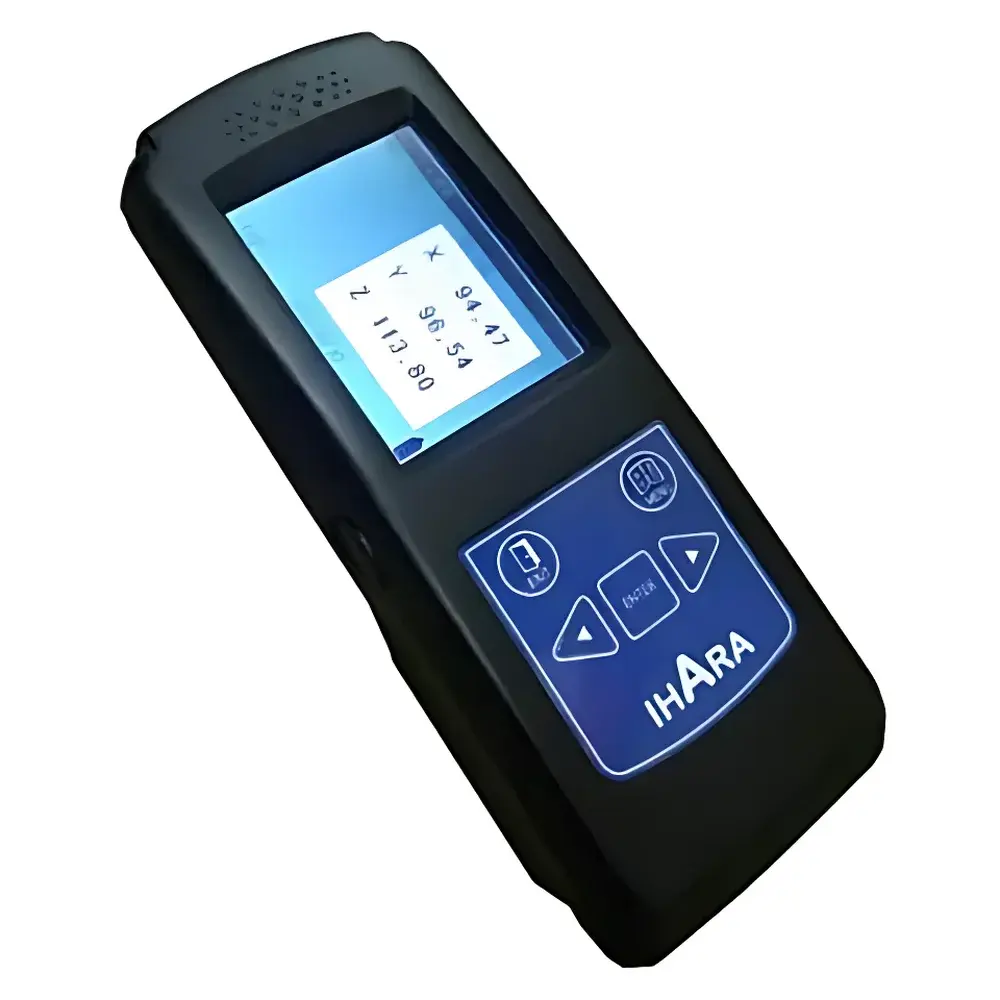
Ihara Electronic S300 Portable Spectrophotometric Colorimeter & Densitometer
| Brand | Ihara Electronic |
|---|---|
| Origin | Japan |
| Model | S300 |
| Product Type | Spectrophotometric Colorimeter |
| Instrument Type | Portable |
| Optical Geometry | 45/0° (Annular Illumination) |
| Light Source | LED |
| Spectral Range | 400–700 nm |
| Measurement Aperture | φ10 mm, φ3 mm |
| Standard Compliance | JIS Z8722, ISO 7724, DIN 5033/5036/6174, ASTM D2244/E308/E1164, JIS K7654, ISO 5/4, ANSI PH2.17, DIN 16536 |
| Observer Angle | 2°, 10° |
| Measurement Time | ~1 s |
| Display Language | Japanese, English |
| Communication Interface | USB, RS-232C |
Overview
The Ihara Electronic S300 is a compact, handheld spectrophotometric colorimeter and densitometer engineered for high-precision optical measurement in industrial quality control, printing, paint, plastics, and textile laboratories. Operating on the 45/0° annular illumination geometry—standardized under ISO 7724-1 and JIS Z8722—the instrument ensures consistent, geometry-insensitive reflectance measurement by eliminating directional bias from surface texture or gloss. Its solid-state LED light source delivers stable, repeatable spectral output across the visible range (400–700 nm), with no warm-up time and minimal photometric drift over extended operation. The dual-aperture design (φ3 mm and φ10 mm) enables flexible sampling of both fine-detail features (e.g., printed halftone dots, small batch samples) and larger uniform areas, supporting traceable color evaluation aligned with CIE 1931 and CIE 1964 standard observer functions.
Key Features
- Integrated spectrophotometric and densitometric functionality in a single portable platform
- 45/0° optical geometry with annular illumination for robust suppression of specular reflection and gloss influence
- Dual measurement apertures (φ3 mm and φ10 mm) with automatic aperture recognition
- Full-spectrum acquisition (400–700 nm) at <1 nm nominal resolution, enabling calculation of all major color spaces and metrics
- Comprehensive colorimetric outputs: CIE XYZ, Yxy, CIELAB (L*a*b*), CIELCH (L*C*h*), CIELUV (L*u*v*), Hunter Lab, Whiteness (5 methods), Yellowness (2 methods)
- Advanced color difference computation: ΔE*ab, ΔECMC (l:c = 2:1), ΔE94, ΔE00, ΔEuv, ΔEHunter, ΔEFMC2
- Densitometric modes compliant with ISO Status T, E, A, I and DIN Wide/Narrow filters for reflective density measurement
- CMYK concentration, dot gain, screen percentage, and concentration delta reporting per ISO 2846-1 and ISO 12647-2
- Pass/fail judgment with user-definable tolerance thresholds and visual feedback
- On-device L*a*b* vector graphing for trend analysis and chromaticity deviation visualization
Sample Compatibility & Compliance
The S300 accommodates opaque, translucent, and textured solid samples—including coated paper, plastic films, metallic finishes, and powder coatings—without requiring external calibration tiles for routine use. Its 45/0° configuration meets the geometric requirements of ASTM D2244 for color difference assessment and ISO 12647-2 for process control in offset lithography. All color calculations adhere to CIE publication conventions and are traceable to NIST-traceable reference standards via factory calibration certificates. The instrument supports GLP-compliant operation through timestamped measurement logs, operator ID fields (via optional software), and audit-ready data export. Regulatory alignment includes compliance with FDA 21 CFR Part 11 when used with validated PC software for electronic records, and full conformance with ISO/IEC 17025 documentation requirements for accredited testing laboratories.
Software & Data Management
Data acquisition, analysis, and reporting are supported via Ihara’s proprietary Windows-based application (S300 Manager), which provides secure, encrypted local storage and configurable export formats (CSV, XLSX, PDF). The software enforces user-level access control, version-stamped calibration history, and full audit trails—including parameter changes, measurement deletions, and report generation events—satisfying 21 CFR Part 11 electronic signature and record retention criteria. Raw spectral data (31-point or interpolated 10-nm intervals) is retained alongside calculated values, enabling retrospective reprocessing using updated color formulas or observer functions. USB and RS-232C interfaces support integration into automated QA workflows, including PLC-triggered measurements and MES-linked pass/fail status transmission.
Applications
- Print production: Spot color verification, CMYK density profiling, dot gain analysis, press run consistency monitoring
- Pigment & coating formulation: Batch-to-batch color matching, metamerism screening, weathering stability tracking
- Plastics & polymers: Molding color consistency, additive dispersion uniformity, UV degradation assessment
- Food & packaging: Label color fidelity, substrate whiteness/yellowness specification, regulatory compliance (e.g., ISO 22197-2 for photocatalytic surfaces)
- Automotive interiors: Trim component color harmonization, leather and fabric batch release testing
- Academic research: Teaching CIE fundamentals, spectral reflectance modeling, multi-observer comparison studies
FAQ
Does the S300 require annual recalibration?
Yes. Ihara recommends annual factory recalibration against NIST-traceable ceramic standards to maintain measurement uncertainty within ±0.02 ΔE*ab for white tiles and ±0.04 ΔE*ab for colored references, as verified per ISO/IEC 17025 procedures.
Can the S300 measure transparent or liquid samples?
No. The S300 is designed exclusively for reflective solid and semi-solid samples. Transmission or transmittance measurements require dedicated instruments with integrating sphere geometry and collimated beam paths.
Is spectral data export supported?
Yes. Full 31-channel spectral reflectance data (at 10-nm intervals) and interpolated 1-nm datasets can be exported in ASCII format for third-party analysis in MATLAB, Python (NumPy/Pandas), or spectrophotometric modeling tools.
What is the measurement repeatability specification?
Under controlled conditions (23 °C ±2 °C, 50% RH ±5%), the S300 achieves ≤0.03 ΔE*ab (SD) for 20 consecutive readings on a stable white ceramic tile, per ISO 13655:2017 methodology.
Does the device support custom color tolerances per product line?
Yes. Up to 99 independent tolerance sets can be stored onboard, each defining unique ΔL*, Δa*, Δb*, and ΔE limits, along with pass/fail logic for individual color spaces and difference formulas.




