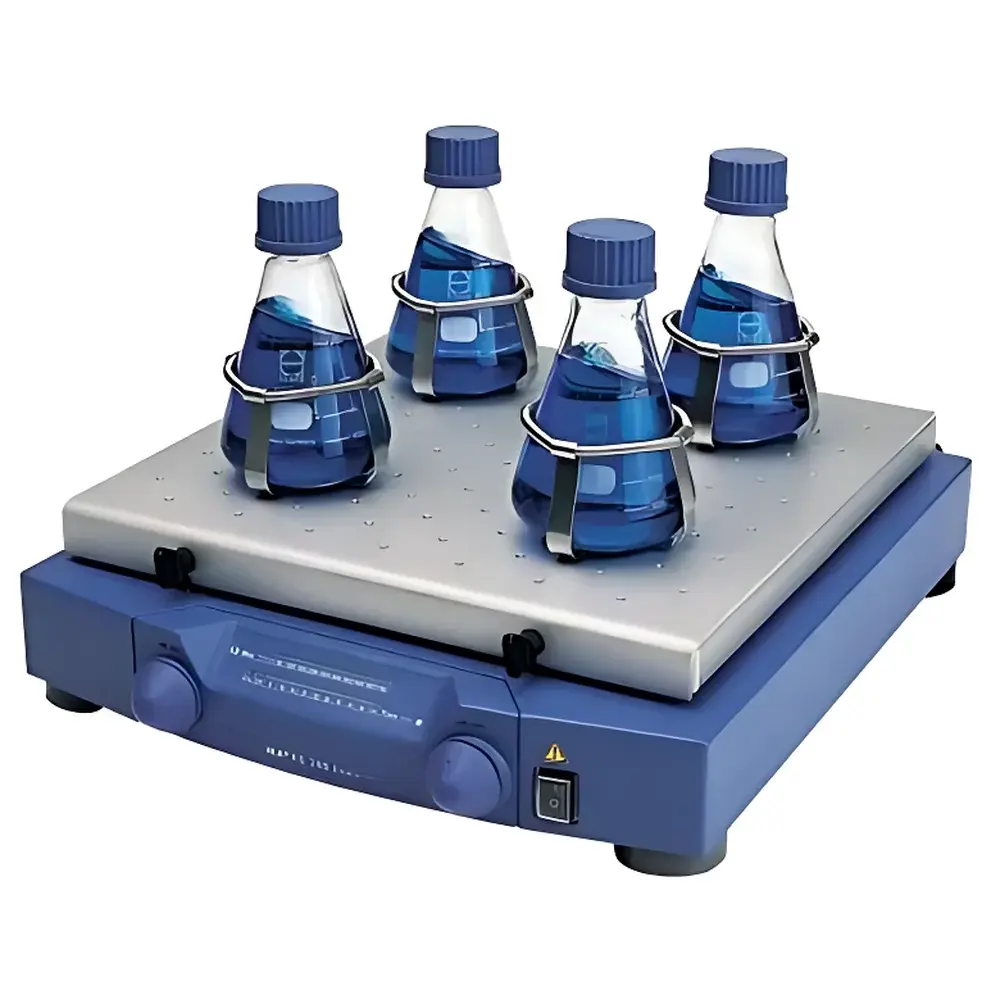
IKA KS260 & HS260 Series Orbital and Reciprocating Shakers
| Brand | IKA |
|---|---|
| Origin | Germany |
| Model | KS260 / HS260 |
| Timer Range | 1–599 min (KS260 control) / 5–50 min (KS260 basic, HS260 basic) / 9 h 50 min (HS260 control) |
| Oscillation Frequency | 10–500 rpm |
| Orbit Diameter | 10 mm (KS260), 20 mm (HS260) |
| Load Capacity | 7.5 kg |
| Temperature Range | 5–50 °C |
| Number of Platforms | 1 |
| Power Supply | 100–240 V, 50/60 Hz |
| IP Rating | IP21 |
| Interface | RS232 (KS260 control), Analog Output (KS260 control) |
| Software Compatibility | labworldsoft® |
Overview
The IKA KS260 and HS260 series represent two distinct platform shaker architectures engineered for precision and reproducibility in life science laboratories: the KS260 delivers orbital motion optimized for uniform suspension of cell cultures, microbial growth, and immunoassay plates, while the HS260 employs reciprocating motion ideal for gentle yet effective mixing of viscous samples, sediment resuspension, and hybridization protocols. Both platforms operate on a robust brushless DC motor architecture with electronic speed regulation, ensuring stable rotational dynamics across the full operating range (10–500 rpm for KS260; 10–300 rpm for HS260). Designed for continuous-duty operation (100% duty cycle), these shakers maintain thermal stability within ambient conditions of 5–50 °C and relative humidity up to 80%, complying with DIN EN 60529 (IP21 ingress protection). The standardized 360 × 98–100 × 420 mm footprint enables seamless integration into biosafety cabinets, cold rooms, and modular lab benches without spatial compromise.
Key Features
- Two motion modalities: orbital (KS260) and reciprocating (HS260), each supporting application-specific fluid dynamics and shear profiles
- Electronic speed and timer control with LED or LCD display depending on model variant (basic vs. control)
- Configurable operation modes: programmable timed cycles (1–599 min for KS260 control; up to 9 h 50 min for HS260 control) or continuous run mode
- Universal mounting interface compatible with IKA’s full range of interchangeable fixtures—including tube racks (1.5–50 mL), microplate clamps (96-/384-well), flask holders (up to 2 L), and custom adapter plates
- RS232 serial interface and analog output (KS260 control models only) for integration into centralized laboratory automation systems and LIMS environments
- labworldsoft® software compatibility enabling remote parameter configuration, multi-device synchronization, audit-trail logging, and export of timestamped operational metadata—supporting GLP/GMP-aligned documentation requirements
Sample Compatibility & Compliance
The KS260 and HS260 platforms accommodate diverse sample formats without mechanical adaptation: standard Erlenmeyer flasks (125–2000 mL), centrifuge tubes (15–50 mL), Petri dishes, deep-well plates, and PCR strip tubes are all supported via optional IKA-certified fixtures. Each fixture is engineered to minimize cross-contamination risk and ensure consistent amplitude transmission (10 mm orbit for KS260; 20 mm stroke for HS260). The devices conform to IEC 61010-1 safety standards for laboratory equipment and carry CE marking under the EU Machinery Directive. While not intrinsically temperature-controlled, their specified ambient operating range (5–50 °C) ensures compatibility with external incubators, cold rooms, and benchtop environmental chambers—making them suitable for ISO/IEC 17025-accredited testing workflows requiring documented environmental control.
Software & Data Management
The control variants (KS260 control, HS260 control) support bidirectional communication via RS232, enabling full parameter scripting and real-time status monitoring through IKA’s labworldsoft® suite. This software provides role-based user access, configurable alarm thresholds (e.g., speed deviation >±2 rpm), and automated generation of CSV-formatted operation logs—including start/stop timestamps, setpoints, actual values, and error codes. Audit trails meet FDA 21 CFR Part 11 requirements when deployed with validated system configurations, including electronic signatures and immutable record retention. Analog output (0–10 V) allows direct connection to PLCs or data acquisition systems for process validation in regulated bioprocessing environments.
Applications
These shakers serve critical functions across molecular biology, microbiology, immunology, and quality control labs. The KS260 orbital platform supports aerobic bacterial culture (e.g., E. coli in LB broth), yeast fermentation studies, ELISA plate washing steps, and solubility screening assays where laminar mixing minimizes foaming. The HS260 reciprocating platform is routinely used for DNA extraction buffer homogenization, tissue lysate preparation, antibody-antigen binding kinetics, and Western blot membrane blocking—where linear oscillation reduces shear-induced protein denaturation. Both models are referenced in ASTM D7348 (standard practice for microbial suspension preparation) and ISO 8665 (laboratory shaker performance specifications).
FAQ
Are clamps and fixtures included with the KS260 or HS260?
No—clamps, tube racks, microplate holders, and flask adapters are sold separately to allow users to configure the system precisely for their vessel inventory.
Can these shakers be operated inside a CO₂ incubator?
They are not rated for humidified CO₂ environments; however, they may be placed externally with tubing routed into the incubator chamber for indirect agitation of culture vessels.
Is firmware upgrade capability available?
Yes—firmware updates for control models are distributed via labworldsoft® and require RS232 connectivity and administrator-level software permissions.
What is the maximum load when using a 2-L flask clamp?
The 7.5 kg load rating includes both vessel weight and fixture mass; always verify total assembly weight before initiating operation.
Does IKA provide IQ/OQ documentation packages?
Yes—validated installation and operational qualification templates are available upon request for GxP-regulated facilities, aligned with ISO/IEC 17025 and USP guidance.