
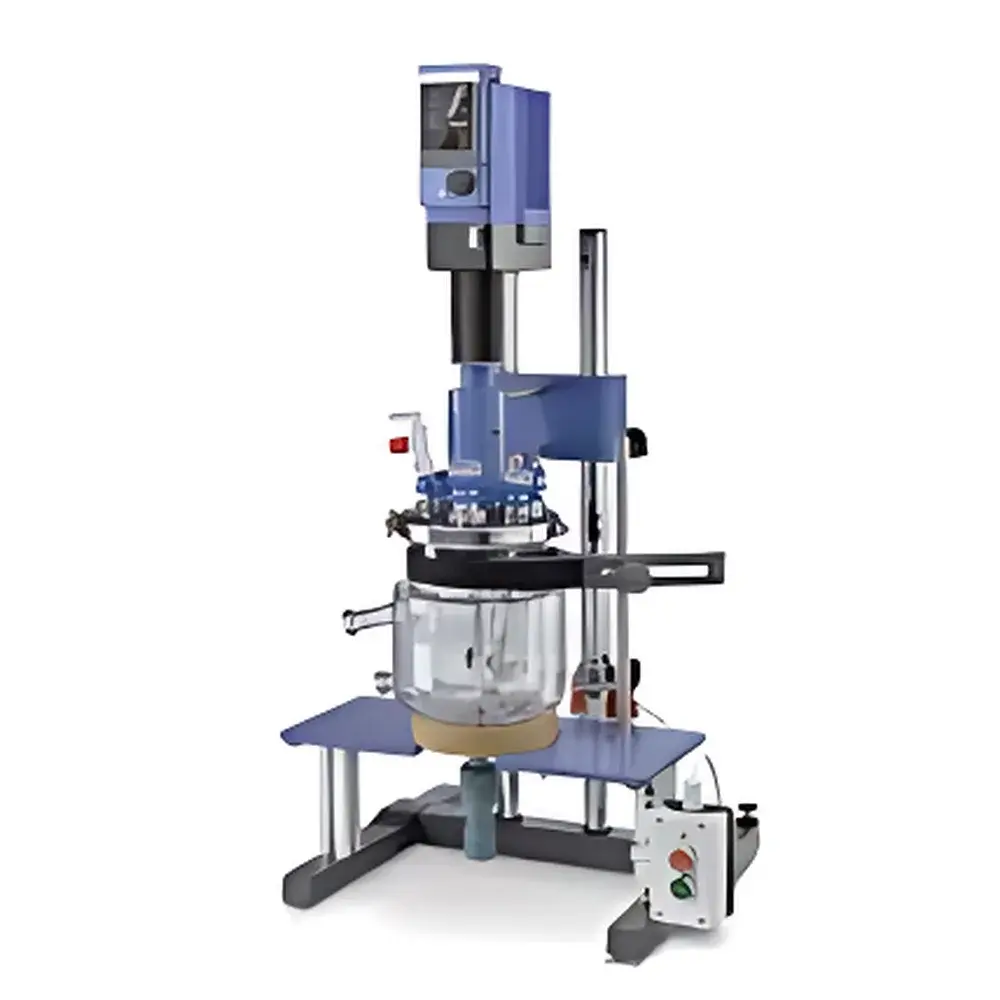
IKA LR-2.ST Configuration 2 Modular Laboratory Reactor System
| Brand | IKA |
|---|---|
| Origin | Germany |
| Model | LR-2.ST Configuration 2 |
| Vessel Capacity | 2000 mL |
| Construction Material | Borosilicate Glass 3.3 |
| Operating Pressure Range | Up to 6 bar (gauge) / Vacuum down to 25 mbar abs |
| Jacketed Vessel | Yes (LR 2000.1) |
| Stirring Drive | EUROSTAR 200 control P4, high-torque digital motor |
| Stirrer Type | LR 2000.11 anchor impeller with flow-through orifices |
| Sealing Material | FFPM (perfluoroelastomer) for solvent and thermal resistance |
| Speed Control | Stepless electronic regulation (0–250 rpm), microprocessor-controlled speed stability under load |
| Torque Monitoring | Integrated relative torque display for real-time viscosity trend indication |
| Safety Features | Interlocked safety switch, pressure/vacuum-rated lid assembly |
| Compatibility | ULTRA-TURRAX® disperser, temperature probe, pH electrode, and auxiliary feed ports |
Overview
The IKA LR-2.ST Configuration 2 is a fully modular, jacketed laboratory reactor system engineered for precise control and reproducible execution of synthetic, catalytic, polymerization, and process optimization experiments under variable pressure, temperature, and mixing conditions. Based on Couette-type hydrodynamic principles and integrated torque-based rheological monitoring, the system enables quantitative assessment of reaction progress through real-time viscosity trends—critical for kinetic studies, endpoint detection, and scale-up correlation. Its core architecture centers on a DIN-standard borosilicate glass 3.3 vessel (LR 2000.1, 2 L nominal capacity) with double-walled jacketing for external temperature control via circulating chillers or heating baths. Designed to ISO 9001-compliant manufacturing standards in Staufen, Germany, the LR-2.ST meets fundamental requirements for GLP-compliant reaction documentation when paired with validated software workflows.
Key Features
- Modular platform supporting sequential integration of temperature control, gas dosing, reflux condensation, distillation, and inline sampling modules
- EUROSTAR 200 control P4 drive unit delivering up to 20 N·cm nominal torque with closed-loop speed regulation—even under high-viscosity or gas-evolving loads
- FFPM-sealed, pressure-rated reactor head accommodating multiple standardized ports (DIN 15/22, ISO-KF 25) for sensors, dispensers, and inert gas inlets
- Anchor impeller LR 2000.11 with radial flow orifices optimized for heat transfer and suspension of solids in viscous media
- Integrated relative torque sensor enabling non-invasive, continuous viscosity profiling without requiring calibration fluids or external viscometers
- Safety interlock circuit preventing operation unless lid is correctly seated and pressure/vacuum thresholds remain within defined operational envelope
Sample Compatibility & Compliance
The LR-2.ST Configuration 2 accommodates a broad spectrum of chemistries—including organometallic catalysis, exothermic nitration, hydrogenation under H₂ (up to 6 bar), and moisture-sensitive Grignard reactions—thanks to its chemically inert glass body and FFPM sealing system (resistant to THF, DMF, chlorinated solvents, and temperatures from –80 °C to +200 °C). All wetted parts conform to USP Class VI and FDA 21 CFR 177.2600 specifications. The system supports vacuum operations down to 25 mbar absolute, enabling low-temperature solvent removal and degassing prior to air-sensitive steps. Pressure containment complies with PED 2014/68/EU Category I requirements for laboratory-scale vessels. Documentation packages include EU Declaration of Conformity and material traceability certificates for glass and elastomers.
Software & Data Management
While the base LR-2.ST operates via front-panel controls, optional connectivity to IKA LabWorldSoft v4.x enables time-synchronized logging of speed, torque, temperature (via Pt100 input), and external analog signals (e.g., pH, conductivity). Data export adheres to ASTM E2500-13 guidelines for raw data integrity, with CSV and PDF report generation. When deployed in regulated environments, the software package may be qualified per GAMP 5 to support 21 CFR Part 11 compliance—including electronic signatures, audit trails, and role-based access control—subject to site-specific validation protocols.
Applications
- Kinetic modeling of esterification and transesterification reactions via torque-derived viscosity curves
- Thermal hazard evaluation (e.g., RC1-type screening) using controlled heating ramps under nitrogen blanket
- Development of nanoparticle synthesis protocols requiring precise shear history and nucleation timing
- Process analytical technology (PAT) integration for real-time endpoint determination in API crystallization
- Scale-down validation of pilot-plant reactor hydrodynamics using geometrically similar impeller-to-vessel ratios
- Multi-step tandem reactions involving sequential addition, temperature staging, and phase separation
FAQ
What is the maximum allowable working pressure for the LR 2000.1 jacketed vessel?
The vessel is rated for 6 bar gauge pressure at 20 °C; derating applies above 100 °C per IKA’s published pressure-temperature chart.
Can the system be used for hydrogenation with H₂ gas?
Yes—provided appropriate gas handling accessories (mass flow controller, back-pressure regulator, explosion-proof stirrer motor option) are installed and operated within certified fume hood environments.
Is the torque signal calibrated for absolute viscosity measurement?
No—the relative torque output serves as a qualitative, repeatable trend indicator; absolute viscosity quantification requires correlation with rotational viscometry standards.
Does the system support automated reagent addition?
Yes—via optional IKA RCT digital dosing modules or third-party syringe pumps interfaced through analog voltage inputs.
What maintenance intervals are recommended for the FFPM seals?
Seals should be inspected before each high-pressure or high-temperature run; replacement is advised after 500 hours of cumulative operation above 150 °C or exposure to strong oxidizers.
Related Products



