
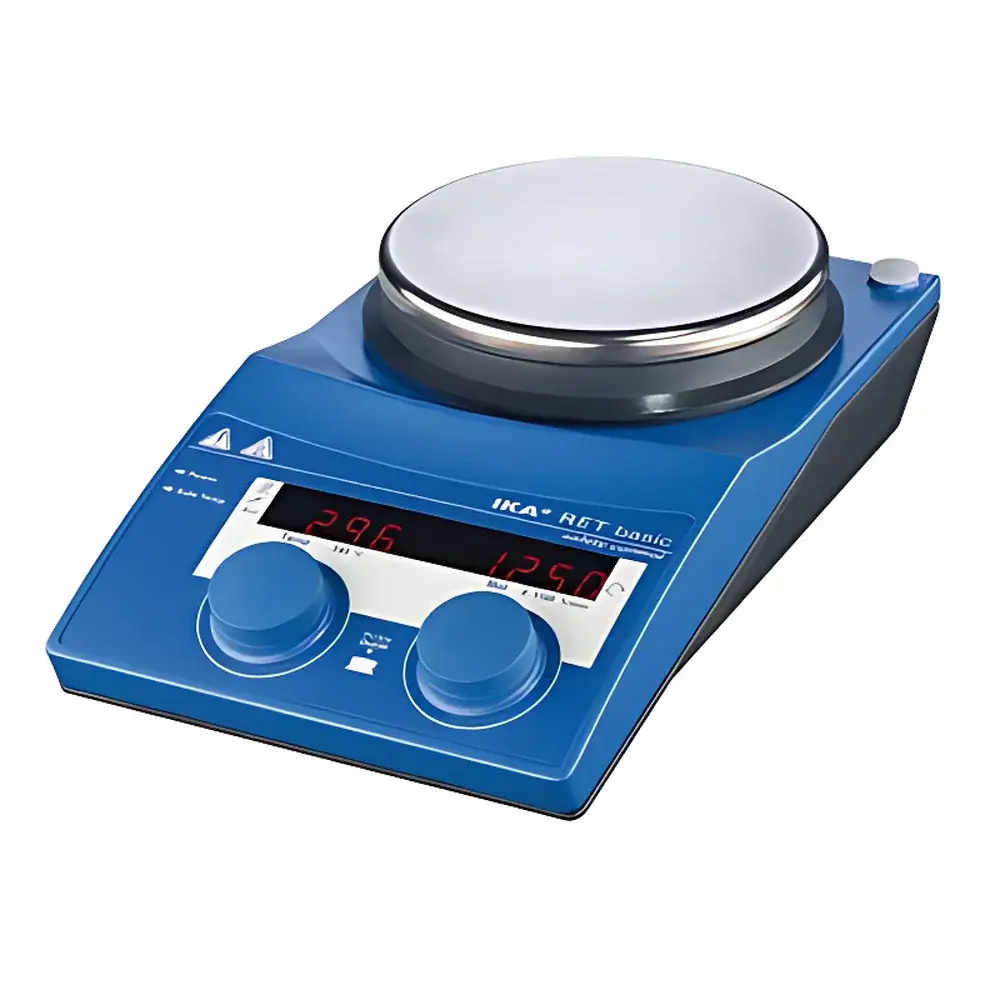
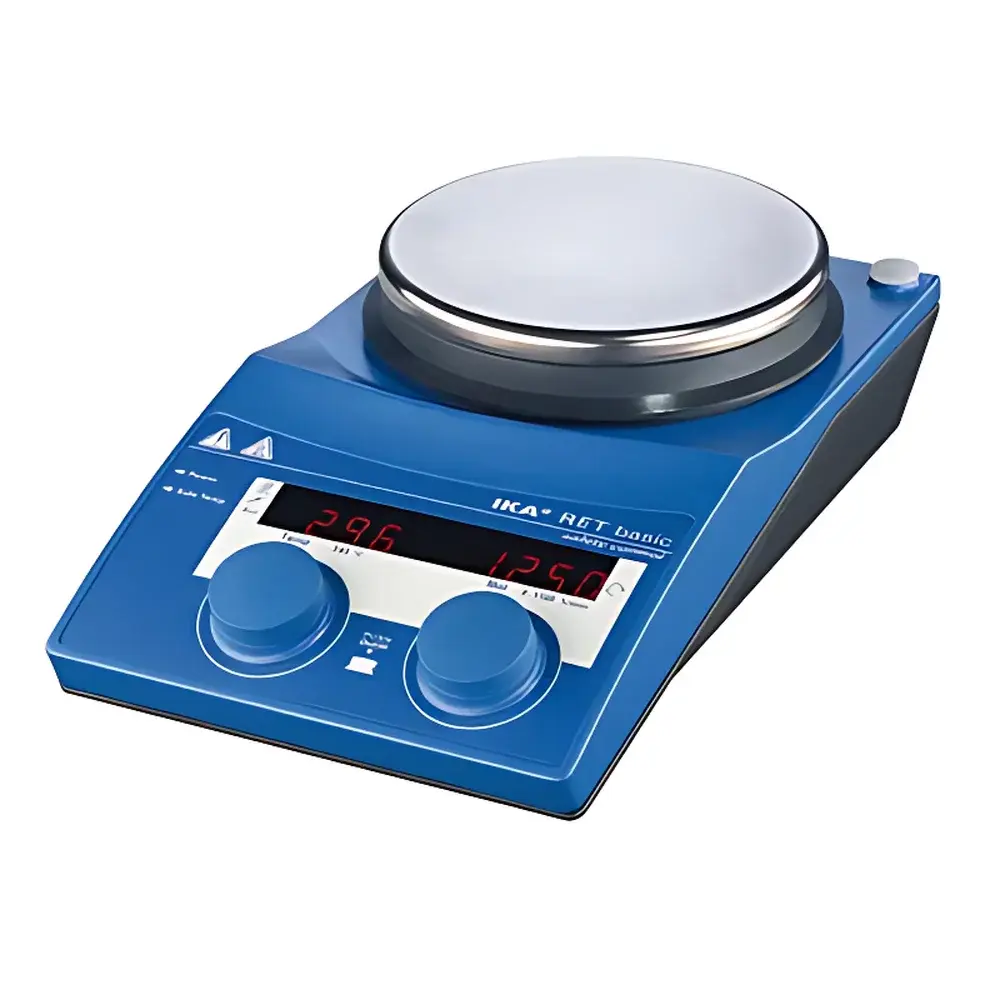
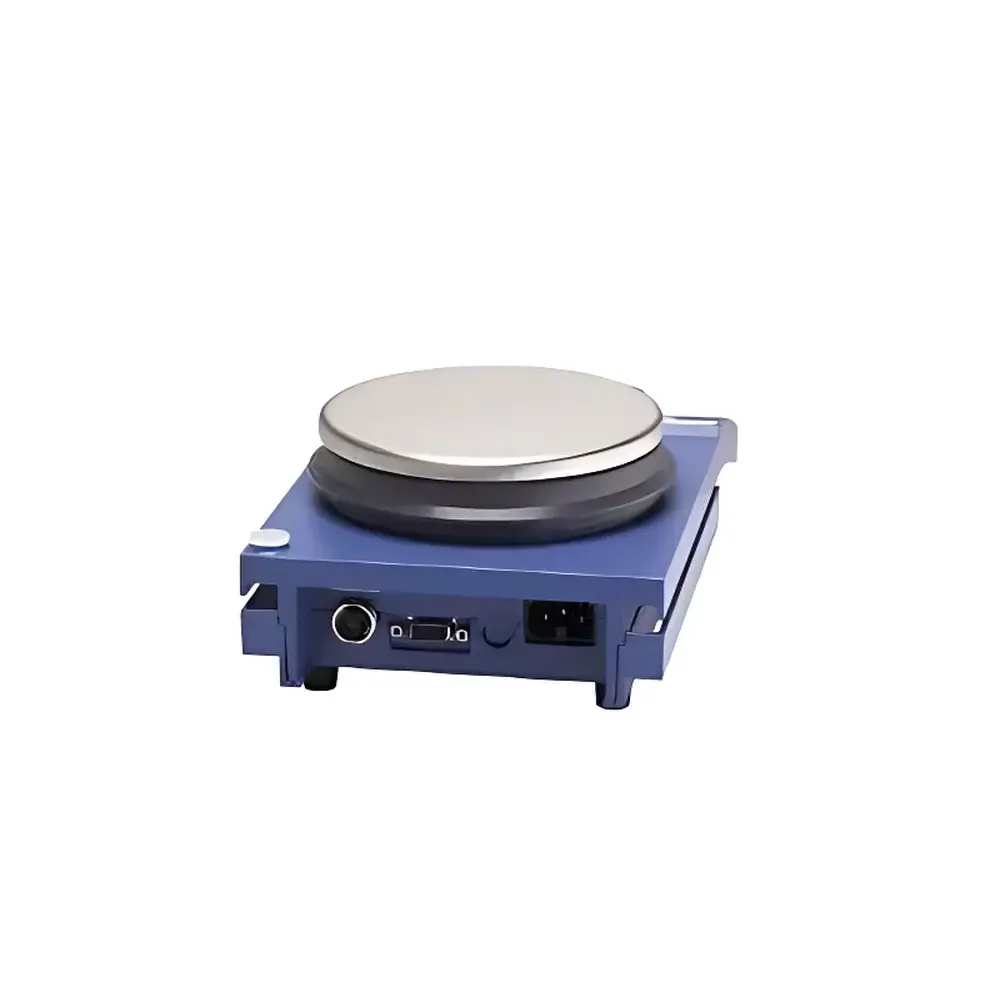
IKA RET Basic Heating Magnetic Stirrer
| Brand | IKA |
|---|---|
| Origin | Germany |
| Model | RET Basic |
| Stirring Volume (H₂O) | 20 L |
| Speed Range | 0–1500 rpm |
| Heating Power | 600 W |
| Temperature Range | RT to 340 °C |
| Safety Temperature Limit | 50–380 °C |
| Plate Material | Stainless Steel (RET Basic) / White Coated Stainless Steel (RET Basic C) |
| Plate Diameter | Ø135 mm |
| Dimensions (W×D×H) | 160×280×97 mm |
| Weight | 2.4 kg |
| IP Rating | IP42 |
| Compliance | DIN 12878 (for external temperature probe interface) |
| Max. Stir Bar Length | 80×10 mm |
| Heating Rate (1 L H₂O) | 7 K/min |
| Temp. Control Accuracy (with ETS-D6) | ±0.2 K |
| Ambient Operating Conditions | 5–40 °C, ≤80% RH |
Overview
The IKA RET Basic Heating Magnetic Stirrer is a precision-engineered laboratory instrument designed for reliable, reproducible heating and stirring of liquid samples under controlled thermal conditions. Based on the proven principle of magnetic coupling—where a rotating permanent magnet beneath the heated ceramic or stainless-steel plate induces rotation in a submerged magnetic stir bar—the RET Basic delivers consistent agitation without mechanical drive shafts or seals that compromise integrity or require maintenance. Its integrated resistive heating element enables rapid thermal response (up to 7 K/min in 1 L water), while its microprocessor-controlled PID regulation ensures stable setpoint maintenance across the full operating range from ambient temperature to 340 °C. Engineered for routine use in chemistry, pharmaceutical development, materials synthesis, and quality control labs, the RET Basic adheres to fundamental safety and performance expectations defined by DIN EN 60529 (IP42 ingress protection) and DIN 12878 (standardized interface for external Pt100 contact thermometers).
Key Features
- Stainless-steel (RET Basic) or chemically resistant white-coated stainless-steel (RET Basic C) heating plate with Ø135 mm active surface—optimized for uniform heat distribution and compatibility with corrosive reagents.
- Electronic speed control with analog dial and calibrated scale, offering precise adjustment from 0 to 1500 rpm; motor output power of 5 W ensures robust torque for viscous media up to 20 L (H₂O equivalent).
- Dual-mode temperature management: independent heater setpoint control (RT–340 °C) plus user-definable safety limit (50–380 °C) to prevent thermal runaway during unattended operation.
- DIN 12878-compliant sensor port enables integration with IKA’s ETS-D5 (±0.5 K accuracy) or ETS-D6 (±0.2 K accuracy) external Pt100 probes for closed-loop, sample-contact temperature regulation—critical for reaction monitoring and method validation.
- Integrated H99 protective film included as standard to minimize surface contamination and simplify cleaning between experiments.
- Compact footprint (160 × 280 × 97 mm) and lightweight design (2.4 kg) facilitate placement inside fume hoods, glove boxes, or shared benchtop environments without compromising stability.
Sample Compatibility & Compliance
The RET Basic supports a wide range of sample types—including aqueous solutions, organic solvents, polymer melts, and mildly aggressive acids or bases—thanks to its inert plate surface and sealed electronics architecture. It complies with IP42 protection rating per DIN EN 60529, safeguarding internal components against dripping water and solid objects ≥1 mm. For regulated environments, the device supports GLP/GMP-aligned workflows when used with traceable temperature probes and documented calibration records. While not intrinsically certified for explosive atmospheres, its non-sparking motor design and absence of exposed electrical contacts make it suitable for general-purpose chemical laboratories operating under standard safety protocols (e.g., OSHA Lab Standard 29 CFR 1910.1450). No FDA 21 CFR Part 11 compliance is claimed, as the unit lacks audit-trail-capable software or user authentication features.
Software & Data Management
The RET Basic operates via standalone hardware controls only—no embedded firmware, USB connectivity, or PC interface is provided. All parameter inputs (speed, temperature, safety limit) are adjusted manually using front-panel dials and displayed via analog scale indicators. This design prioritizes operational simplicity, electromagnetic compatibility (EMC), and long-term reliability over digital functionality. Users requiring data logging or remote monitoring must integrate external devices—such as standalone temperature dataloggers (e.g., Testo 176 T4) or programmable PLCs—via the DIN 12878 probe interface. Calibration certificates for optional ETS-D5/D6 probes may be supplied separately to support ISO/IEC 17025 traceability requirements.
Applications
- Synthesis and reflux of organic compounds requiring precise thermal profiles and homogeneous mixing.
- Buffer and media preparation in molecular biology and cell culture workflows.
- Dissolution testing and viscosity assessment of pharmaceutical suspensions and gels.
- Standardization of titration reagents and pH calibration solutions under thermostatically stabilized conditions.
- Pre-concentration and evaporation support in environmental sample preparation (e.g., EPA Method 3510C).
- Teaching laboratories where robustness, intuitive operation, and compliance with foundational lab safety standards are essential.
FAQ
What is the maximum recommended stirring volume for viscous samples?
While rated for up to 20 L of water, effective agitation of high-viscosity fluids (e.g., >1000 mPa·s) typically requires reduction to ≤5 L and use of appropriately sized stir bars (e.g., 80 × 10 mm elliptical).
Can the RET Basic be used with temperature probes other than IKA ETS-D5/D6?
Only probes conforming to DIN 12878 mechanical and electrical specifications (Pt100, 2-wire, 0–400 Ω range) are guaranteed compatible; third-party probes may yield inaccurate readings or fail to engage the control loop.
Is the heating plate surface resistant to HF or molten alkali metals?
No. The stainless-steel or coated plate is not resistant to hydrofluoric acid or fused sodium/potassium hydroxide; alternative heating platforms (e.g., PTFE-coated or quartz) are required for such applications.
Does the unit include overheat protection beyond the user-set safety limit?
Yes—a redundant bimetallic thermal cutoff (independent of microprocessor control) activates at ~390 °C to permanently disable heating if primary regulation fails.
What maintenance is required for long-term reliability?
Annual verification of speed accuracy (using optical tachometer) and temperature uniformity (across plate surface with IR thermometer) is recommended; no lubrication or internal servicing is needed under normal use conditions.



