
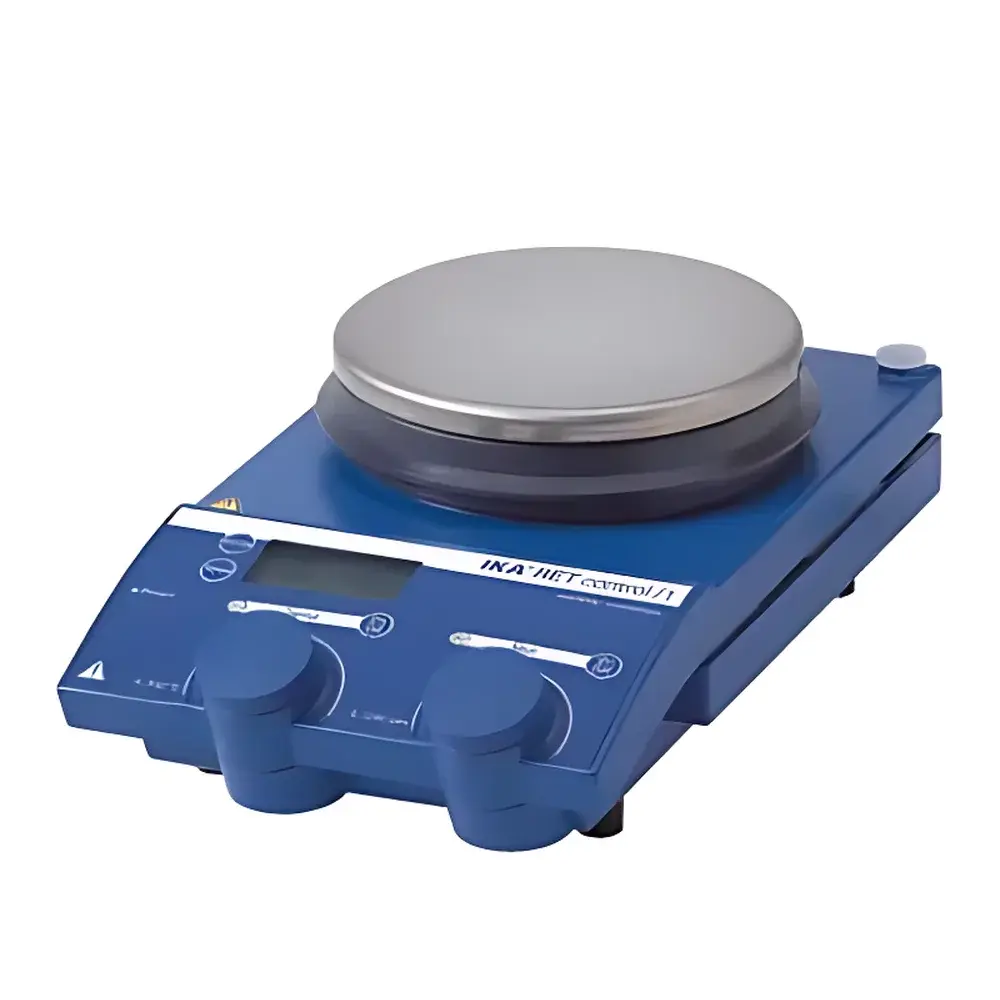
IKA RET Control Heating Magnetic Stirrer
| Brand | IKA |
|---|---|
| Origin | Germany |
| Model | RET Control (Safety-Controlled) |
| Heating Power | 600 W |
| Max. Stirring Volume (H₂O) | 20 L |
| Speed Range | 0–1200 rpm |
| Temp. Range | RT–340 °C |
| Safety Temp. Setpoint Range | 50–350 °C |
| Temp. Control Accuracy (with PT100 sensor) | ±0.2 K |
| Speed Control | Continuous (Electronic Ramp Control) |
| Heating Plate Material | Stainless Steel 1.4301 (DIN) |
| Plate Diameter | Ø135 mm |
| Dimensions (W×H×D) | 160 × 280 × 97 mm |
| Weight | 2.8 kg |
| Protection Rating | IP42 |
| Interface | RS232, Analog Output, DIN 2878 (for ETS-D5 contact thermometer) |
| Input Power | 630 W |
| Voltage/Frequency | 220–230 V / 115 V / 100 V, 50/60 Hz |
| Ambient Operating Conditions | 5–40 °C, ≤80% RH |
Overview
The IKA RET Control Heating Magnetic Stirrer is an engineered solution for precise, reproducible, and safe thermal mixing in analytical, quality control, and synthetic laboratories. Designed around the Couette flow principle—where rotation of a magnetic stir bar induces laminar fluid motion within a vessel—the instrument integrates independent, microprocessor-controlled heating and stirring functions. Its core architecture supports temperature-critical applications requiring both kinetic energy input and thermal stability, such as dissolution testing, catalyst activation, polymerization initiation, and buffer equilibration. Unlike basic stirrers, the RET Control implements dual-loop thermal regulation: primary heating via a high-efficiency 600 W resistive element embedded beneath a corrosion-resistant 1.4301 stainless steel plate, and secondary feedback control using external PT100 sensors connected via standardized DIN 2878 interface—enabling closed-loop accuracy of ±0.2 K when paired with compatible probes like the ETS-D5.
Key Features
- Independent, continuously adjustable heating (RT to 340 °C) and stirring (0–1200 rpm) with electronic ramp control for gradual acceleration/deceleration—minimizing vortex formation and sample splashing
- Dual thermal safety architecture: user-configurable safety cutoff (50–350 °C) plus automatic self-diagnostic at power-on to verify sensor integrity and heater functionality
- High-precision temperature regulation with optional external PT100 probe support, meeting calibration traceability requirements for GLP-compliant workflows
- RS232 serial interface and analog output (0–10 V) for integration into centralized lab automation systems or data loggers compliant with FDA 21 CFR Part 11 audit trail standards
- Robust mechanical design: IP42-rated enclosure for protection against dripping water and solid ingress; compact footprint (160 × 97 × 280 mm) optimized for fume hood or benchtop deployment
- Included H99 protective cover prevents dust accumulation on the heating surface and reduces cleaning frequency without impeding heat transfer
Sample Compatibility & Compliance
The RET Control accommodates standard laboratory glassware up to 20 L volume (e.g., beakers, round-bottom flasks, jacketed reactors), provided magnetic stir bars up to 80 mm in length are used. Its stainless steel heating plate conforms to DIN 1.4301 material specifications, ensuring resistance to chemical exposure during routine use with aqueous, organic, and mildly acidic/basic media. The device complies with IEC 61010-1 (Safety Requirements for Electrical Equipment for Measurement, Control, and Laboratory Use) and carries CE marking for the European Economic Area. Its DIN 2878 interface enables interoperability with certified contact thermometers referenced in ASTM E2877-22 (Standard Guide for Selection and Use of Contact Thermometers), supporting method validation under ISO/IEC 17025-accredited environments.
Software & Data Management
While the RET Control operates as a standalone instrument with intuitive LCD-based local control, its RS232 port enables bidirectional communication with third-party software platforms—including LabVIEW, MATLAB, or custom Python-based acquisition scripts—via ASCII command protocol. Real-time parameters (actual temperature, setpoint, RPM, safety status) can be streamed at configurable intervals. Analog output provides continuous voltage-scaled representation of measured temperature for connection to chart recorders or PLCs. All configuration changes and thermal events are timestamped internally, satisfying minimum metadata requirements for audit-ready documentation per GMP Annex 11 and USP Analytical Instrument Qualification guidelines.
Applications
- Controlled-temperature solubility studies in pharmaceutical development (e.g., USP dissolution apparatus auxiliary heating)
- Precipitation and crystallization protocols requiring stable thermal gradients over extended durations
- Preparation of homogeneous calibration standards and reference materials under defined thermal history
- Viscosity-sensitive reactions where shear rate must remain decoupled from thermal input
- Environmental testing of material stability (e.g., ASTM D3418 for polymer transition temperatures)
- QC/QA workflows requiring documented thermal profiles for reagent activation or enzyme denaturation assays
FAQ
Does the RET Control support external temperature feedback during stirring?
Yes—it features a dedicated DIN 2878 interface for connecting PT100-compatible contact thermometers (e.g., IKA ETS-D5), enabling real-time, sensor-driven temperature regulation with ±0.2 K accuracy.
Can multiple units be synchronized or networked?
No native multi-unit synchronization is provided; however, individual devices can be integrated into a centralized control system via RS232 or analog output signals using external programmable logic controllers or SCADA software.
Is the heating plate chemically resistant to common solvents?
The 1.4301 stainless steel plate offers broad resistance to water, alcohols, acetone, and dilute acids/bases—but prolonged exposure to halogenated solvents or strong oxidizers is not recommended without protective liners.
What safety certifications does this model hold?
It meets IEC 61010-1 for laboratory electrical safety and carries CE, UKCA, and cULus markings where applicable—verified by TÜV Rheinland test reports available upon request.
How is calibration verification performed?
Users may perform operational qualification (OQ) using NIST-traceable reference thermometers and tachometers; factory calibration certificates (including as-found/as-left data) are available as an optional service.
Related Products



