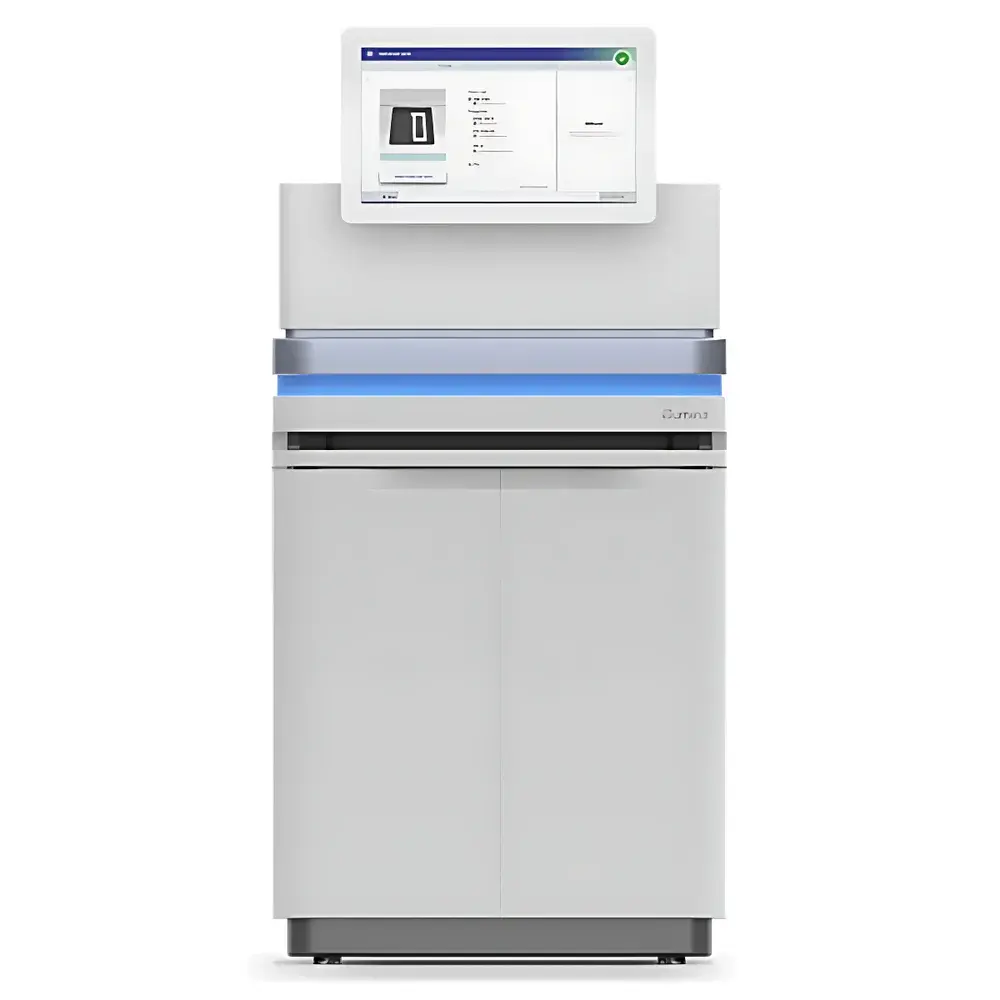
Illumina NovaSeq 6000 Sequencing System
| Brand | Illumina |
|---|---|
| Origin | Shanghai, China |
| Manufacturer Type | Authorized Distributor |
| Product Category | Domestic (P.R.C.-assembled) |
| Model | NovaSeq 6000 |
| Instrument Class | Next-Generation Sequencing (NGS) Platform |
| Regulatory Status | Not a Medical Device (Non-IVD) |
| Form Factor | Benchtop High-Throughput Sequencer |
| Output Capacity | Up to 6 Tb per run |
| Read Yield | Up to 20 billion reads per run |
| Run Time | 3–5 hours (for rapid kits) |
| Read Length Configurations | 2 × 50 bp, 2 × 100 bp, 2 × 150 bp, and 2 × 250 bp (paired-end) |
| Flow Cell Options | S1, S2, S4, and SP flow cells (single or dual flow cell loading) |
| Compatibility | Illumina-compatible library prep kits (e.g., TruSight, Nextera, NovaSeq Xp) |
Overview
The Illumina NovaSeq 6000 is a benchtop next-generation sequencing (NGS) platform engineered for scalable, high-throughput DNA sequencing across diverse research applications. It leverages Illumina’s proven two-channel sequencing-by-synthesis (SBS) chemistry with patterned flow cell technology to deliver exceptional data quality, reproducibility, and flexibility. Unlike first-generation Sanger sequencers—explicitly misclassified in some regional listings—the NovaSeq 6000 is a true second-generation NGS instrument, supporting massively parallel sequencing of millions to billions of DNA fragments simultaneously. Its architecture enables whole-genome sequencing (WGS), whole-exome sequencing (WES), RNA-Seq, ChIP-Seq, methylation analysis, and large-scale population genomics studies—all on a single integrated platform. The system supports both rapid turnaround (as short as 3 hours for 2 × 50 bp runs using the Rapid Kit) and ultra-deep coverage modes (up to 44 hours), making it suitable for labs balancing speed, depth, and cost-per-gigabase.
Key Features
- Scalable throughput via interchangeable flow cells: SP (up to 1.2 Tb), S1 (up to 2 Tb), S2 (up to 3.2 Tb), and S4 (up to 6 Tb per run)
- Dual-flow cell operation allows concurrent processing of heterogeneous sample types or protocols within one instrument cycle
- Precise cluster generation using ExAmp chemistry and patterned nanowell arrays ensures uniform cluster density and reduced phasing/pre-phasing errors
- Integrated Real-Time Analysis (RTA) software performs on-instrument base calling, quality scoring (Q30+ ≥ 85% typical), and demultiplexing
- Modular design supports seamless integration into GLP-compliant and GMP-adjacent workflows with audit-ready logging capabilities
- Compatible with Illumina’s end-to-end ecosystem—including library preparation kits, index adapters, and QC reagents—ensuring protocol standardization and inter-laboratory comparability
Sample Compatibility & Compliance
The NovaSeq 6000 accepts standard Illumina libraries prepared from genomic DNA, FFPE-derived DNA, cDNA, small RNA, and amplicons. Input requirements range from 0.2 ng to 1,000 ng depending on library type and desired coverage. All flow cells are certified for use under ISO 13485–aligned manufacturing controls (though the instrument itself is not classified as an IVD device per FDA 21 CFR Part 809 or EU IVDR). The platform complies with key analytical standards including CLSI MM19-A, ISO/IEC 17025 for testing laboratories, and supports alignment with CAP/CLIA validation frameworks when deployed in clinical research settings. Data integrity is maintained through hardware-enforced encryption, role-based user access control, and optional 21 CFR Part 11–compliant electronic signature modules via Illumina BaseSpace Sequence Hub.
Software & Data Management
Instrument control, run monitoring, and primary analysis are managed through Illumina Experiment Manager (IEM) v2.4+, which provides SOP-driven workflow templates, automated QC flagging, and real-time yield/quality dashboards. Raw BCL files are converted to FASTQ via bcl2fastq v2.20+ or DRAGEN Bio-IT Platform for accelerated secondary analysis. BaseSpace Sequence Hub offers cloud-based storage, variant calling (via Torrent Suite-compatible pipelines), and collaborative project sharing with configurable permissions. Local deployment options include Illumina Connected Analytics for on-premise HIPAA- and GDPR-aligned data governance. All software versions undergo quarterly security patching and maintain traceable version histories required for regulatory audits.
Applications
- Whole-genome resequencing (human, model organisms, microbes) at 30×–100× coverage
- Single-cell multi-omics (scRNA-Seq + scATAC-Seq co-assay integration)
- Longitudinal cohort studies requiring consistent read depth across thousands of samples
- Discovery-phase biomarker identification in oncology and immunogenomics
- Metagenomic profiling of complex microbiomes with strain-level resolution
- CRISPR screen deconvolution and functional genomics validation
FAQ
Is the NovaSeq 6000 classified as a first-generation sequencer?
No. It is a second-generation NGS platform based on reversible dye-terminator SBS chemistry—not Sanger dideoxy chain termination.
Can the NovaSeq 6000 be used in clinical diagnostic environments?
While not FDA-cleared or CE-IVD marked, it is widely deployed in CLIA-certified and CAP-accredited laboratories for clinical research and LDT development under validated SOPs.
What is the minimum sample input requirement for standard WGS libraries?
For optimal cluster density and uniformity, Illumina recommends 100–500 ng of dual-indexed, PCR-amplified libraries with fragment sizes between 300–700 bp.
Does the system support third-party library prep kits?
Yes—provided they generate Illumina-compatible adapters (e.g., A-tailing, P5/P7 ligation) and pass onboard cluster density calibration checks.
How is data security ensured during local analysis?
Local installations support AES-256 encryption at rest, TLS 1.2+ for network transfers, and integration with enterprise Active Directory/LDAP authentication systems.