
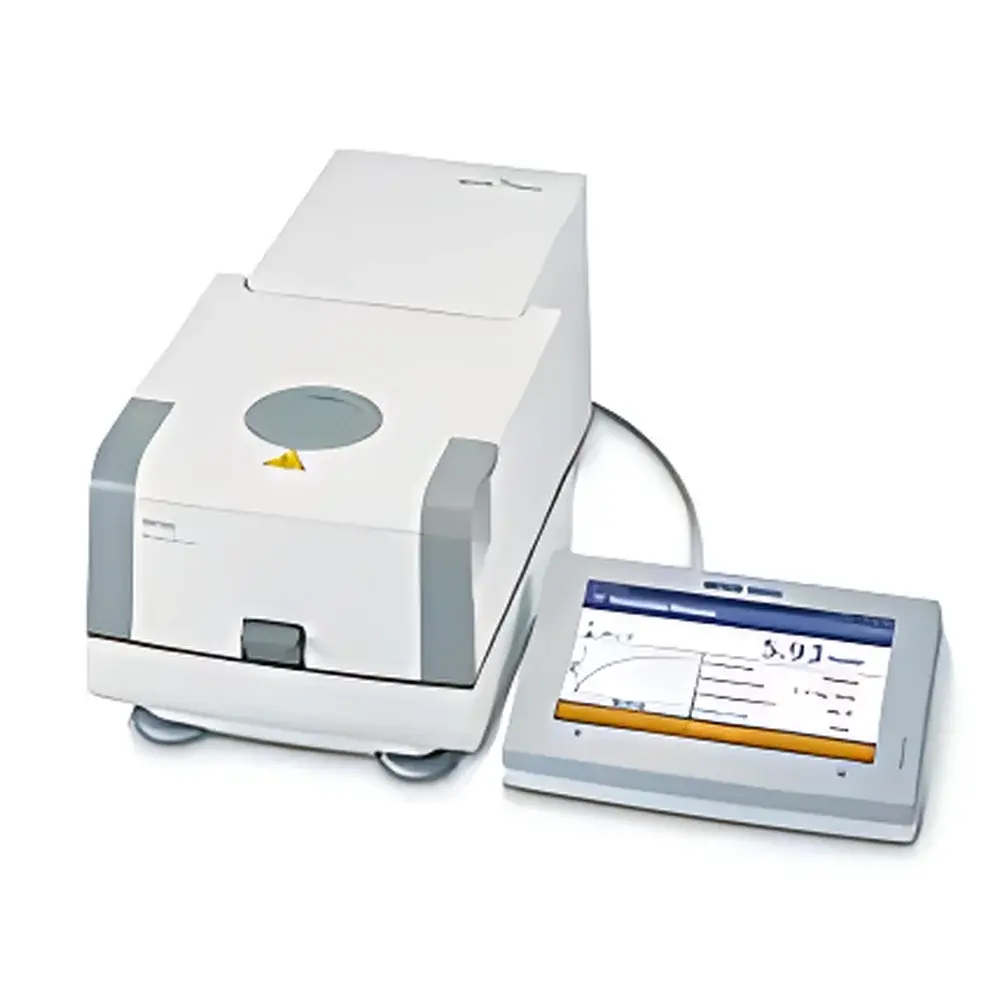
METTLER TOLEDO HX204 Infrared Moisture Analyzer
| Brand | METTLER TOLEDO |
|---|---|
| Origin | Switzerland |
| Model | HX204 |
| Readability | 0.01% (moisture content) / 0.001 g |
| Repeatability (sd) | 0.05% (2 g sample), 0.01% (10 g sample) |
| Moisture Range | 0.01–100% MC |
| Heating Temperature Range | 40–230 °C |
| Weighing Capacity | 200 g |
| Minimum Sample Mass | 0.1 g |
| Drying Programs | Standard, Fast, Slow, Step |
| Method Storage | 300 methods |
| Result Storage | 3000 results |
| Display Modes | %MC, %DC, g, %AM, %AD, g/kg DC, g/kg MC |
| Data Output | A4/Letter print, PDF export, USB & Ethernet connectivity |
| Calibration | FACT (Fully Automatic Calibration Technology) with internal weights |
| Leveling | Integrated electronic level control |
| Performance Verification | SmartCal validation test substance |
Overview
The METTLER TOLEDO HX204 Infrared Moisture Analyzer is a high-precision, thermogravimetric instrument engineered for rapid, reliable quantification of moisture content in solid and semi-solid samples across pharmaceutical, food, chemical, and materials science laboratories. It operates on the principle of loss-on-drying (LOD), where sample mass loss upon controlled infrared heating is measured gravimetrically using a MonoBloc single-module weighing cell. This architecture eliminates mechanical stress points and ensures long-term stability and reproducibility. Designed and manufactured in Switzerland, the HX204 integrates halogen lamp heating technology with real-time mass monitoring to deliver accurate moisture determination—expressed as % moisture content (%MC) or % dry content (%DC)—in accordance with standardized methodologies including ASTM D4442, ISO 712, USP <921>, and AOAC 952.06.
Key Features
- MonoBloc Weighing Technology: A 200 g capacity, single-module sensor delivering 0.001 g readability and exceptional stability under thermal load—critical for low-mass, high-sensitivity moisture assays.
- Halogen Lamp Heating System: Provides uniform, controllable radiant heat across the sample surface, enabling precise temperature ramping (40–230 °C) and minimizing thermal degradation risks in heat-sensitive matrices.
- OneClick Operation Interface: A dedicated hardware key initiates pre-configured drying methods directly from the home screen, reducing operator error and ensuring method consistency across shifts and users.
- FACT Auto-Calibration: Fully Automatic Calibration Technology uses internal reference weights to perform temperature-compensated calibration at operating conditions—supporting GLP/GMP compliance and audit readiness.
- Integrated Electronic Leveling: Real-time digital leveling feedback ensures consistent positioning and alignment, eliminating manual bubble-level dependency and reinforcing SOP adherence.
- Sealed, Flat-Surface Design: The smooth, non-porous housing and enclosed draft shield contain spills and simplify cleaning—reducing cross-contamination risk and downtime between analyses.
Sample Compatibility & Compliance
The HX204 accommodates diverse sample types—including powders, granules, pellets, pastes, and thin films—with minimum mass requirements as low as 0.1 g. Its open-sample pan geometry supports rapid heat transfer while maintaining compatibility with standard aluminum or stainless-steel sample dishes. The instrument meets essential regulatory expectations for analytical instrumentation: its data integrity framework supports 21 CFR Part 11-compliant audit trails when paired with METTLER TOLEDO LabX software; all stored methods and results are timestamped, user-ID tagged, and immutable post-generation. Routine performance verification is enabled via SmartCal—a certified reference material that assesses combined thermal and gravimetric accuracy in a single 10-minute test, satisfying internal quality control intervals defined by ISO/IEC 17025 and pharmaceutical QA protocols.
Software & Data Management
While standalone operation is fully functional via the intuitive touchscreen interface, the HX204 achieves full traceability and enterprise integration through optional LabX software. LabX enables centralized method deployment across multiple instruments, automated report generation (A4/Letter PDFs with embedded drying curves), and secure database archiving with role-based access control. All measurement data—including real-time drying curves, intermediate mass readings, and final %MC/%DC values—are exportable via USB or network connection in CSV or XML formats. Built-in result processing tools include statistical summaries, ID management, control charting, and pass/fail evaluation against user-defined specification limits—facilitating continuous process verification per ICH Q5 and Q9 guidelines.
Applications
The HX204 serves as a primary moisture testing platform in regulated environments where batch release decisions depend on precise water content. Key use cases include: quantifying residual solvents in active pharmaceutical ingredients (APIs); verifying moisture levels in excipients prior to tablet compression; monitoring hygroscopicity of polymer blends in R&D; determining water activity proxies in cereal-based foods; validating drying endpoints in lyophilization cycle development; and assessing moisture uptake in battery electrode coatings. Its ability to resolve sub-0.01% MC changes makes it suitable for QC labs performing stability-indicating assays per ICH Q1A(R3) and for research groups investigating hydration kinetics in clays or zeolites.
FAQ
What standards does the HX204 comply with for moisture analysis?
The HX204 supports compliance with ASTM D4442 (wood), ISO 712 (cereals), USP <921> (pharmaceuticals), AOAC 952.06 (food), and EN ISO 1186 (plastics), provided appropriate method validation is performed per laboratory SOPs.
Can the HX204 be validated for GMP environments?
Yes—when used with LabX software, it supports 21 CFR Part 11 requirements including electronic signatures, audit trails, and data integrity controls. FACT calibration and SmartCal verification provide documented evidence of ongoing instrument fitness-for-purpose.
Is external calibration required in addition to FACT?
FACT handles routine drift correction using internal weights, but periodic external calibration with certified mass standards (e.g., Class E2 or better) is recommended per ISO/IEC 17025 and internal quality system requirements.
How does the HX204 handle heterogeneous or layered samples?
For non-uniform materials, users should ensure representative sampling, homogenize if possible, and apply consistent sample spreading techniques. The halogen heating profile is optimized for surface-to-core thermal penetration, and drying curve analysis helps identify incomplete drying events.
What maintenance is required to sustain accuracy over time?
Routine cleaning of the heating chamber and draft shield, daily FACT calibration, weekly SmartCal verification, and annual preventive maintenance—including lamp output verification and sensor diagnostics—are recommended to maintain metrological confidence.



