
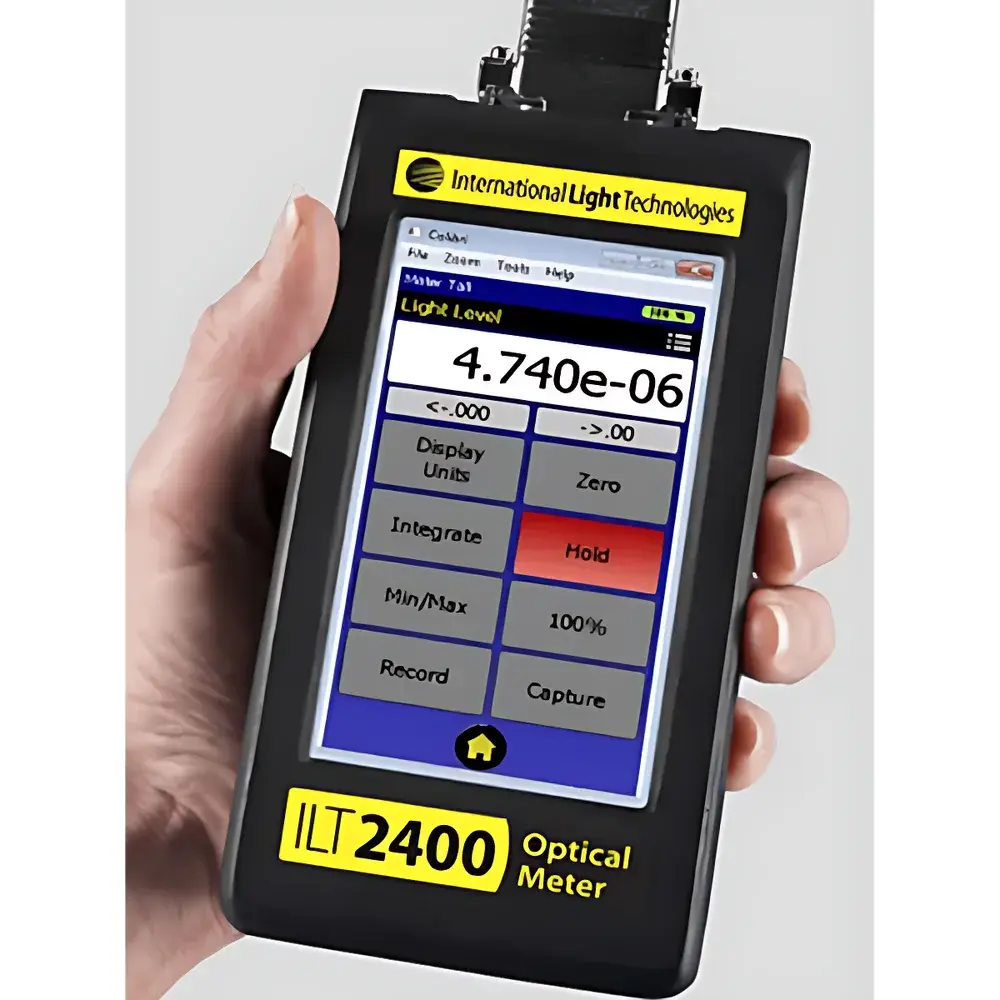
ILT2400 Handheld Photometer
| Brand | ILT (International Light Technologies) |
|---|---|
| Model | ILT2400 |
| Type | Research-Grade Handheld Photometer |
| Origin | Manufactured in Peabody, MA, USA |
| Calibration | NIST-traceable, ISO/IEC 17025-accredited |
| Measurement Range | 50 pA to 1 mA photocurrent (8-decade optical dynamic range) |
| Display | 4.3" VGA capacitive touchscreen (rotatable ±90°) |
| Bias Voltage | 5 V reverse bias |
| Averaging & Range | Smart Averaging™ with auto-ranging |
| Internal Storage | 4 GB |
| Operating Temperature | 0–40 °C |
| USB Interfaces | Micro-USB (data download), Mini-USB (charging & remote logging via DataLight III) |
| Dimensions | 1.6" H × 3.0" W × 6.0" L |
| Detector Interface | 15-pin D-sub connector |
| Compliance | CE-marked for EMC (no RF emission |
| Battery Life | Up to 8 hours (rechargeable Li-ion) |
| Minimum Integration Time | 100 µs |
| Sampling Rate | Up to 16 readings/sec |
| Software | DataLight III (Windows/macOS compatible) |
| Sensor Compatibility | Backward-compatible with ILT1700-series detectors and accessories |
Overview
The ILT2400 Handheld Photometer is a precision-engineered, field-deployable optical measurement system designed for quantitative photometric and radiometric analysis across research, industrial safety, regulatory compliance, and applied photonics applications. Unlike conventional handheld meters constrained by fixed-range analog circuitry, the ILT2400 employs a digitally controlled, low-noise transimpedance amplifier architecture with adaptive gain switching—enabling seamless, artifact-free measurement over an 8-decade dynamic range (50 pA to 1 mA photocurrent). Its core measurement principle relies on calibrated photodetector response under defined spectral weighting functions (e.g., CIE photopic V(λ), UV-A, UV-B, UVC, or user-defined spectral filters), traceable to NIST standards through ISO/IEC 17025-accredited calibration protocols. The instrument operates as a true photometric data acquisition platform—not merely a display device—integrating real-time signal conditioning, timestamped storage, and configurable integration timing down to 100 µs. All firmware and hardware are developed and assembled at ILT’s vertically integrated facility in Peabody, Massachusetts, ensuring full control over design validation, calibration chain integrity, and long-term metrological stability.
Key Features
- 8-decade linear dynamic range enabled by intelligent auto-ranging and Smart Averaging™ algorithm—eliminates manual range selection and minimizes saturation risk during transient or pulsed light measurements
- 4.3-inch rotatable VGA capacitive touchscreen supporting both landscape and portrait orientation for ergonomic operation in confined or overhead measurement scenarios
- Integrated 4 GB non-volatile memory with timestamped data logging; supports simultaneous real-time display and background storage without latency
- Rechargeable lithium-ion battery delivering up to 8 hours of continuous operation; dual USB interface (Micro-USB for data export, Mini-USB for charging and remote control)
- 15-pin D-sub detector interface ensuring mechanical and electrical compatibility with ILT’s full portfolio of calibrated sensors—including cosine-corrected photodiodes, fiber-coupled probes, thermal detectors, and narrowband UV/VIS/NIR filter assemblies
- 5 V reverse bias capability for optimized responsivity and linearity with photodiode-based detectors requiring external bias
- CE-compliant electromagnetic compatibility (EN 61326-1); engineered for low-noise operation in electrically noisy laboratory, manufacturing, and clinical environments
Sample Compatibility & Compliance
The ILT2400 accepts interchangeable, factory-calibrated detectors conforming to IEC 60825-1 (laser safety), IEC 62471 (photobiological safety), and ANSI RP-27 series standards. Its modular architecture supports detectors with spectral responsivity tailored for specific applications: CIE V(λ)-weighted photometry (lux, fc, cd/m²), UV-C germicidal irradiance (254 nm), plant photosynthetic photon flux density (PPFD, 400–700 nm), UVA/B erythemal action spectrum, and broadband radiometry (W/cm²). All calibrations are documented per ISO/IEC 17025 requirements, including uncertainty budgets, reference standard traceability (NIST SRM 2219, 2220), and environmental correction factors. The system meets GLP audit readiness criteria: DataLight III software provides electronic signatures, audit trails, and 21 CFR Part 11–compliant user access controls when deployed in regulated environments (e.g., pharmaceutical UV disinfection validation, medical phototherapy QA).
Software & Data Management
DataLight III is a native cross-platform application (Windows 10/11, macOS 12+) that transforms the ILT2400 into a full-featured optical data workstation. It enables real-time waveform capture, spectral weighting selection, unit conversion (lux ↔ W/m² ↔ µmol/m²/s), statistical analysis (min/max/avg/std dev), and customizable report generation (PDF/CSV/XLSX). Raw time-series data is stored with metadata including detector serial number, calibration date, integration time, bias voltage, and ambient temperature. The software supports script-driven batch acquisition, trigger synchronization with external equipment (via TTL input), and direct export to MATLAB, Python (NumPy/Pandas), or LabVIEW via ASCII or binary protocols. Firmware updates and configuration backups are managed through the same interface, ensuring version control and reproducibility across multi-instrument deployments.
Applications
- Laser safety officer (LSO) assessments per ANSI Z136.1—measuring MPE-exposure durations and beam profile characterization
- UV-C disinfection system validation in healthcare and HVAC—quantifying irradiance uniformity, dose accumulation (J/m²), and lamp aging trends
- Photobiomodulation and dermatological light therapy QA—verifying spectral output, irradiance stability, and treatment field homogeneity
- Plant phenotyping and horticultural lighting design—PPF (Photosynthetic Photon Flux) and PPFD mapping under LED grow lights
- Optical lithography process monitoring—intensity profiling of stepper/exposure tool UV sources
- Radiation hazard assessment in nuclear medicine and synchrotron facilities—broadband and filtered UV/VIS leakage detection
- Materials degradation testing—accelerated photo-oxidation studies using calibrated solar simulators
- Display and lighting product development—luminance (cd/m²), illuminance (lux), and chromaticity verification per CIE 15:2018
FAQ
Is the ILT2400 compatible with third-party detectors?
No—the ILT2400 is designed exclusively for use with ILT-manufactured, calibrated detectors featuring proprietary impedance matching and communication protocols. Interchangeability is guaranteed only within the ILT1700/ILT2400 sensor ecosystem.
Does the instrument support real-time analog output?
Yes—via optional analog output module (sold separately), providing 0–5 V or 4–20 mA proportional to selected measurement unit, suitable for PLC integration or oscilloscope triggering.
Can calibration certificates be renewed annually?
Yes—ILT offers accredited recalibration services with full ISO/IEC 17025 documentation, including before/after performance verification and uncertainty analysis.
What operating systems support DataLight III?
DataLight III v4.2+ supports Windows 10/11 (64-bit) and macOS Monterey (12) through Sonoma (14); legacy versions are available for older OS releases upon request.
Is firmware upgrade capability built-in?
Yes—firmware updates are delivered via DataLight III and applied over USB without requiring service center return; all versions are archived and validated per ILT’s internal change control procedure.





