
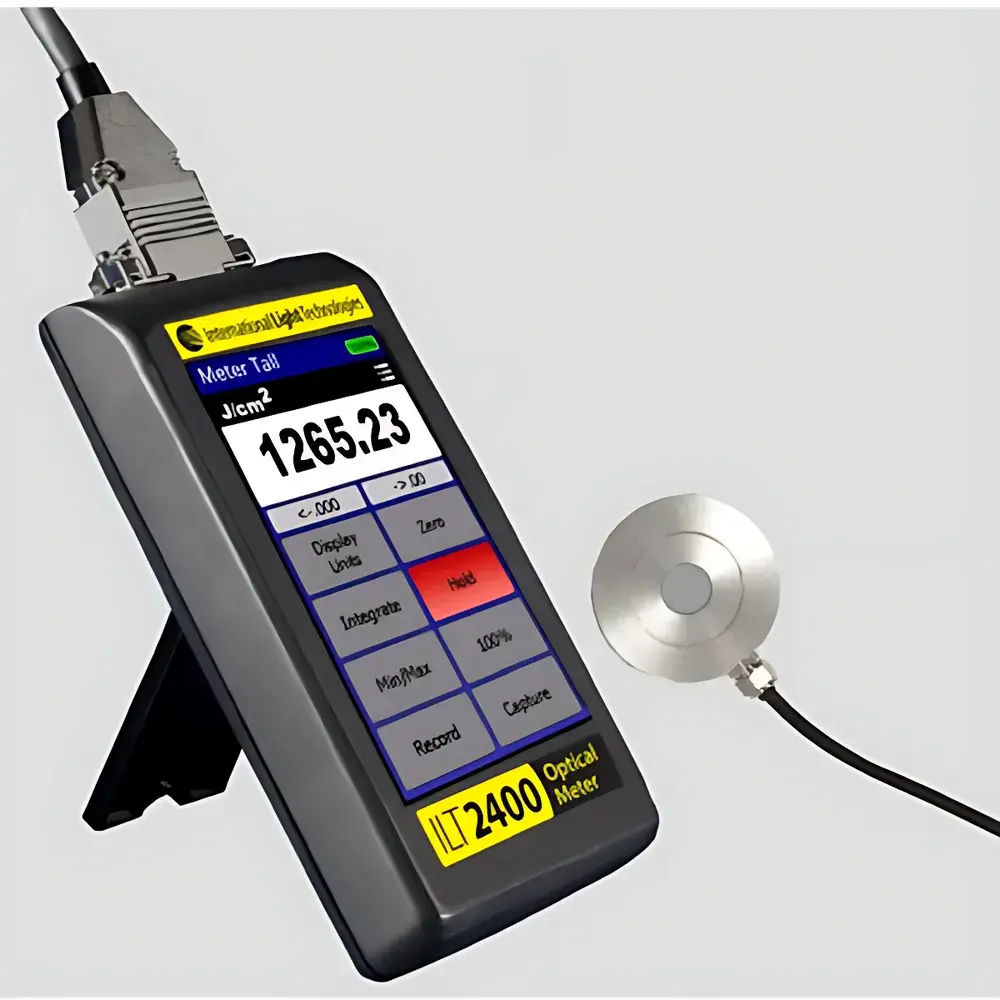
ILT2400 UVGI-NB UVC Radiometer System by Labsphere
| Brand | Labsphere |
|---|---|
| Origin | USA |
| Model | ILT2400 UVGI-NB |
| Calibration | NIST-traceable, ISO/IEC 17025:2017 accredited at 254 nm |
| Spectral Response | Optimized for 254 nm narrowband UVC sources (e.g., low-pressure mercury lamps) |
| Irradiance Range | 4.0 × 10⁻⁷ W/cm² (0.4 µW/cm²) to 4 W/cm² |
| Dose Range | 4.0 × 10⁻⁷ J/cm² (0.4 µJ/cm²) to >10⁶ J/cm² |
| Detector Type | SiC photodiode with integrated XSD14T254 flat-profile sensor (15 mm H × 42 mm Ø) |
| Electrical Range | 50 pA to 1 mA photocurrent |
| Dynamic Range | 8 decades |
| Display | 4.3″ VGA capacitive color touchscreen |
| Bias Voltage | 5 V reverse bias |
| Data Storage | 4 GB internal |
| Interface | USB Micro (data download), USB Mini (charging & remote logging via DataLight III) |
| Operating Temperature | 0–40 °C |
| Dimensions (meter) | 41 mm H × 76 mm W × 152 mm L |
| Sensor Cable Length | 2.13 m (7 ft) |
| Compliance | CE-marked for EMC (no RF emission interference), RoHS compliant |
| Software | DataLight III (Windows/macOS compatible), supports audit trail, CSV export, real-time graphing, and GLP-compliant session logging |
Overview
The ILT2400 UVGI-NB UVC Radiometer System by Labsphere is a purpose-engineered, handheld optical measurement instrument designed specifically for quantitative validation of germicidal ultraviolet irradiation (UVGI) systems operating at the critical 254 nm wavelength. It employs a silicon carbide (SiC) photodiode-based detector—XSD14T254—with a flat, low-profile geometry (15 mm height × 42 mm diameter) and built-in bandpass filtering to isolate 254 nm emissions from low-pressure mercury lamps and other narrowband UVC sources. The system operates on the principle of calibrated photocurrent measurement: incident UVC photons generate a proportional current in the SiC detector, which is amplified, digitized, and processed under fixed reverse bias (5 V) to ensure linearity and stability across eight decades of irradiance (4.0 × 10⁻⁷ to 4 W/cm²). Its NIST-traceable calibration—formally accredited to ISO/IEC 17025:2017 at 254 nm—ensures metrological integrity for applications where regulatory compliance, clinical safety, or process validation is non-negotiable.
Key Features
- Integrated 254 nm-optimized XSD14T254 sensor with minimal cosine error and uniform spatial response for accurate surface, air, and water disinfection monitoring
- 4.3″ capacitive VGA touchscreen interface enabling real-time irradiance (W/cm²) and cumulative dose (J/cm²) display, with on-device data review and annotation
- Two dedicated USB interfaces: Micro-B for high-speed data download and firmware updates; Mini-B for charging and synchronized remote logging via DataLight III software
- 4 GB internal flash memory supporting continuous timestamped acquisition at user-defined intervals (100 ms to 60 s), with automatic session file generation
- Detachable 2.13 m (7 ft) shielded coaxial cable between meter and sensor—enabling safe, operator-distanced measurements during UVC exposure
- Compact, ruggedized housing (41 × 76 × 152 mm) with integrated fold-out stand for stable benchtop or field deployment without external fixtures
- Full electrical dynamic range from 50 pA to 1 mA photocurrent, enabling high-fidelity detection at sub-µW/cm² levels while maintaining saturation immunity up to 4 W/cm²
Sample Compatibility & Compliance
The ILT2400 UVGI-NB is validated for use with all standard 254 nm UVC emitters, including low-pressure (LP) mercury vapor lamps, amalgam lamps, and filtered LED-based sources. Its spectral rejection ratio (>10⁵:1 at 280 nm and beyond) ensures negligible contribution from UVB or visible stray light—critical when measuring in mixed-spectrum environments or near reflective surfaces. The system meets IEC 61000-6-3 (EMC emissions) and IEC 61000-6-1 (immunity) requirements and carries full RoHS compliance documentation. While not CE-marked for safety (as defined under Directive 2014/30/EU), its electromagnetic noise profile has been independently verified to produce zero RF interference during concurrent operation with sensitive biosafety cabinet monitors, PCR thermocyclers, or patient telemetry systems—making it suitable for use inside Class II BSCs and hospital isolation rooms. All calibration certificates include uncertainty budgets per ISO/IEC 17025:2017 Annex A, with traceability documented to NIST Standard Reference Photometers (SRPs) and supported by interlaboratory comparison reports.
Software & Data Management
DataLight III—the native cross-platform application for Windows and macOS—provides comprehensive control, visualization, and reporting capabilities. It supports bidirectional communication for real-time parameter configuration (integration time, averaging mode, auto-zero), live graphing of irradiance vs. time, and synchronized multi-channel logging when used with optional auxiliary sensors. Each exported dataset includes embedded metadata: device serial number, sensor ID, calibration date, operator ID (configurable), GPS coordinates (if enabled), and environmental temperature. Audit trails are fully compliant with FDA 21 CFR Part 11 requirements, featuring electronic signatures, immutable session logs, and change history for all configuration modifications. Export formats include CSV (for LIMS integration), PDF (for QA sign-off), and XML (for automated workflow ingestion). Raw binary files are retained internally and may be reprocessed with updated calibration coefficients without hardware recalibration.
Applications
- Validation of upper-room and in-duct UVGI systems per ASHRAE Guideline 180 and CDC/NIOSH recommendations
- Dose mapping of UVC disinfection robots and mobile units across healthcare facility surfaces (bedrails, countertops, HVAC grilles)
- Verification of PPE decontamination cycles—including N95 respirators—per FDA Emergency Use Authorization (EUA) protocols
- Commissioning and routine performance testing of UVC water treatment reactors (e.g., ballast water, pharmaceutical process water)
- Accelerated aging studies of UVC-transparent materials (quartz sleeves, polymer housings) using controlled radiant exposure
- Research-grade quantification of viral inactivation kinetics (e.g., SARS-CoV-2, influenza A, MS2 bacteriophage) under standardized fluence conditions
FAQ
Is the ILT2400 UVGI-NB suitable for measuring pulsed UVC sources?
Yes—its 100 µs minimum integration time and oversampling architecture enable accurate peak irradiance capture and time-resolved dose calculation for xenon flash lamps and pulsed LED arrays.
Can the XSD14T254 sensor be used with other ILT meters?
Yes—the 15-pin analog output connector is mechanically and electrically compatible with all ILT2400-series meters; however, only the UVGI-NB configuration includes factory-applied 254 nm spectral weighting and associated calibration coefficients.
Does the system support GLP/GMP audit requirements?
Yes—DataLight III provides configurable user roles, electronic signatures, full audit trail export, and calibration certificate linkage—meeting core GLP Annex 11 and GMP Annex 11 expectations for analytical instrumentation.
How often does the sensor require recalibration?
Labsphere recommends annual recalibration against NIST-traceable standards; however, users may perform in-house verification using a reference lamp with documented spectral output and stability history.
Is the 7-ft sensor cable shielded against EMI in high-noise industrial settings?
Yes—the coaxial cable incorporates dual-layer braided shielding (95% coverage) and ferrite suppression at both ends, validated to maintain signal integrity in proximity to VFDs, RF sealers, and MRI suites.



