
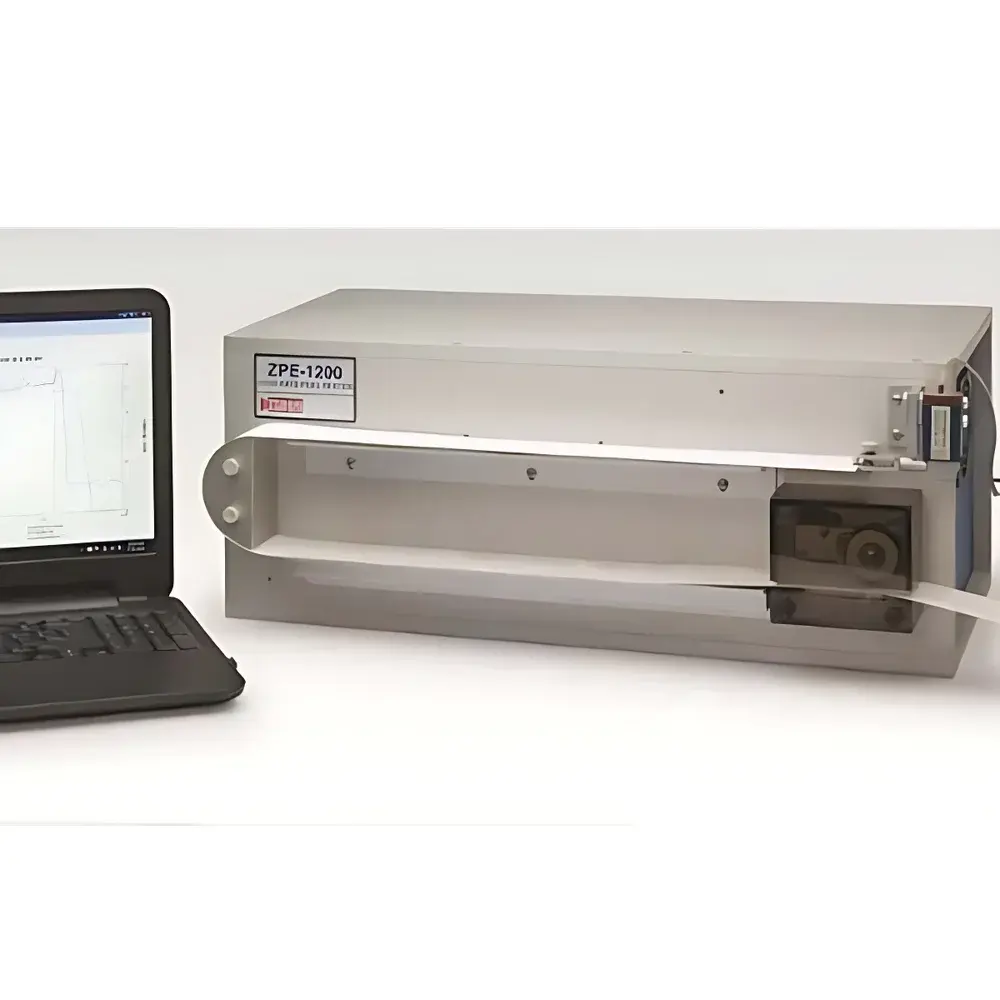
IMASS ZPE-1200 High-Speed Release Testing System
| Brand | IMASS |
|---|---|
| Origin | USA |
| Manufacturer Type | Authorized Distributor |
| Origin Category | Imported |
| Model | ZPE-1200 |
| Pricing | Upon Request |
Overview
The IMASS ZPE-1200 High-Speed Release Testing System is an engineered solution for quantitative measurement of peel, release, and adhesion force dynamics under controlled, high-velocity conditions—specifically designed for R&D laboratories and quality control environments in flexible packaging, label manufacturing, medical device packaging, and adhesive tape production. Unlike static or low-speed peel testers, the ZPE-1200 employs a closed-loop servo-controlled drive system with encoder feedback to maintain precise velocity profiles across its full operational range (0.04–5 m/s, or 95–12,000 in/min). It operates on the principle of dynamic tensile separation: a specimen—comprising a backing substrate and adhered layer—is peeled at defined speed regimes while force data are captured in real time via TEDS-enabled load cells. This enables characterization of rate-dependent interfacial behavior, including stick-slip transitions, viscoelastic relaxation effects, and kinetic energy dissipation during delamination—critical parameters for validating packaging integrity, seal performance, and regulatory compliance per ASTM D689, ISO 8510-2, and FINAT FTM 1 & 2.
Key Features
- Wide dynamic speed range: 0.04–5 m/s (95–12,000 in/min), configurable in constant-velocity or programmable ramp modes—including bidirectional acceleration/deceleration profiles.
- TEDS-compliant load cells (5 lb / 2.2 kg or 10 lb / 5 kg capacity, selected at order)—eliminating manual calibration, zero balancing, or range pre-selection; all force data acquired within rated capacity are valid and traceable.
- Encoder-based motor control ensures inherent velocity accuracy without periodic recalibration; system repeatability supports <±0.5% CV for force and <±0.3% CV for speed under GLP-aligned test conditions.
- Silent linear actuator-driven pinch rollers ensure consistent sample engagement without mechanical backlash or vibration-induced noise.
- USB-A/B interface (no external DAQ hardware required) enables direct connection to Windows-based PCs running IMASS ReleaseTest™ software for real-time visualization, parameter scripting, and raw data export (CSV, TXT).
- Air-bearing support fan is user-deactivatable—reducing ambient noise and power consumption when not needed for ultra-low-friction sample guidance.
- Optional auxiliary drive cap improves sample alignment and reduces edge misfeed during high-speed peel initiation—particularly beneficial for narrow-width or low-stiffness substrates.
Sample Compatibility & Compliance
The ZPE-1200 accommodates standard test specimens per ASTM D903, ISO 8510-2, and PSTC-101, including tapes, pressure-sensitive labels, laminated films, blister foil seals, and pouch closures. Specimen widths up to 100 mm are supported with adjustable clamping geometry. Multi-layer statistical segmentation (up to 25 layers per test run) allows discrete analysis of sequential peel events—e.g., liner removal followed by label application or multi-laminate delamination. All firmware and software modules comply with FDA 21 CFR Part 11 requirements for electronic records and signatures when configured with audit-trail logging, user access controls, and secure data archiving. System validation documentation (IQ/OQ/PQ templates) and traceable calibration certificates (NIST-traceable load cell and encoder verification) are provided upon request.
Software & Data Management
IMASS ReleaseTest™ v4.x provides intuitive test method setup, real-time force–velocity curve overlay, and automated calculation of mean peel force, standard deviation (STDEV), coefficient of variation (COV), and peak-to-mean ratio. Statistical aggregation begins from the second test cycle onward—enabling robust trending across batches or material lots. Raw time-series data (force, position, velocity, timestamp) are logged at ≥1 kHz sampling rate and stored in open-format files compatible with MATLAB, Python (pandas), JMP, and Minitab. Export options include annotated PDF reports with embedded metadata (operator ID, environmental conditions, calibration status). Software supports password-protected method libraries, version-controlled test protocols, and role-based permissions aligned with ISO/IEC 17025 laboratory management systems.
Applications
- Quantifying peel force kinetics of pressure-sensitive adhesives (PSAs) across industrial speed ranges used in converting lines.
- Evaluating seal strength degradation in medical pouches subjected to accelerated aging or sterilization cycles.
- Validating liner release consistency for self-adhesive pharmaceutical labels under high-speed packaging line conditions.
- Comparing viscoelastic response of biodegradable films versus conventional polyolefin laminates during high-rate delamination.
- Supporting root-cause analysis of label curl, flagging, or misapplication in OEM packaging validation studies.
FAQ
What standards does the ZPE-1200 support out-of-the-box?
ASTM D689, D903, D3330, ISO 8510-2, FINAT FTM 1 & 2, PSTC-101, and TAPPI T-813—all implemented via preconfigured test templates in ReleaseTest™ software.
Is NIST-traceable calibration included with shipment?
Yes—a full calibration certificate for both load cell and encoder subsystems, traceable to NIST standards, is supplied with each unit.
Can the system be integrated into a LIMS or MES environment?
Yes—via CSV/JSON export, OPC UA connectivity (optional add-on), or REST API integration for automated data ingestion into enterprise quality systems.
Does the ZPE-1200 require compressed air or external cooling?
No—operation is fully electric; the optional air-bearing fan is self-contained and draws less than 5 W when active.
How is multi-layer statistical segmentation applied during analysis?
Each peel event (e.g., liner release, facestock separation, adhesive transfer) is assigned a unique layer ID; statistics (mean, STDEV, COV) are computed independently per layer, enabling failure mode attribution.






