
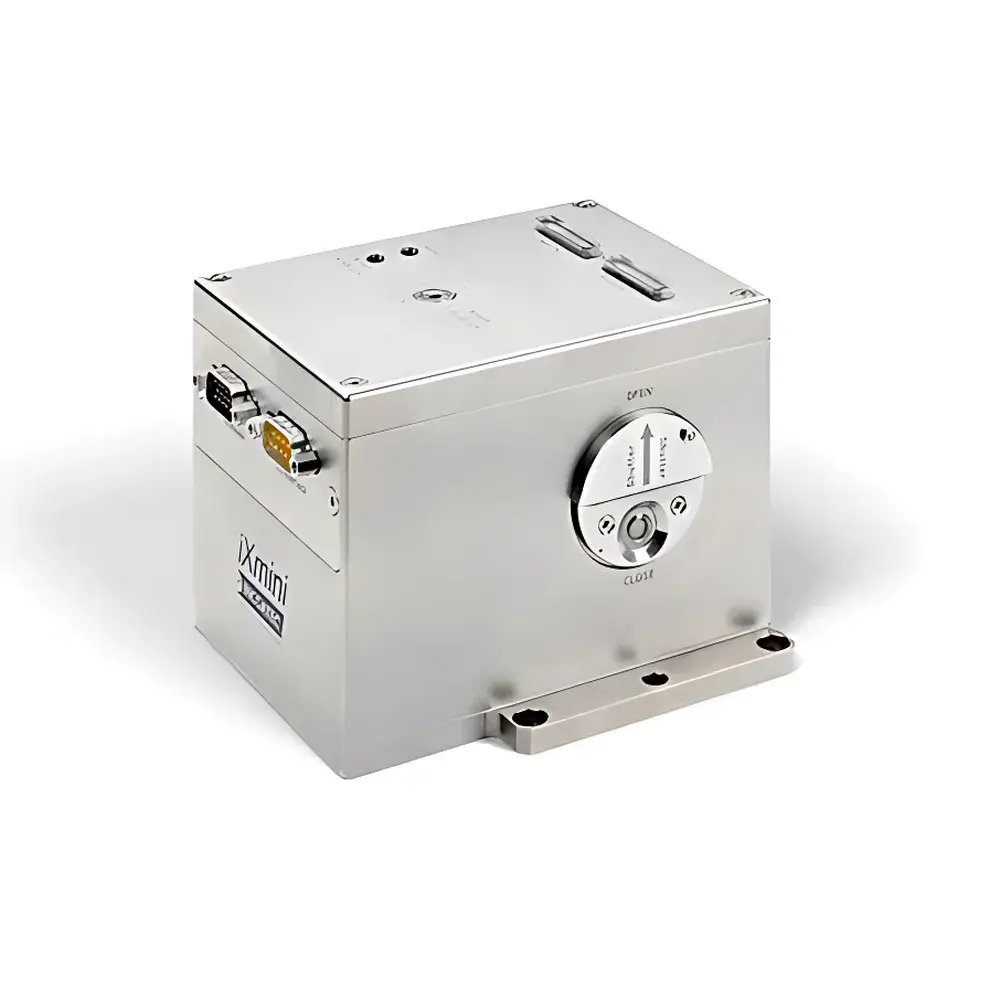
Incoatec iXmini Portable Microfocus X-ray Calibration Source
| Brand | Incoatec |
|---|---|
| Origin | Germany |
| Model | iXmini |
| Anode Material | Fe or Cu |
| X-ray Energy (Kα) | 6.4 keV (Fe) or 8.04 keV (Cu) |
| Max Power | 100 mW (4–10 kV, 2–10 µA) |
| Dimensions | 103 × 120 × 89.5 mm³ |
| Weight | ~1500 g |
| Operating Voltage | DC 24.0 ± 1 V |
| Vacuum Compatibility | down to 10⁻² – 10⁻³ mbar |
| Safety | Dual independent interlock circuits |
| Beam Control | Manual shutter |
| Status Indicators | X-RAY ON and BEAM ON LEDs |
Overview
The Incoatec iXmini is a compact, non-radioactive microfocus X-ray calibration source engineered for precision flat-field correction and energy-scale calibration of X-ray detectors—particularly CMOS-based imaging sensors, hybrid pixel detectors, and scientific-grade CCD/CMOS cameras used in synchrotron beamlines, laboratory diffractometers, and X-ray fluorescence (XRF) systems. Unlike traditional calibration methods relying on radioactive isotopes (e.g., 55Fe) or metal foil fluorescence sources, the iXmini employs a sealed metal-ceramic transmission-type X-ray tube with a thin 150 nm beryllium exit window and selectable Fe or Cu anodes. Its operation is based on electron-impact excitation of characteristic Kα emission lines—6.4 keV for Fe and 8.04 keV for Cu—enabling traceable, stable, and reproducible photon flux generation without regulatory burden associated with radioactive materials. Designed for operational continuity during synchrotron downtime or lab maintenance windows, the iXmini delivers on-demand, lab-integrated calibration capability under low-vacuum conditions (10⁻²–10⁻³ mbar), making it suitable for integration into vacuum-compatible detector test benches and metrology stations.
Key Features
- Non-radioactive, exempt from nuclear regulatory licensing—eliminates requirements for radioactive material storage, transport permits, and disposal protocols per IAEA RS-G-1.9 and national radiation safety frameworks.
- Compact footprint (103 × 120 × 89.5 mm³) and lightweight design (~1500 g) optimized for benchtop deployment, portable detector characterization rigs, and cleanroom-compatible setups.
- Dual independent hardware interlock circuits ensure fail-safe beam inhibition—X-ray emission only initiates when both interlocks are physically closed and 24 V DC power is applied.
- Integrated high-voltage generator eliminates external HV cabling and reduces EMI susceptibility; operates at 4–10 kV with current up to 10 µA, delivering up to 100 mW maximum power.
- Four factory-preset power levels (selectable via top-mounted rotary knob) enable rapid adaptation to varying detector sensitivity, exposure time constraints, and signal-to-noise requirements.
- Manual beam shutter with unambiguous mechanical position feedback—requires manual actuation before power-up and after shutdown, aligning with ALARA (As Low As Reasonably Achievable) principles for user-controlled exposure.
- Dual LED status indicators (X-RAY ON and BEAM ON) provide real-time visual confirmation of tube warm-up, stable output, and active irradiation—critical for GLP-compliant calibration logging.
Sample Compatibility & Compliance
The iXmini is compatible with silicon-based direct-detection sensors (e.g., PILATUS, EIGER, Timepix), back-illuminated CMOS detectors (e.g., Andor Zyla, Hamamatsu ORCA-Fusion), and scintillator-coupled imaging plates. Its Fe/Cu Kα lines serve as primary reference energies for energy calibration across soft-to-hard X-ray regimes (6–8 keV), supporting ISO 17025-accredited calibration workflows. The device complies with EU Machinery Directive 2006/42/EC and EN 61010-1:2010 for electrical safety in laboratory equipment. While not a medical device, its design adheres to IEC 62495:2013 (radiation protection for analytical X-ray equipment) and supports audit-ready documentation for FDA 21 CFR Part 11–aligned electronic records when paired with timestamped image acquisition software.
Software & Data Management
The iXmini requires no proprietary driver or firmware—operation is fully hardware-controlled via 24 V DC input and mechanical interlocks. However, when integrated into automated calibration pipelines (e.g., using Python-based PyFAI, DAWN, or custom LabVIEW/Vision modules), its consistent spectral output enables robust flat-field model generation. Users routinely acquire multi-exposure series (e.g., 100–1000 s integrations) to quantify intensity uniformity vs. exposure duration; empirical data confirm that ≥600 s exposures yield flat-field correction residuals 95% of active sensor area. Metadata—including anode type, kV/µA setting, interlock state, and timestamp—is captured externally by host acquisition software, satisfying traceability requirements under ISO/IEC 17025 Clause 7.7 (uncertainty of measurement) and GMP Annex 11 (computerized system validation).
Applications
- Flat-field correction of synchrotron and lab-source X-ray imaging detectors during beamline commissioning or detector replacement cycles.
- Energy-scale calibration and linearity verification of energy-resolving detectors (e.g., silicon drift detectors, SDDs) prior to XRF or XAS experiments.
- Periodic performance validation of radiation monitoring systems and dosimetry arrays in metrology labs.
- Reference source for developing and validating detector response models in Monte Carlo simulation frameworks (e.g., Geant4, MCNP).
- Teaching and training platform for X-ray physics laboratories—demonstrating characteristic radiation, attenuation, and detector quantum efficiency without radiological hazards.
FAQ
Is the iXmini compliant with international radiation safety regulations?
Yes—the iXmini is classified as a “non-radioactive X-ray generating device” under IAEA SSG-46 and falls outside the scope of radioactive material regulation. It requires only standard electrical safety compliance—not radiation licensing.
Can the iXmini be operated continuously for extended periods?
Yes—its solid-state thermal design and absence of active cooling allow indefinite duty-cycle operation at ≤100 mW, provided ambient temperature remains below 35 °C and airflow is unrestricted.
What vacuum levels are supported during operation?
The iXmini functions reliably at pressures ranging from atmospheric to 10⁻²–10⁻³ mbar, enabling direct integration into low-vacuum detector test chambers without additional shielding or differential pumping.
How is beam stability verified over time?
Users monitor count-rate consistency across repeated 600 s exposures using histogram statistics in downstream analysis tools; typical variation is <±0.3% over 8-hour sessions when ambient temperature is stabilized.
Does Incoatec provide NIST-traceable calibration certificates?
While the iXmini itself is not calibrated as a radiation source, its anode material and geometry are manufactured to tight tolerances enabling Kα energy uncertainty <±0.02 keV—traceable to NIST SRM 1262a (Fe) and SRM 1263a (Cu) reference standards via manufacturer’s QC documentation.
Related Products





