
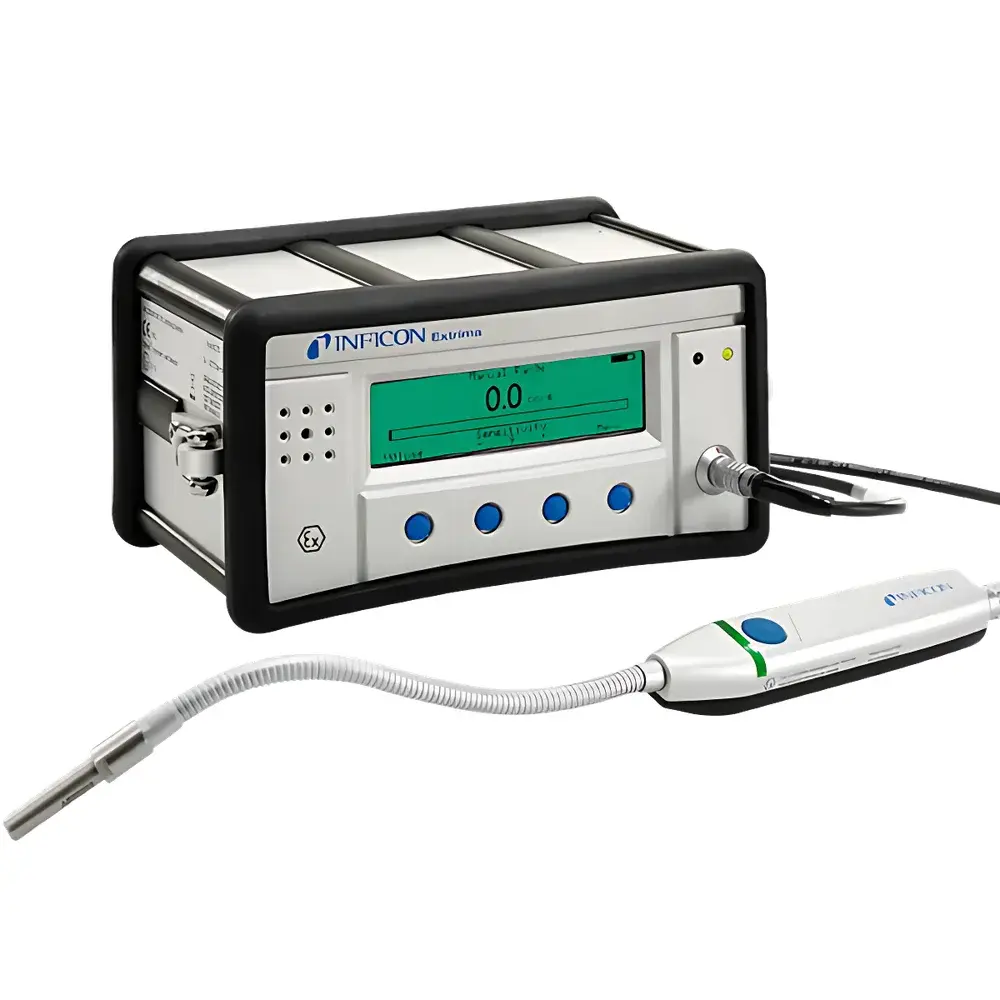
INFICON Extrima Intrinsically Safe Hydrogen Leak Detector
| Brand | INFICON |
|---|---|
| Origin | Sweden |
| Model | Extrima |
| Certification | ATEX, IECEx, TIIS, NEPSI, CSA |
| Protection Class | Ex ia IIC T3, Zone 0 / Class I, Division 1 |
| Detection Gas | H₂ (pure or 5% H₂/95% N₂ mixture) |
| Sensitivity | ≤0.5 ppm (≈1×10⁻⁷ cc/s He-equivalent) |
| Startup Time | ≤60 s |
| Ingress Protection | IP67 |
| Operating Duration | Up to 12 h in explosive atmospheres without pre-purging |
| Battery | Rechargeable Li-ion, field-replaceable |
| Response/Recovery Time | <1 s / <2 s |
| Environmental Operation | Humid, wet, and condensing conditions supported |
| Selectivity | Highly selective for hydrogen |
Overview
The INFICON Extrima is a portable, intrinsically safe hydrogen leak detector engineered for reliable, real-time detection of molecular hydrogen (H₂) in the most hazardous classified locations—including Zone 0 (IEC/ATEX) and Class I, Division 1 (NEC) environments. Unlike catalytic bead or thermal conductivity sensors, the Extrima employs a proprietary electrochemical sensing principle optimized exclusively for H₂, delivering exceptional selectivity, stability, and immunity to interference from common background gases such as methane, carbon monoxide, propane, or aviation fuels. Its design complies fully with the stringent requirements of intrinsic safety (Ex ia IIC T3), enabling direct deployment into explosive atmospheres without prior ventilation or purge cycles—critical for time-sensitive inspections in live operational zones. The instrument’s rapid 60-second startup, sub-second response, and fast recovery ensure high-throughput scanning during aircraft fuel system verification, hydrogen-cooled generator commissioning, or post-maintenance validation in petrochemical plants.
Key Features
- Intrinsically safe certification to Ex ia IIC T3 for continuous operation in Zone 0 and Class I, Division 1 areas—validated by ATEX, IECEx, TIIS, NEPSI, and CSA.
- Hydrogen-specific electrochemical sensor with ≤0.5 ppm detection limit (equivalent to 1×10⁻⁷ cc/s helium leak rate), enabling quantification of micro-leaks in critical safety systems.
- IP67-rated enclosure ensures full protection against dust ingress and immersion in water up to 1 m for 30 minutes—suitable for outdoor, marine, and humid industrial settings.
- 12-hour battery endurance in hazardous zones without pre-purging, supporting extended shift-based inspections across large-scale infrastructure.
- Zero cross-sensitivity to hydrocarbons, alcohols, or hydraulic fluids—eliminating false positives during fuel system testing on commercial aircraft or turbine enclosures.
- Hot-swappable, rechargeable lithium-ion battery with status indicator and low-power diagnostics for uninterrupted field use.
Sample Compatibility & Compliance
The Extrima is validated for direct use with both pure hydrogen and standardized test gas mixtures (5% H₂ / 95% N₂), conforming to ASTM E2842–22 and ISO 9934-3 for non-destructive leak testing methodology. Its sensor architecture meets the functional safety requirements of IEC 61508 SIL 2 for safety-related instrumentation. All certifications—including ATEX Directive 2014/34/EU, IEC 60079-0/-11, and CSA C22.2 No. 157—were obtained under third-party witnessed test protocols. The device supports GLP-compliant documentation when paired with optional data logging accessories, and its firmware architecture enables audit-trail-ready operation per FDA 21 CFR Part 11 requirements when integrated into regulated manufacturing workflows.
Software & Data Management
The Extrima operates as a standalone field instrument with no embedded software dependencies. Optional Bluetooth-enabled data loggers (e.g., INFICON LeakLogger Pro) support timestamped, GPS-tagged leak records exportable in CSV and PDF formats. All logged data include sensor calibration status, ambient temperature/humidity metadata, and operator ID fields—facilitating traceability in AS9100D-certified aerospace maintenance organizations. Firmware updates are performed via USB-C interface using INFICON’s certified configuration utility, with version control and digital signature verification ensuring integrity and regulatory compliance.
Applications
- Aerospace: Full-fuel-system leak verification on commercial and military aircraft—including wing tanks, feed lines, refueling couplings, oxygen supply manifolds, and fire suppression circuits—during production, line maintenance, and heavy checks.
- Power Generation: Integrity assessment of hydrogen-cooled turbogenerators, PEM fuel cell stacks, and associated piping networks in nuclear and renewable energy facilities.
- Process Industry: In-service inspection of flange joints, valve stems, pressure regulators, and storage vessels in hydrogen distribution infrastructure, ammonia synthesis plants, and chlor-alkali electrolysis units.
- Petrochemical Refining: Monitoring of hydrotreater reactors, hydrocracker manifolds, and sulfur recovery unit seals where H₂ partial pressures exceed 10 bar.
FAQ
Can the Extrima detect hydrogen in the presence of jet fuel vapors or hydraulic fluid aerosols?
Yes. Its hydrogen-selective electrochemical sensor exhibits negligible response to JP-8, Jet A, MIL-PRF-83282, or Skydrol LC-4—enabling confident leak localization without false alarms during aircraft ground servicing.
Is calibration required before each use?
No. The Extrima features automatic baseline stabilization and drift compensation. Annual factory calibration is recommended; field zeroing is optional and performed via built-in clean-air reference mode.
Does it meet FAA Advisory Circular AC 43.13-1B requirements for fuel system leak testing?
Yes. Its documented sensitivity, repeatability, and intrinsic safety rating align with Section 4A-402 and Appendix 1 guidance for pressurized and vacuum-based leak detection methods.
Can it be used underwater or in submerged conduits?
No. While IP67-rated for temporary immersion, the Extrima is not designed for submersion during active measurement; it must remain above liquid level with unobstructed sensor inlet access.
What is the service life of the electrochemical sensor?
Typical operational lifespan exceeds 24 months under standard industrial conditions; replacement is performed as a field-serviceable module with full recalibration traceability to NIST standards.




