
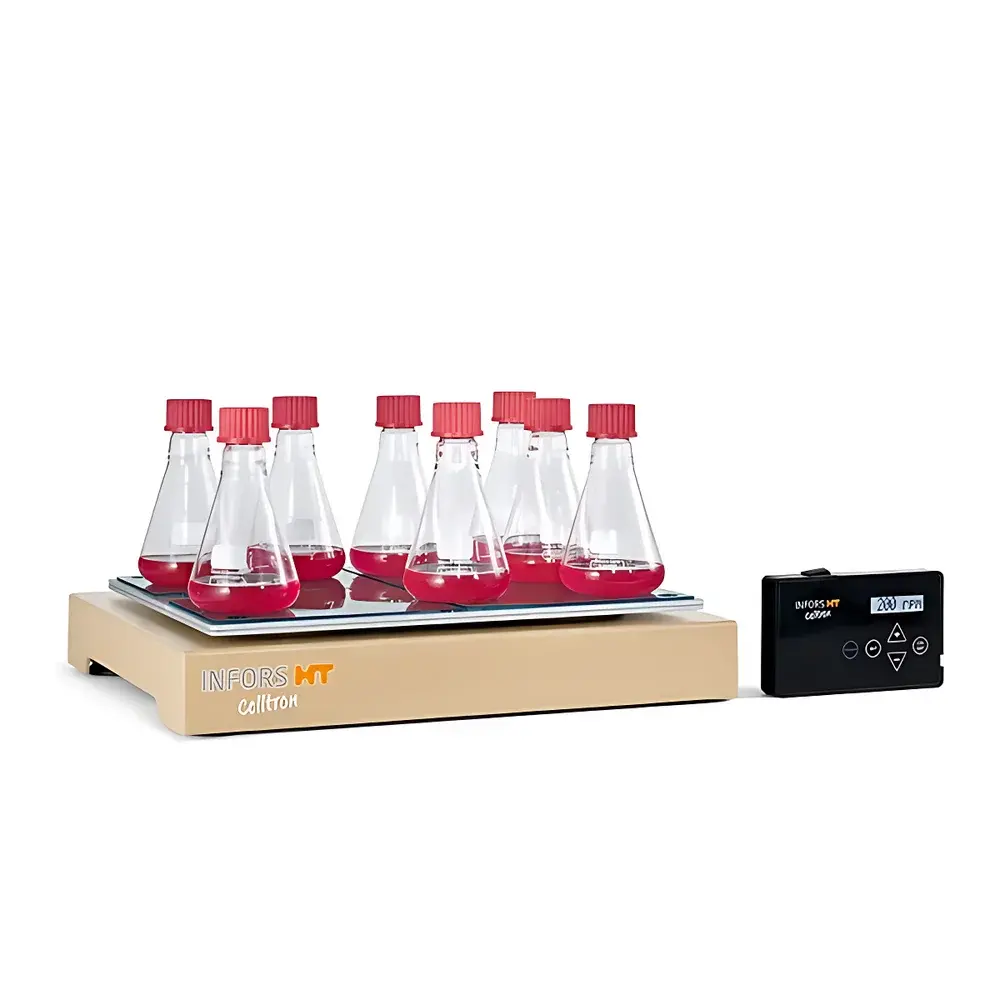
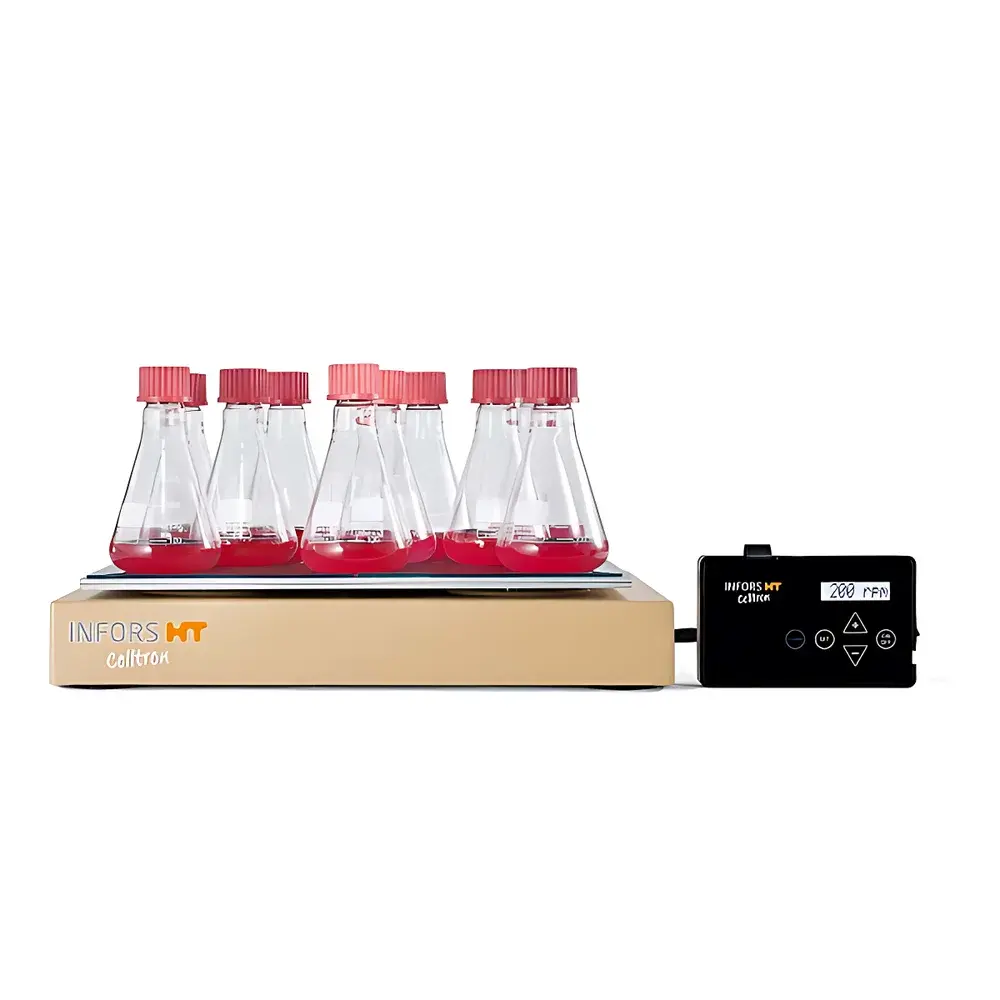
INFORS Celltron CO₂ Incubator-Compatible Orbital Shaker
| Brand | INFORS |
|---|---|
| Origin | Switzerland |
| Model | Celltron |
| Timer Range | 0–9 days 23 hrs 59 min |
| Oscillation Speed | 20–200 rpm (±1% control accuracy) |
| Amplitude | 25 mm |
| Temperature Range | 4°C–60°C |
| Number of Platforms | 1 |
| Max Load Capacity | ≤3.5 kg |
| Platform Dimensions | 380 × 450 × 90 mm |
| Power Supply | 110/230 V ±10%, 50–60 Hz, 14 W |
| Humidity Tolerance (shaker body) | <98% RH (non-condensing) |
| (controller) | <60% RH |
| Compatible Vessels | 50 mL × 35, 100 mL × 23, 250 mL × 12, 500 mL × 5, 1000 mL × 5, 2800 mL × 1 |
| Housing Material | ABS plastic + stainless steel |
| Surface Treatment | Silver-ion antimicrobial coating (Ag⁰) |
| Drive System | Brushless DC motor with magnetic coupling |
| Remote Controller | External, magnet- or hook-mountable, sealed cable feedthrough via incubator glass door |
Overview
The INFORS Celltron is a purpose-engineered orbital shaker designed exclusively for integration within CO₂ incubators to enable dynamic, low-shear suspension culture of mammalian, insect, and stem cells under strictly controlled physiological conditions. Unlike conventional benchtop shakers, the Celltron operates inside the humidified, 5% CO₂, temperature-regulated environment of standard incubators—eliminating repeated door openings and preserving chamber stability. Its core mechanism employs a brushless DC motor coupled via magnetic transmission, ensuring zero mechanical contact, no belt wear, and minimal heat generation (<14 W total power draw). This thermal neutrality prevents localized heating that could compromise incubator uniformity—a critical requirement for long-term cell expansion, bioprocess development, and reproducible assay outcomes. The device complies with IEC 61000-6-3 (EMC emissions) and IEC 61000-6-2 (immunity), and its electrical architecture—including epoxy-coated coils and moisture-sealed motor windings—is validated for continuous operation at up to 98% relative humidity without condensation.
Key Features
- Magnetic Drive Architecture: Eliminates belts, gears, and shaft seals—reducing maintenance, vibration artifacts, and microbial ingress pathways.
- Antimicrobial Silver-Ion Surface Coating: A proprietary Ag⁰ layer on all exposed housing surfaces achieves ≥10⁵-fold reduction in viable bacteria and fungi (tested per ISO 22196:2011), mitigating cross-contamination risk in shared incubators.
- External Touchscreen Controller: Mounted outside the incubator via magnetic base or hook; displays real-time speed, amplitude, timer, and temperature status without opening the chamber door.
- Sealed Cable Feedthrough: Ultra-thin, flexible shielded cable passes through standard incubator glass doors via factory-rated grommet—no internal power outlet required.
- Low-Shear Orbital Motion: 25 mm fixed amplitude with programmable ramp-up/ramp-down profiles ensures gentle suspension of sensitive adherent-cell-derived aggregates and organoids.
- Thermal Isolation Design: All heat-generating components (motor, driver electronics) reside inside the incubator; only the controller (rated ≤45°C ambient) remains external, preserving CO₂ homogeneity and minimizing thermal drift.
Sample Compatibility & Compliance
The Celltron accommodates standard tissue-culture vessels including Erlenmeyer flasks (50–2800 mL), square-bottom tubes, and multi-well plates (up to 6-well format when placed on optional adapter plates). Its load capacity (≤3.5 kg) supports stacked configurations for high-throughput seed train expansion. The device meets ISO 13485 design control requirements for medical device-associated lab equipment and conforms to EN 61010-1:2010 for safety in laboratory use. For regulated environments, audit trails for parameter changes are stored locally on the controller (non-volatile memory), supporting GLP-compliant documentation. While not FDA 21 CFR Part 11–certified out-of-the-box, the controller’s timestamped event log (start/stop, speed change, alarm trigger) provides traceable operational records suitable for internal QA review.
Software & Data Management
The Celltron operates via embedded firmware with no PC dependency. All settings—including speed (20–200 rpm, ±1% setpoint accuracy), timer (0–9 d 23 h 59 min), and auto-restart after power interruption—are configured through the intuitive capacitive touchscreen interface. The controller stores up to 10 user-defined protocols with name tags and recall history. Event logging captures timestamps for every parameter modification, run initiation, and alarm activation (e.g., overtemperature, lid open detection, motor stall). Data export is not supported; however, the controller’s LED display and audible/visual alerts provide immediate operational feedback without requiring software installation or network connectivity—reducing IT validation burden in GMP labs.
Applications
- Scalable suspension culture of CHO, HEK293, and hybridoma cells in serum-free or chemically defined media.
- Stirred-tank mimicry for early-stage bioreactor process development using shake-flask models.
- Differentiation protocols requiring precise agitation control (e.g., embryoid body formation, neural spheroid maturation).
- Microcarrier-based adherent cell expansion under perfusion-compatible conditions.
- Long-term viability studies (>72 h) where static controls exhibit nutrient gradient collapse or pH drift.
- CO₂-independent applications such as hypoxia modeling (when used in N₂/CO₂-mixed incubators) or low-O₂ fermentation screening.
FAQ
Can the Celltron be used outside a CO₂ incubator?
Yes—it functions as a standalone orbital shaker at ambient temperatures between 4°C and 60°C, though its antimicrobial coating and humidity-resistant construction are optimized for incubator deployment.
Is calibration required before first use?
No factory calibration is needed; speed accuracy is maintained via closed-loop motor control. Users may verify performance using an external tachometer per ASTM E2500-13 Annex A3 guidelines.
What happens if the incubator door is opened during operation?
The shaker continues running unless manually paused. The external controller retains all active settings and resumes timing uninterrupted—no parameter reset occurs.
Does the remote controller require batteries or external power?
It draws power parasitically from the main unit via the interconnect cable; no batteries or separate power supply are necessary.
How is cleaning and decontamination performed?
Wipe exterior surfaces with 70% ethanol or 0.5% hydrogen peroxide; avoid chlorine-based disinfectants which degrade the silver-ion coating. Autoclaving or submersion is prohibited.



