
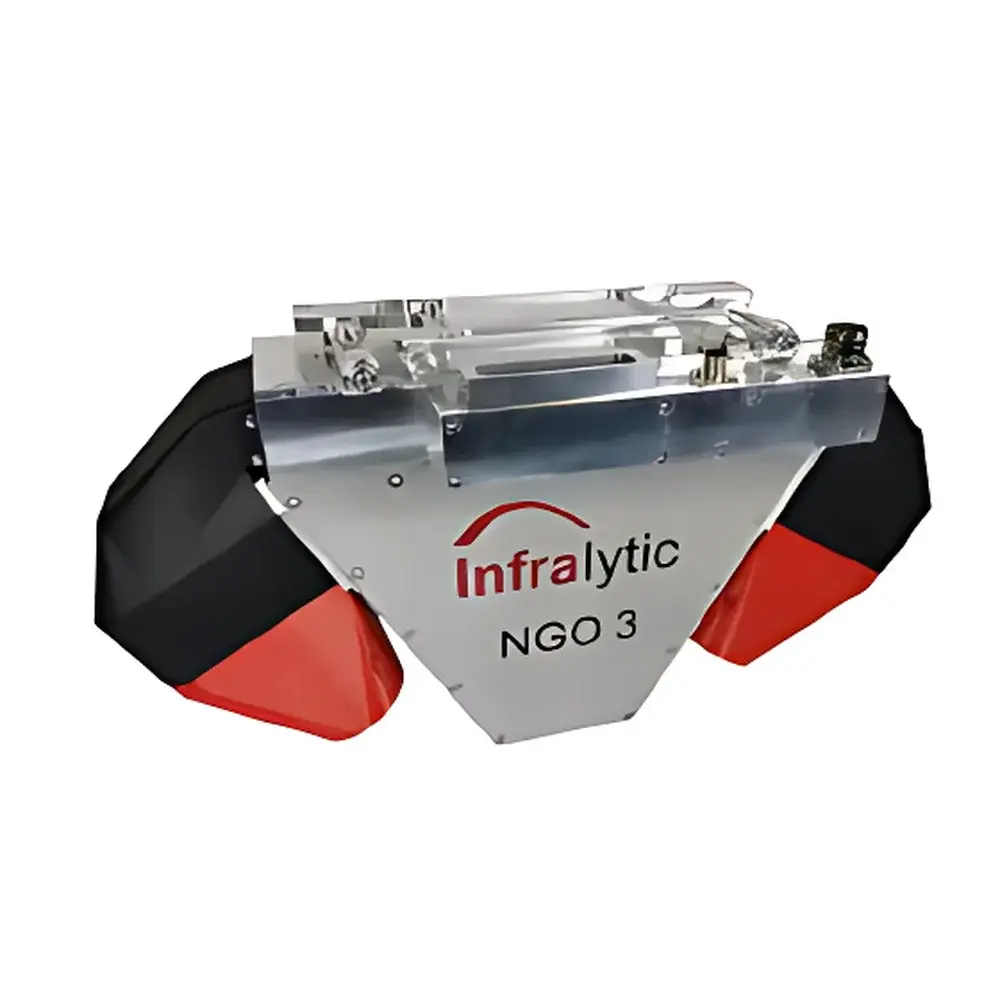
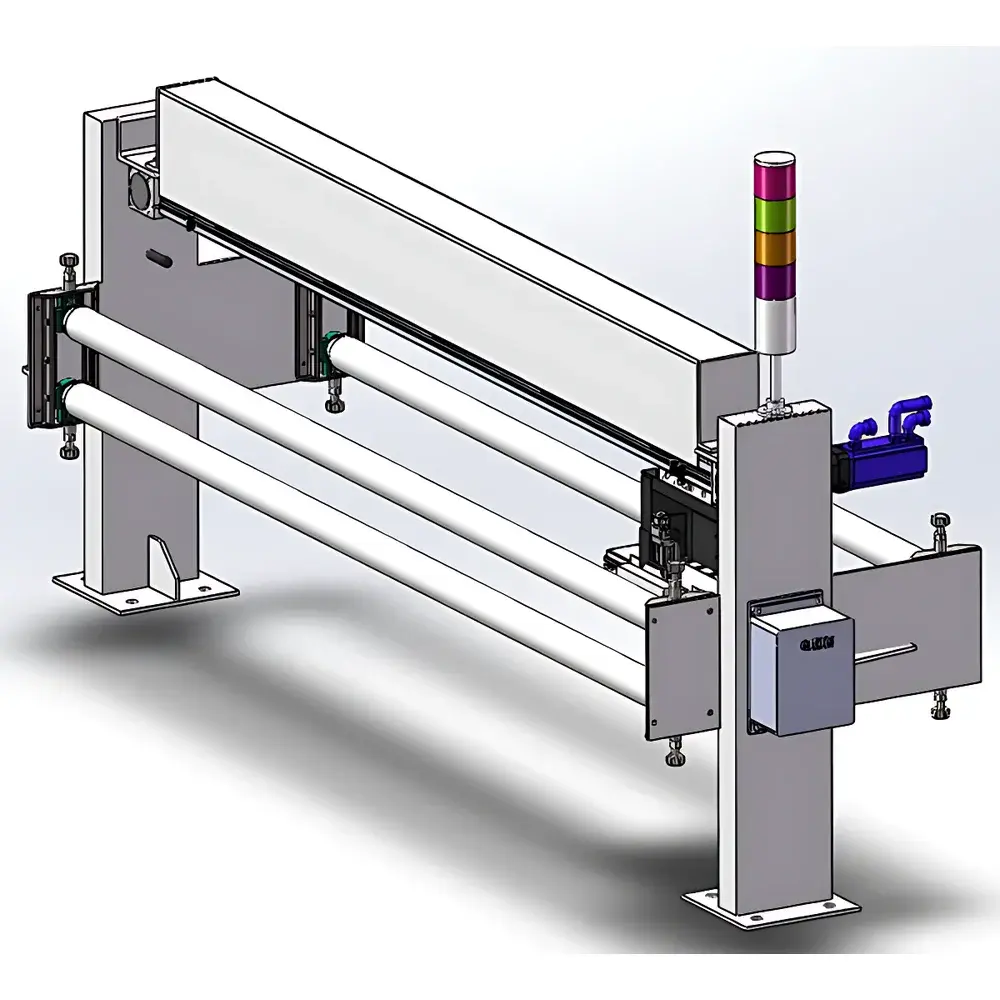
Infralytic NG2/NG3/NGO3 Non-Contact Oil & Water Film Thickness Gauge
| Origin | Germany |
|---|---|
| Manufacturer Type | Authorized Distributor |
| Origin Category | Imported |
| Model | NG2 / NG3 / NGO3 |
| Price Range | USD 68,000 – 136,000 |
| Measurement Principle | Quad-Wavelength Infrared Spectrophotometry |
| Measuring Range | 0.1–6 g/m² (oil), 0.1–10 g/m² (water) |
| Resolution | 0.1 mg/m² |
| Accuracy | ±10% (±5° angular tolerance) |
| Angular Drift Sensitivity | < 0.4% |
| Standoff Distance | 200 mm |
| Strip Height Tolerance | ±20 mm |
| Dimensions | 519 × 264 × 100 mm |
| Weight | 8 kg |
| Operating Temperature | 0 °C to +55 °C |
| Measurement Frequency | ≤120 Hz |
| IP Rating | IP65 |
| Compatible Substrates | Ferrous & non-ferrous metals, ceramics |
Overview
The Infralytic NG2/NG3/NGO3 series represents a class of industrial-grade, non-contact infrared film thickness gauges engineered for real-time, in-line quantification of oil-based rolling emulsions and residual water films on moving metallic and ceramic strip surfaces. These instruments operate on the principle of quad-wavelength infrared spectrophotometry—selectively probing absorption bands characteristic of hydrocarbon chains (C–H stretch at ~3.4 µm) and water molecules (O–H stretch at ~2.9 µm and ~6.1 µm)—enabling simultaneous or independent quantification of oil and water mass per unit area (g/m² or mg/m²). Unlike contact-based or beta-gauge methods, this optical technique eliminates mechanical wear, substrate interaction, and calibration drift associated with physical probes. Designed for integration into hot and cold rolling mills, continuous casting lines, and pickling/tension leveling stations, the system delivers stable performance under ambient thermal gradients, vibration, and airborne particulates typical of steel production environments.
Key Features
- Non-contact measurement at fixed 200 mm standoff distance—ensures operator safety and eliminates risk of sensor damage from strip surface irregularities or thermal expansion.
- Real-time measurement frequency up to 120 Hz—synchronized with strip speed (up to 25 m/s) for high-resolution spatial profiling across coil width.
- Automatic in-situ verification via internal reference path—performs continuous spectral self-checking to detect optical contamination, source degradation, or detector drift without interrupting production.
- Angular drift compensation algorithm—maintains measurement stability even with ±5° misalignment between sensor head and strip plane, critical for long-term mounting integrity.
- Vibration-insensitive optical architecture—mechanically decoupled interferometric optics and rigid aluminum housing (IP65-rated) ensure robustness against mill-floor mechanical resonance.
- Strip-speed-independent output—measurement result is normalized to surface area regardless of line velocity, eliminating need for tachometer input or speed-dependent recalibration.
Sample Compatibility & Compliance
The NG2/NG3/NGO3 gauges are validated for use on all conductive and non-conductive flat rolled products—including carbon steel, stainless steel, aluminum, copper alloys, and technical ceramics—with no requirement for electrical grounding or surface conductivity. The infrared transmission method remains insensitive to substrate emissivity, surface roughness (Ra ≤ 10 µm), or minor oxide layer formation. All models comply with IEC 61000-6-2 (immunity to industrial electromagnetic interference) and IEC 61000-6-4 (emission limits). The NGO3-W variant meets additional requirements for wet-process monitoring under EN 61326-1 for industrial measurement control equipment. Data acquisition supports audit-ready traceability per ISO/IEC 17025 and GLP-aligned workflows when integrated with validated SCADA or MES systems.
Software & Data Management
Each gauge ships with Infralytic ControlSuite™ v4.2—a Windows-based configuration and visualization platform supporting OPC UA, Modbus TCP, and Ethernet/IP protocols for seamless integration into plant-level automation architectures. Real-time film thickness values are streamed as analog-equivalent digital signals (4–20 mA or 0–10 V) and timestamped digital outputs (RS-485/USB). The software provides configurable alarm thresholds, statistical process control (SPC) charting (X̄-R, Cpk), and automatic report generation compliant with FDA 21 CFR Part 11 requirements—including electronic signatures, audit trails, and data integrity logging. Historical datasets are stored in industry-standard .csv and HDF5 formats, enabling post-process correlation with rolling force, interstand tension, and emulsion flow rate logs.
Applications
- Hot and cold rolling mills—monitoring residual emulsion mass after final stand to optimize blow-off air pressure and reduce energy consumption in downstream drying sections.
- Continuous casting finishing lines—quantifying lubricant film uniformity on slab surfaces prior to reheating, supporting defect root-cause analysis for surface scabbing or scale adhesion.
- Electrolytic cleaning and pickling lines—verifying removal efficiency of rolling oils prior to coating or galvanizing processes.
- Coil coating pre-treatment zones—assessing water carryover from rinse stages to prevent oven contamination and coating delamination.
- R&D laboratories—benchmarking new emulsion formulations under simulated rolling conditions using offline NG2 benchtop configurations.
FAQ
Can the NGO3-W measure water films on hot strip above 100°C?
Yes—the optical path is thermally isolated; the sensor head operates within its specified 0–55°C ambient range while measuring substrates up to 800°C via radiation shielding and active cooling options.
Is calibration required after installation?
Initial factory calibration is traceable to PTB (Physikalisch-Technische Bundesanstalt); field verification uses certified reference foils or gravimetrically prepared test strips. No routine recalibration is needed under stable environmental conditions.
How does the system handle strip edge effects or waviness?
The 20 mm height tolerance and proprietary beam-focusing optics maintain measurement validity across ±20 mm vertical displacement—covering typical crown, wedge, and edge wave profiles observed in wide-strip rolling.
Does the NG3 support dual oil/water mode simultaneously?
Yes—NG3 and NGO3 models feature time-multiplexed quad-wavelength acquisition, delivering synchronized oil and water mass readings at full 120 Hz update rate.
What maintenance is required during operation?
Annual inspection of optical windows and verification of purge gas integrity (if installed); no consumables or moving parts require replacement within 10-year design service life.



