
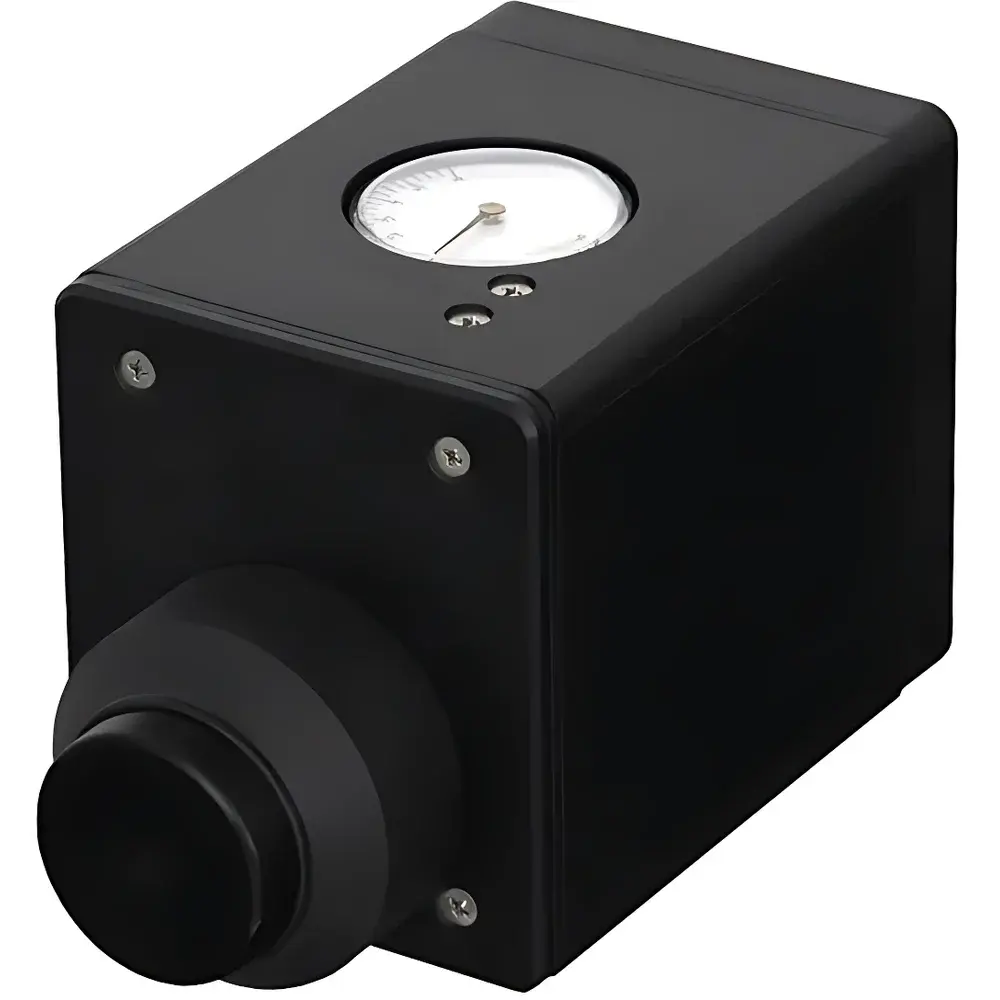
Inframet DPM66 Eyepiece Diopter Meter
| Brand | Inframet |
|---|---|
| Origin | Poland |
| Model | DPM66 |
| Diopter Range | ±6 D |
| Interface | USB |
| Optical Principle | Collimated Image Detection with Adjustable Simulated Eye Refraction |
| Compliance | Designed for ISO 10940-compliant eyepiece verification workflows |
Overview
The Inframet DPM66 Eyepiece Diopter Meter is a precision optical metrology instrument engineered to quantify the effective diopter value of eyepieces in direct-view imaging systems—including binoculars, rifle scopes, night vision devices, and optical sighting equipment. Unlike conventional refractometric tools based on long-focus telescopic optics, the DPM66 implements a short-depth-of-field collimated imaging architecture that emulates the human eye’s variable refractive state. It functions as an electronic analog of the accommodative visual system: by adjusting its internal simulated refractive error across a calibrated range of ±6 diopters (D), the device identifies the precise diopter setting at which the test eyepiece projects a maximally resolved, collimated image onto its integrated sensor plane. This zero-error alignment condition—where the DPM66’s simulated refractive state matches the eyepiece’s inherent diopter correction—is detected either subjectively by an observer viewing the output image or objectively via real-time image sharpness analysis in Inframet’s proprietary software. The core measurement principle relies on collimated target projection (e.g., USAF 1951 resolution chart) and high-contrast edge detection, ensuring traceable, repeatable results aligned with international standards for optical instrument calibration.
Key Features
- Calibrated diopter adjustment range: −6 D to +6 D, manually controlled via precision side-mounted knob with engraved scale
- Short-depth-of-field optical design enables unambiguous diopter identification—no ambiguity from residual focus tolerance
- USB 2.0 interface for real-time video streaming to Windows-based PCs, laptops, or tablets (driver-free UVC compliance)
- Integrated CMOS imaging sensor optimized for high-contrast collimated target evaluation
- Compatible with standard collimators or custom-built projection modules featuring rotating target wheels (e.g., USAF 1951, EIA 1956, or Siemens star patterns)
- No internal light source required—operates passively using external collimated illumination
- Compact, benchtop form factor (210 × 120 × 100 mm) with aluminum housing for thermal stability and EMI shielding
Sample Compatibility & Compliance
The DPM66 is designed exclusively for direct-view optical systems with exit pupils accessible for collimated imaging—primarily military-grade sights, surveying instruments, aviation HUD components, and laboratory-grade stereomicroscopes. It does not support oculars with built-in corrective lenses requiring physical disassembly. The instrument supports verification against ISO 10940:2018 (“Ophthalmic optics — Spectacle lenses — Fundamental requirements”) for diopter labeling accuracy, and its measurement methodology aligns with procedures referenced in MIL-STD-1472G (Human Engineering) for visual display validation. While the DPM66 itself is not FDA-regulated, its use in GMP-compliant optical assembly lines satisfies traceability requirements under ISO 9001:2015 clause 7.1.5. Calibration certificates (traceable to PLM—Polish Central Office of Measures) are available upon request.
Software & Data Management
Inframet provides the optional DPM-SW suite for automated image sharpness evaluation, supporting both Laplacian variance and FFT-based modulation transfer function (MTF) estimation. The software logs each measurement with timestamp, user ID, diopter setting, and calculated sharpness index (0–100 scale), exporting data in CSV and XML formats compatible with LIMS integration. Audit trails comply with 21 CFR Part 11 requirements when deployed with Windows domain authentication and electronic signature modules. Raw video streams may be captured in AVI or MP4 (H.264) for offline review; no proprietary codecs are used. Firmware updates are delivered via signed .hex packages verified through SHA-256 checksums.
Applications
- Final verification of diopter labeling on production-line optical sights prior to shipment
- Periodic recalibration of eyepiece diopter dials in field-service workshops
- R&D validation of new ocular designs under varying interpupillary distances (IPD) and eye relief conditions
- Root-cause analysis of focus shift in thermal imagers after environmental stress testing (−40°C to +70°C)
- Supporting ISO/IEC 17025-accredited calibration labs performing third-party eyepiece certification
- Integration into automated test stands for high-volume OEM manufacturing (via API-driven control over USB HID protocol)
FAQ
What collimator specifications are recommended for optimal DPM66 performance?
A collimator with angular resolution ≤30 arcseconds, MTF >0.4 at 50 lp/mm, and spectral transmission >85% across 400–700 nm is recommended. Inframet offers the optional COL-1000 series with motorized target wheel and integrated LED illuminator.
Can the DPM66 measure eyepieces with non-spherical correction (e.g., astigmatism-compensating designs)?
No—the DPM66 quantifies only spherical equivalent diopter. It cannot resolve cylindrical components or higher-order aberrations. For full wavefront analysis, coupling with a Shack-Hartmann sensor is advised.
Is firmware update capability available in the field?
Yes—updates are performed via USB using Inframet’s certified updater tool. Each release includes version-locked cryptographic signatures and rollback protection.
Does the DPM66 require annual recalibration?
While the mechanical and optical subsystems exhibit long-term stability, Inframet recommends biennial verification against NIST-traceable diopter standards (e.g., PTB-certified reference eyepieces) to maintain ISO/IEC 17025 conformance.
Can multiple DPM66 units be synchronized for parallel testing?
Not natively—but external trigger synchronization (TTL input) allows coordinated acquisition across up to four units using a master clock signal, enabling batch verification of multi-channel optical assemblies.




