
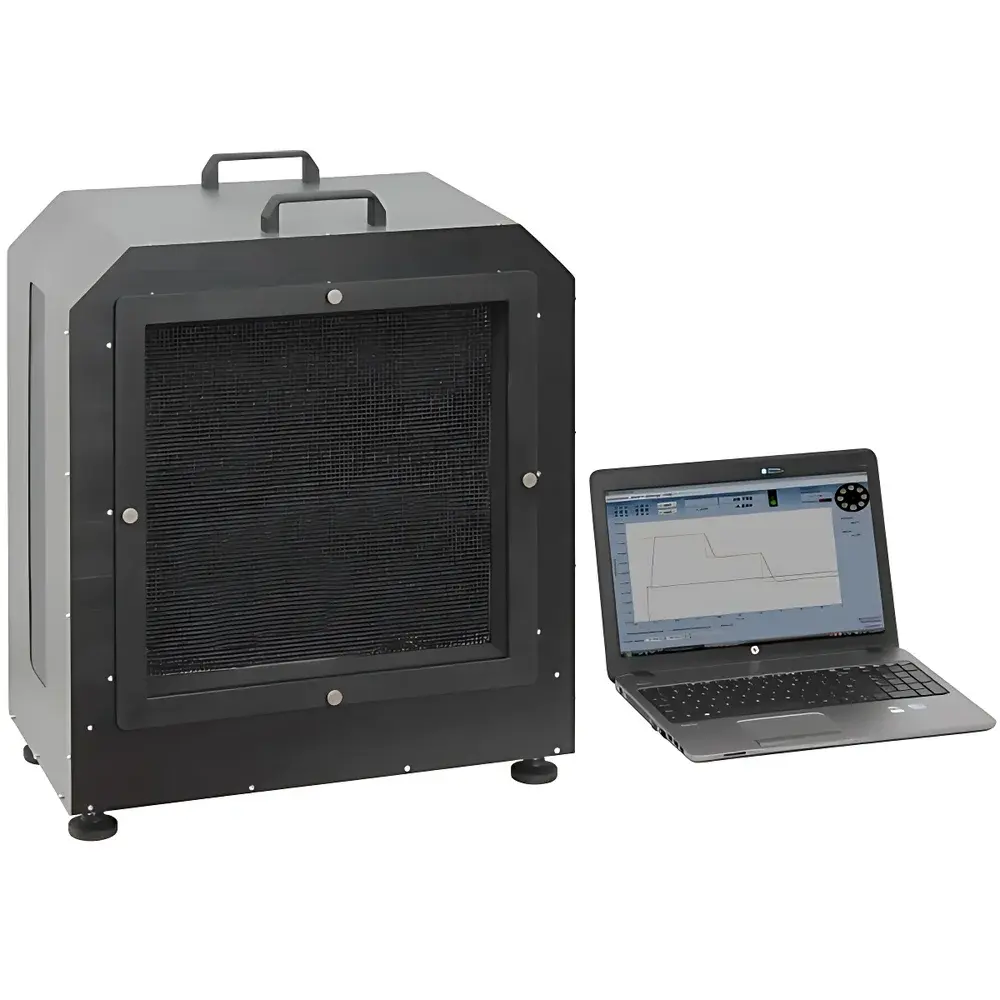
Inframet MAB Large-Area Terahertz Blackbody Source
| Brand | Inframet |
|---|---|
| Origin | Poland |
| Model | MAB |
| Spectral Coverage | 10 GHz – 3 THz (configurable bands A–Ka) |
| Emissivity | ≥0.96–0.99 (band-dependent) |
| Aperture Size | 150 mm × 150 mm to 1000 mm × 1000 mm |
| Temperature Range | −30°C to +300°C (model-dependent: LT, ST, EX, HT, EHT) |
| Temperature Resolution | 1 mK |
| Temperature Uniformity | <0.1×(T−T<sub>amb</sub>) or 0.5°C |
| Stability | ±5 mK @ ΔT = 10°C |
| Total Temperature Uncertainty | +100 mK (at T = 25°C, ambient = 25°C) |
| Heating/Cooling Rate | 0.40°C/s / 0.20°C/s (band A, 25°C) |
| Settling Time | <120 s (band A) |
| Control Interface | RS-232/USB 2.0 (standard), RS-485 (optional) |
| Power Supply | 230 VAC |
| Max. Power Consumption | 300 W – 12 kW |
| Operating Temp. | 5°C – 40°C |
| Storage Temp. | −10°C – +60°C |
| Humidity | 5–95% RH (non-condensing) |
| Weight | 18 kg – 170 kg |
| Dimensions | 200×200×300 mm – 1250×1400×400 mm |
Overview
The Inframet MAB Large-Area Terahertz Blackbody Source is a precision-calibrated, electronically controlled thermal radiation source engineered for radiometric calibration and performance validation of terahertz (THz) and sub-terahertz imaging systems, bolometric arrays, heterodyne receivers, and broadband radiometers. Unlike conventional blackbodies optimized for mid-IR or far-IR wavelengths, the MAB employs a proprietary cast-absorptive coating specifically formulated for high emissivity across 0.01–3 THz (i.e., 30 GHz–3 THz), corresponding to free-space wavelengths from 10 mm down to 0.1 mm. Its operation is grounded in Planckian thermal emission theory, with spectral radiance governed by absolute temperature and surface emissivity—making it a primary standard for traceable THz radiometry. The MAB’s large-area aperture (up to 1 m × 1 m), combined with tight thermal uniformity and sub-millikelvin resolution, enables spatially resolved calibration of wide-field THz cameras and focal plane arrays under realistic illumination geometry.
Key Features
- Configurable spectral bands (A–Ka) covering 10 GHz–3 THz, with band-specific emissivity ≥0.96–0.99, verified via FTIR and THz-TDS metrology
- Aperture sizes scalable from 150 mm × 150 mm to 1000 mm × 1000 mm; typical configuration: 400 mm × 400 mm
- High-precision thermoelectric and resistive heating architecture enabling 1 mK setpoint resolution and ±5 mK short-term stability
- Thermal uniformity <0.1×(T−Tamb) or ≤0.5°C across full aperture—critical for minimizing spatial nonlinearity in imaging system characterization
- Integrated controller with embedded PID algorithms, real-time thermal mapping, and dual-sensor redundancy for drift compensation
- RS-232/USB 2.0 standard interface; RS-485 optional for industrial multi-unit synchronization and SCADA integration
- Compact monolithic design: blackbody cavity, thermal stage, and electronics housed in a single mechanically rigid chassis (IP52-rated enclosure)
Sample Compatibility & Compliance
The MAB is compatible with all passive and active THz detection modalities—including microbolometer arrays, pyroelectric detectors, Schottky diode mixers, and superconducting transition-edge sensors (TES). Its spectral output conforms to ISO/IEC 17025 requirements for calibration laboratories performing THz radiometric measurements. While not a certified reference standard per se, the MAB supports compliance with ASTM E1547 (Standard Guide for Use of Thermography in Predictive Maintenance), ISO 18434-1 (Condition monitoring — Thermography), and EU Directive 2014/30/EU (EMC). Its temperature uncertainty budget (±100 mK at 25°C) is traceable to national standards via NIST-traceable platinum resistance thermometers (PRTs) mounted at multiple depth locations within the absorber substrate. For GLP/GMP environments, audit-ready logging (timestamped setpoints, actual temperatures, error flags) is supported via ASCII protocol over serial interface.
Software & Data Management
The MAB operates with Inframet’s open-protocol control suite, compatible with Windows/Linux/macOS. The software provides real-time thermal profiling, multi-point uniformity analysis, ramp/soak sequence programming, and automated emissivity-corrected radiance calculation per Planck’s law. All operational parameters—including setpoint history, sensor readings, power consumption, and thermal gradient maps—are exportable as CSV or HDF5 files for post-processing in MATLAB, Python (NumPy/SciPy), or LabVIEW. No proprietary runtime or dongle is required; communication uses standard ASCII commands (e.g., “TEMP?”, “EMIS:BAND?”, “UNIF:MAX?”), enabling seamless integration into custom test automation frameworks compliant with IEEE 12207 or IEC 61508.
Applications
- Calibration of THz time-domain spectroscopy (THz-TDS) systems and continuous-wave (CW) imaging platforms
- Performance verification of security screening portals, pharmaceutical tablet inspection systems, and non-destructive testing (NDT) scanners
- Benchmarking spatial resolution, modulation transfer function (MTF), and noise-equivalent temperature difference (NETD) of uncooled THz cameras
- Validation of atmospheric transmission models in sub-THz remote sensing (e.g., 75–110 GHz weather radar calibration)
- Reference source for inter-laboratory comparison studies under EURAMET TC-THz coordination
- Thermal background simulation in space-based THz astronomy instrument testing (e.g., cryogenic chamber integration)
FAQ
What spectral bands are available, and how is emissivity validated?
The MAB offers six factory-configured bands (A–Ka), each with emissivity ≥0.96–0.99 measured using Fourier-transform infrared (FTIR) spectrometry calibrated against gold-coated integrating spheres and validated via THz time-domain spectroscopy (THz-TDS) in the 0.1–3 THz range.
Can the MAB be operated under vacuum or in inert gas environments?
Standard units are rated for ambient air operation only; custom vacuum-compatible variants (with feedthroughs and low-outgassing materials) are available upon request and require mechanical redesign approval.
Is temperature uniformity specified across the entire aperture or only at center points?
Uniformity is measured at ≥16 spatially distributed points across the full active aperture using calibrated PRT arrays; data is provided in the Certificate of Conformance for each unit.
Does the MAB support 21 CFR Part 11-compliant electronic records?
While the base firmware does not include digital signature or audit trail features, the ASCII command protocol enables third-party LIMS integration with full Part 11 compliance when deployed with validated middleware (e.g., LabWare, Thermo Fisher SampleManager).
What is the recommended recalibration interval?
Inframet recommends annual recalibration against traceable standards; intervals may be extended to 24 months under documented stable operating conditions per ISO/IEC 17025 Clause 7.7.






