
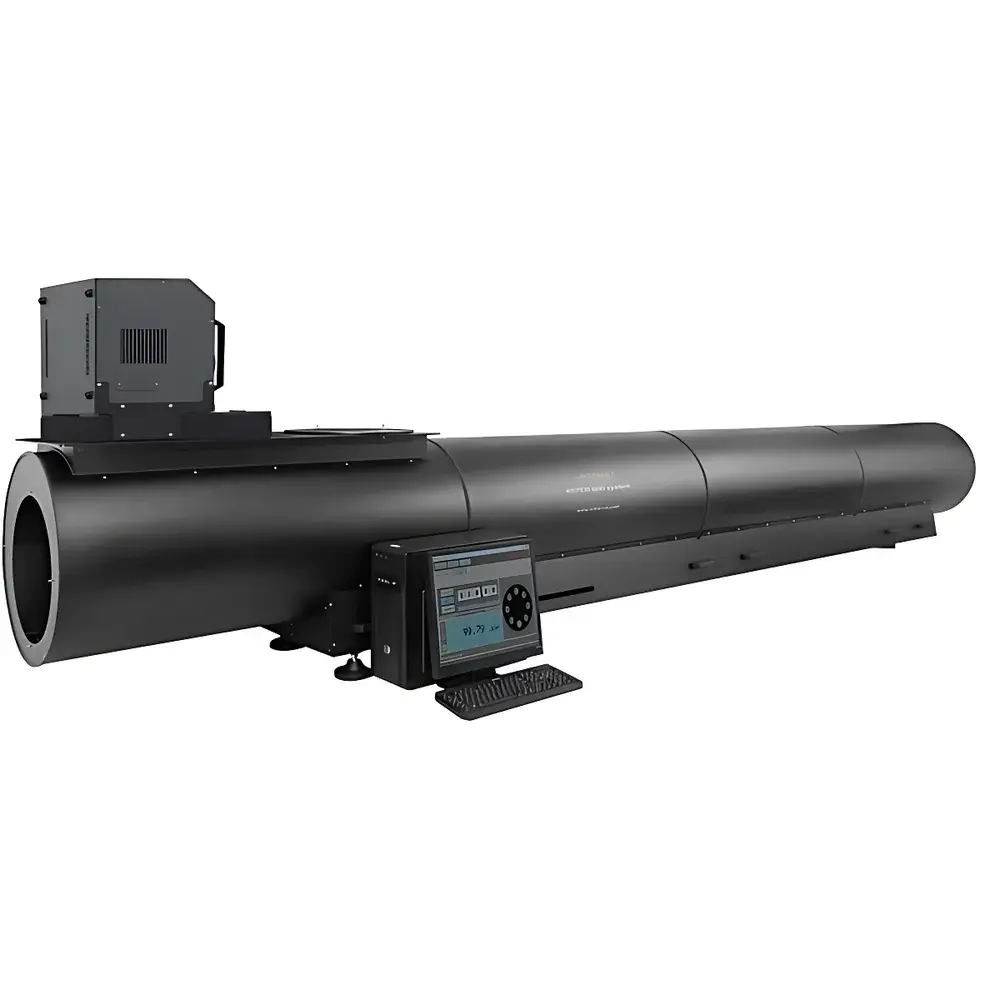
Inframet MULTIC Broadband Multispectral Imaging Test System
| Brand | Inframet |
|---|---|
| Origin | Poland |
| Model | MULTIC |
| Aperture Compatibility | Up to 400 mm or 500 mm |
| Spectral Range | Visible to Far-IR |
| Core Radiation Sources | VASIP14D Broadband Multispectral Source & TCB4D Blackbody |
| Optical Configuration | Off-axis Newtonian Collimator |
| Target Mounting | Interchangeable Standard Targets at Focal Plane |
| Calibration Status | Factory-calibrated Projection System |
| Compliance | Designed for ISO 12233, ASTM E1552, MIL-STD-1472D, and GLP/GMP-aligned test workflows |
| Software | Dedicated control & analysis suite with audit-trail logging (21 CFR Part 11 ready) |
Overview
The Inframet MULTIC Broadband Multispectral Imaging Test System is a precision-engineered, factory-calibrated collimated projection platform designed for comprehensive performance evaluation of long-range, broadband multispectral imaging systems—including thermal imagers, visible–near-infrared (VNIR), short-wave infrared (SWIR), and hyperspectral cameras. Operating on the principle of collimated image projection, the system replicates real-world scene radiometry and geometry across a continuous spectral band spanning from 0.4 µm (visible) to beyond 14 µm (far-infrared). Its optical architecture is based on an off-axis Newtonian collimator—engineered for minimal wavefront distortion and high pointing stability—with an effective aperture of either 400 mm or 500 mm, enabling full-aperture testing of large-format optical sensors without vignetting or spatial truncation. At its core lies the VASIP14D broadband multispectral source: a spectrally programmable, spatially uniform radiation emitter capable of simulating calibrated targets with controlled shape, size, contrast, and spectral radiance. Complementing this is the TCB4D blackbody source, traceably calibrated to ITS-90, used specifically for thermal sensitivity metrics such as NETD, MRTD, and D*.
Key Features
- Modular, integrated hardware platform with rigid mechanical architecture ensuring long-term alignment stability and repeatability
- Off-axis Newtonian collimator with diffraction-limited performance across visible to far-IR bands
- VASIP14D broadband source delivering spectrally tunable, spatially uniform irradiance with programmable temporal modulation
- TCB4D blackbody (±0.1 °C stability, 30–600 °C range) for quantitative thermal calibration and noise-equivalent parameter measurement
- MRW-6L dual rotating target wheel supporting up to 12 standardized patterns (e.g., USAF 1951, slanted-edge, pinhole arrays, step wedges, non-uniformity targets)
- WEB module for automated spectral band selection and source switching without manual reconfiguration
- BOREX precision kinematic mounting platform with 6-axis adjustment and reference mechanical datum plane for optical-mechanical axis registration
- Full software integration including real-time image acquisition, parameter scripting, batch test sequencing, and automated report generation
Sample Compatibility & Compliance
The MULTIC system supports full-field characterization of imaging sensors with entrance apertures ≤400 mm or ≤500 mm depending on configuration. It accommodates focal lengths from 50 mm to >1000 mm and is compatible with cooled/uncooled microbolometers, InSb, HgCdTe, Si-based CMOS/CCD, and custom hyperspectral line-scan or snapshot architectures. All calibration artifacts—including targets, sources, and collimator wavefront—are traceable to national metrology institutes (e.g., PTB, NIST). The system satisfies requirements for laboratory accreditation under ISO/IEC 17025 and supports compliance documentation for defense (MIL-STD-1472D, STANAG 4347), aerospace (ECSS-E-ST-70-08C), and regulatory (FDA 21 CFR Part 11, EU Annex 11) environments. Test procedures align with ISO 12233 (spatial resolution), ASTM E1552 (NETD/MRTD), and IEC 62676-5-2 (multispectral sensor interoperability).
Software & Data Management
The MULTIC Control & Analysis Suite provides a unified interface for instrument orchestration, data capture, and metrological post-processing. It includes role-based access control, electronic signatures, and full audit-trail logging compliant with FDA 21 CFR Part 11 and EU Annex 11. Raw image sequences are stored in vendor-neutral formats (e.g., TIFF, HDF5) with embedded metadata (wavelength, temperature, exposure, target ID, collimator focus position). Automated algorithms compute MTF via slanted-edge Fourier analysis, FOV distortion via polynomial fitting, spatial non-uniformity (FPN) using flat-field normalization, and minimum resolvable contrast (MRC) per MIL-STD-150A. Export options include PDF test reports, CSV datasets, and MATLAB-compatible structures for third-party validation.
Applications
- End-to-end verification of multispectral sensor fusion alignment (e.g., co-registration error between thermal and VNIR channels)
- Quantitative assessment of spectral crosstalk, channel registration drift, and polarization sensitivity
- Dynamic range mapping and linearity verification across multiple radiometric scales
- Non-uniformity correction (NUC) algorithm validation under variable scene temperatures and illumination spectra
- MTF degradation analysis due to atmospheric turbulence simulation (via programmable defocus and aberration insertion)
- Support for EO/IR system-level acceptance testing in government and defense prime contractor labs
- Research-grade characterization of novel detector materials (e.g., quantum dot IR photodetectors, 2D material-based photodiodes)
FAQ
What spectral bands does the MULTIC system cover?
The system supports continuous operation from 0.4 µm (visible) to ≥14 µm (far-infrared), enabled by the combined use of the VASIP14D broadband source and TCB4D blackbody.
Can the MULTIC test both cooled and uncooled infrared detectors?
Yes—it is fully compatible with microbolometers, vanadium oxide (VOx), amorphous silicon (a-Si), and photon detectors (InSb, HgCdTe) operating across standard cryogenic and ambient temperature regimes.
Is the system suitable for hyperspectral push-broom sensor validation?
Yes—its slanted-edge and line-pair targets, synchronized timing interface, and spectral-band-selective illumination support spatial-spectral response mapping for line-scan and snapshot hyperspectral architectures.
Does the MULTIC provide traceable calibration certificates?
All radiation sources, collimator wavefront, and target dimensions are supplied with NIST- or PTB-traceable calibration certificates; optional on-site metrological verification is available.
How is mechanical-optical axis registration performed?
Using the BOREX platform’s kinematic mount and integrated theodolite-ready fiducials, users can measure and correct optical axis deviation relative to a defined mechanical datum plane with sub-arcsecond angular resolution.




