
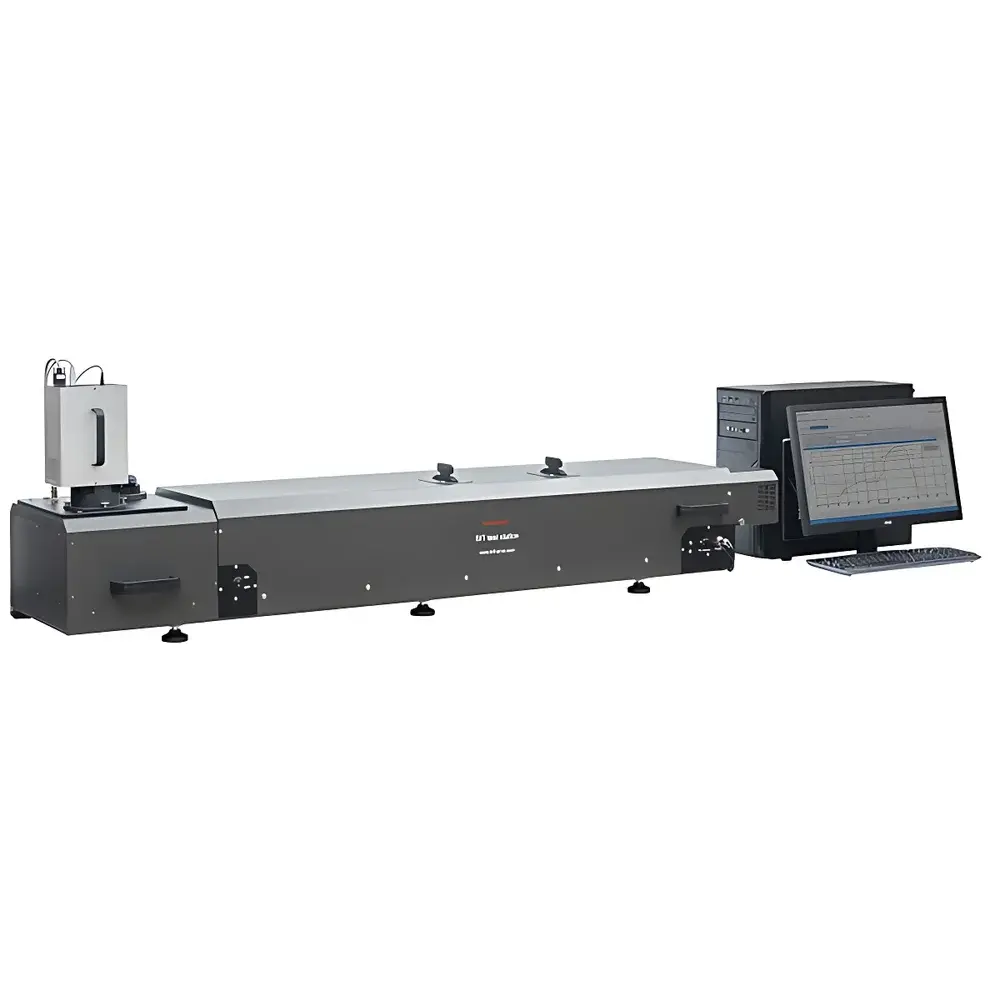
Inframet SIT VIS-SWIR Imaging Detector Test System
| Brand | Inframet |
|---|---|
| Origin | Poland |
| Model | SIT |
| Spectral Range | 400–2200 nm |
| Temperature Operating Range | +5 °C to +35 °C |
| Storage Temperature Range | −5 °C to +55 °C |
| Relative Humidity | ≤90% RH (non-condensing) |
| Weight | 58 kg |
| Dimensions | 173 × 43 × 28 cm |
| Core Modules | SITO Tunable Calibration Source + IPS Image Processing System |
| Measured Parameters | Relative Spectral Responsivity, Radiometric Responsivity, Noise-Equivalent Irradiance (NEI), Specific Detectivity (D*), Spatial Noise |
Overview
The Inframet SIT VIS-SWIR Imaging Detector Test System is a metrologically traceable, laboratory-grade instrumentation platform engineered for the quantitative characterization of focal plane arrays (FPAs) and imaging detector cores operating across the visible to short-wave infrared (VIS-SWIR) spectrum—from 400 nm to 2200 nm. It implements a calibrated, source-based radiometric measurement architecture grounded in the principles of spectral irradiance transfer and digital image statistics. Unlike empirical or comparative setups, the SIT system enables absolute radiometric calibration by coupling a spectrally tunable, spatially uniform calibration source (SITO) with a high-fidelity image acquisition and analysis subsystem (IPS). This architecture supports full-frame pixel-level analysis, enabling rigorous evaluation of detector performance under controlled, repeatable illumination conditions compliant with ISO 15529 (optical radiation measurement) and ASTM E1548 (standard guide for characterizing imaging detectors).
Key Features
- Integrated SITO calibration source delivering continuous spectral tuning from 400 nm to 2200 nm with <±0.5 nm wavelength accuracy and <±2% irradiance stability over 30 minutes.
- Uniformity-optimized optical design ensuring >98% spatial uniformity across the test field (defined at the detector plane), critical for eliminating edge-effect bias in responsivity mapping.
- IPS image processing system comprising industrial-grade frame grabber (12-bit or 16-bit digitization), real-time acquisition software, and post-processing modules for statistical noise decomposition (temporal, spatial, fixed-pattern).
- Full support for silicon (Si), black silicon (Black-Si), and indium gallium arsenide (InGaAs) detector technologies—including cooled and uncooled variants—with automated gain/offset compensation during multi-irradiance sweeps.
- Rugged mechanical construction (58 kg mass, steel-aluminum hybrid chassis) optimized for vibration-damped optical tables; designed for long-term stability in Class 10,000 cleanroom-adjacent environments.
- Compliant with IEC 61000-6-3 (EMC emission limits) and CE marking requirements for laboratory instrumentation within the EU market.
Sample Compatibility & Compliance
The SIT system accommodates standard-format imaging detector cores—such as 640×512, 1280×1024, and custom FPA geometries up to 2048×2048 pixels—with mechanical adaptability via modular mounting plates and adjustable Z-stage alignment. It supports both monochrome and multispectral detector configurations when paired with external filter wheels (not included). All radiometric measurements are referenced to NIST-traceable standards maintained by Inframet’s accredited calibration laboratory (ISO/IEC 17025:2017 certified). Data records include full audit trails meeting GLP and GMP documentation requirements, including timestamped irradiance logs, environmental sensor readings (temperature/humidity), and raw image metadata per acquisition sequence.
Software & Data Management
The proprietary IPS software suite operates on Windows 10/11 (64-bit) and provides a modular GUI for test sequencing, real-time histogram monitoring, and batch-mode parameter extraction. Measurement workflows follow a standardized protocol: dark frame acquisition → irradiance sweep (≥10 intensity levels) → response curve fitting → D* derivation using measured NEI and active area. Export formats include CSV (tabular metrics), TIFF (raw + corrected frames), and XML (metadata-compliant reports). The software supports FDA 21 CFR Part 11 compliance through optional electronic signature modules, role-based access control, and immutable audit logs that record all user actions, parameter changes, and calibration events.
Applications
- Pre-shipment verification of VIS-SWIR camera cores for defense electro-optical systems (e.g., driver vision enhancers, surveillance gimbals).
- R&D validation of novel detector materials—including quantum dot-enhanced Si and extended-InGaAs FPAs—against spectral responsivity targets defined in MIL-STD-810H optical testing annexes.
- Manufacturing quality assurance in high-reliability imaging sensor production lines, where D* and NEI repeatability must meet ±3% tolerance across 100-unit lots.
- Independent third-party certification testing for EN 62676-4 (video surveillance equipment) and ISO 16508-2 (infrared thermography system performance).
- Academic research in hyperspectral calibration transfer, where cross-platform spectral response harmonization requires sub-percent-level relative responsivity uncertainty.
FAQ
What detector interfaces does the SIT system support?
It accepts standard Camera Link, CoaXPress 2.0, and GigE Vision interfaces via configurable frame grabbers; custom FPGA-based acquisition modules are available upon request.
Is the SITO source calibrated against primary standards?
Yes—each SITO unit ships with a certificate of calibration traceable to PTB (Physikalisch-Technische Bundesanstalt) spectral irradiance standards, updated annually.
Can the system measure dynamic range and linearity beyond D* and NEI?
Yes—the IPS software includes ISO 15739-compliant photon transfer curve (PTC) analysis to derive full-well capacity, conversion gain, and integral nonlinearity (INL) up to 99.9% linearity.
Does the system require external cooling or climate control?
No—its operating temperature range (+5 °C to +35 °C) and humidity tolerance (≤90% RH, non-condensing) enable deployment in standard metrology labs without dedicated HVAC conditioning.
How is spatial noise quantified in the analysis pipeline?
Using a three-component model: temporal noise (from repeated dark/light frames), fixed-pattern noise (FPN, extracted via principal component analysis), and residual spatial nonuniformity (RSNU) after two-point correction—reported per ISO 15739 Annex D.




