
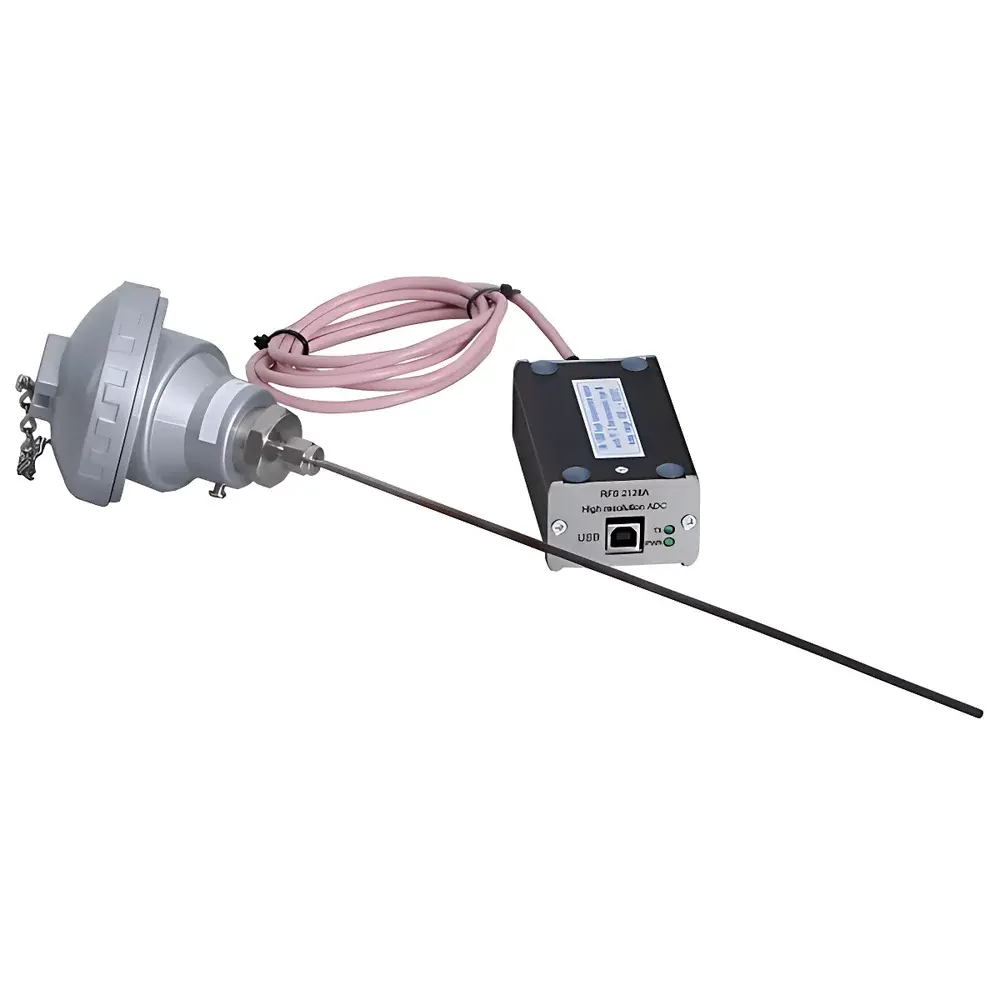
Inframet TM-1000 Ultra-Precision Thermocouple Thermometer
| Brand | Inframet |
|---|---|
| Origin | Poland |
| Model | TM-1000 |
| Thermocouple Types | Type N (Metal-Sheathed), Type S (Ceramic-Sheathed) |
| Temperature Range (Type N) | 100 °C to 1010 °C (short-term up to 1050 °C) |
| Temperature Range (Type S) | 600 °C to 1510 °C (short-term up to 1550 °C) |
| Resolution | 0.01 °C (10 mK) |
| Measurement Uncertainty | ±0.6 °C (≤250 °C, Type N), ±1.2 °C (≤750 °C, Type N), ±1.5 °C (≤1000 °C, Type N) |
| Temperature Units | °C, K, °F |
| Power Supply | 5 V DC via USB |
| Max. Power Consumption | 1 W |
| Connector | USB-B |
| Interface Standard | USB 2.0 |
| Communication Protocol | SCPI-compliant |
| Operating Environment | 10 °C to 40 °C (non-condensing), Storage: −10 °C to 60 °C |
| Controller Dimensions | 110 × 55 × 38 mm |
| Probe Dimensions (N) | Ø3 mm × 400 mm |
| (S) | Ø6 mm × 400 mm |
| Cable Length | 1.5 m |
| Weight | 400 g per set |
Overview
The Inframet TM-1000 Ultra-Precision Thermocouple Thermometer is a laboratory-grade digital temperature measurement system engineered for high reproducibility and traceable thermal metrology in demanding R&D, calibration, and process validation environments. Unlike infrared or resistance-based thermometers, the TM-1000 employs cold-junction-compensated thermocouple sensing—leveraging established Seebeck-effect physics—to deliver direct, contact-based temperature readings with minimal drift and long-term stability. Its dual-probe configuration (Type N and Type S) enables coverage across two complementary high-temperature domains: from furnace annealing and sintering (Type N) to platinum crucible applications and high-purity metal melting point verification (Type S). Designed for integration into automated test benches and ISO/IEC 17025-accredited calibration labs, the instrument meets foundational requirements for thermal uncertainty budgeting under ISO/IEC Guide 98-3 (GUM) and supports traceability to national standards via documented calibration certificates.
Key Features
- SCPI-compliant USB 2.0 interface enabling seamless integration with LabVIEW, Python (PyVISA), MATLAB, and custom DAQ systems—no proprietary drivers required
- Dual thermocouple input support with automatic type recognition and real-time cold-junction compensation (CJC) using integrated Pt100 sensor
- 0.01 °C (10 mK) digital resolution maintained across full operating range, with linearized output referenced to ITS-90
- Compact, fanless controller housing (110 × 55 × 38 mm) designed for benchtop or rack-mounted deployment in vibration-sensitive optical tables
- USB-powered operation (5 V DC, ≤1 W) eliminates need for external power supplies—ideal for portable metrology and cleanroom use
- Compliance with electromagnetic compatibility standards per EN 61326-1:2013 for Class A industrial environments
Sample Compatibility & Compliance
The TM-1000 accommodates solid, semi-solid, and molten-phase samples through its interchangeable thermocouple probes: the 3 mm-diameter Type N probe (metal-sheathed, MgO-insulated) offers rapid response in oxidizing atmospheres up to 1050 °C; the 6 mm-diameter Type S probe (alumina-sheathed, high-purity Pt/Rh) provides enhanced chemical inertness and mechanical rigidity for aggressive environments including air, inert gas, and vacuum furnaces. Both probe configurations maintain dimensional stability and thermal shock resistance per ASTM E230/E230M. The system conforms to essential requirements of the EU Measuring Instruments Directive (MID) Annex MI-001 for thermal measuring instruments and supports audit-ready documentation for GLP and GMP-regulated thermal validation (e.g., IQ/OQ/PQ of ovens, autoclaves, and crystallization reactors).
Software & Data Management
Inframet provides the free, platform-independent TM-Control Suite—a native Windows/macOS/Linux application supporting real-time data logging, multi-channel trending, and statistical analysis (min/max/mean/stdev over user-defined intervals). All measurements include embedded metadata: timestamp (UTC-sync capable), probe serial ID, CJC temperature, and firmware revision. Export formats include CSV (with header annotations), Excel-compatible XLSX, and binary TDMS for NI DIAdem interoperability. For regulated environments, optional 21 CFR Part 11 compliance packages are available—including electronic signatures, role-based access control, and immutable audit trails—validated against FDA guidance on computerized systems used in pharmaceutical manufacturing.
Applications
- Primary and secondary temperature calibration of thermocouples, RTDs, and infrared pyrometers in accredited metrology labs
- In-process monitoring of thermal profiles during ceramic sintering, glass annealing, and semiconductor wafer processing
- Validation of temperature uniformity and stability in Class 121 °C steam sterilizers (ISO 17665) and dry-heat depyrogenation tunnels
- Thermophysical property characterization (e.g., phase transition onset, specific heat estimation) in DSC and TGA cross-checks
- Reference-grade temperature measurement in national metrology institutes conducting fixed-point cell intercomparisons (e.g., Zn, Al, Ag)
FAQ
Is the TM-1000 suitable for use in vacuum or reducing atmospheres?
Yes—both probe variants are rated for operation in vacuum down to 10⁻³ mbar and inert/reducing atmospheres when used with appropriate feedthroughs and sealing protocols. Type S probes require avoidance of silicon-contaminated environments to prevent embrittlement.
Can the instrument perform simultaneous dual-probe measurements?
No—the TM-1000 supports one active thermocouple channel at a time. However, probe swapping is facilitated by gold-plated miniature connectors and auto-recognition firmware, minimizing setup time between N- and S-type calibrations.
What calibration documentation is provided with shipment?
Each unit ships with a factory calibration certificate traceable to PL-1 (Polish Central Office of Measures) and includes as-found/as-left data at five points across each supported thermocouple range, compliant with ISO/IEC 17025:2017 clause 7.7.
Does the USB interface support galvanic isolation?
The standard USB-B port does not incorporate isolation. For electrically noisy industrial settings, Inframet recommends use of a certified USB isolator (e.g., ADUM3160-based) or fiber-optic USB extension solutions to prevent ground loops.





