
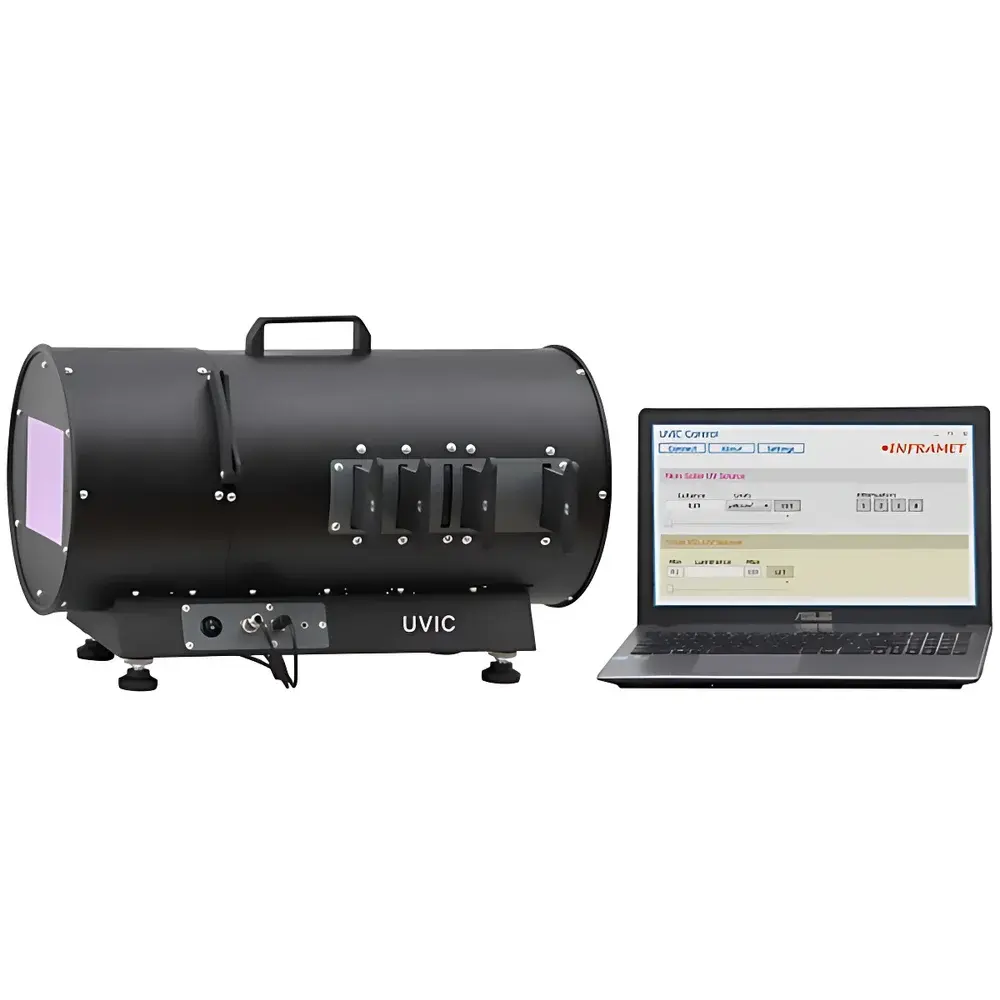
Inframet UVIC Solar-Blind UV Camera Test System
| Brand | Inframet |
|---|---|
| Origin | Poland |
| Manufacturer Type | Authorized Distributor |
| Import Status | Imported |
| Model | UVIC |
| Price Range | USD 105,000 – 132,000 (FOB Europe) |
| UV Channel Spectral Range | 250–275 nm |
| Visible Channel Spectral Range | 360–730 nm |
| UV Radiance Adjustment Range | 10⁻¹⁸ to 10⁻⁶ W/cm² |
| Visible Luminance Range | 0.1–300 cd/m² (≈0.3–1000 lx) |
| Target Types | Six circular apertures (Ø1.6–34 mm), four triangular targets (5–30 mm), six three-bar resolution charts (bar widths 1–5 mm), USAF 1951 visible chart (1–7.13 lp/mm), black circular reference target |
| UV Target Beam Diameter | 36 mm |
| Visible Target Aperture | 160 × 120 mm |
| System Weight | 12 kg |
| Dimensions (W×D×H) | 390 × 380 × 310 mm |
| Operating Temperature | 5–40 °C |
| Storage Temperature | −5–55 °C |
| Humidity | ≤95% RH (non-condensing) |
| Power Supply | AC 230/110 V ±10%, 50/60 Hz (DC 12 V optional) |
| Interface | RS-232 / USB 2.0 |
Overview
The Inframet UVIC Solar-Blind UV Camera Test System is a metrologically traceable, laboratory-grade optical test platform engineered for quantitative performance evaluation of dual-band solar-blind ultraviolet (UV) and visible imaging systems. It operates on the principle of calibrated, spectrally separated illumination—generating spatially defined UV (250–275 nm) and visible (360–730 nm) target patterns under precisely controlled radiometric conditions. The system enables full characterization of critical electro-optical parameters including minimum detectable emittance (MDE), triangle orientation discrimination (TOD), spatial resolution (in line-pairs per milliradian), channel co-alignment error, and solar rejection ratio—all in accordance with established radiometric testing conventions used in defense, aerospace, and scientific UV sensor validation. Designed for repeatable benchtop deployment, the UVIC system supports compliance-driven workflows by providing deterministic, non-destructive measurement of camera response across variable gain, exposure, and spectral irradiance conditions.
Key Features
- Independent, spectrally isolated UV and visible illumination channels: non-solar-blind UV source (250–275 nm, 36 mm aperture) and broadband visible source (360–730 nm, 160 × 120 mm aperture)
- Ultra-wide dynamic radiance control: UV channel adjustable from 10⁻¹⁸ to 10⁻⁶ W/cm² (12 orders of magnitude); visible channel luminance range 0.1–300 cd/m²
- Modular, interchangeable target set: six circular apertures (1.6–34 mm Ø), four triangular targets (5–30 mm), six three-bar resolution charts (1–5 mm bar width), USAF 1951 chart (1–7.13 lp/mm), and black reference targets
- Integrated attenuation architecture: precision neutral-density filters and mechanical shutters enabling reproducible stepwise or continuous irradiance modulation
- Co-aligned optical path design: ensures sub-milliradian angular registration between UV and visible target projections for accurate inter-channel alignment assessment
- Portable turnkey configuration: includes UVIC main unit, calibrated target library, ruggedized laptop, and validated control & analysis software suite
Sample Compatibility & Compliance
The UVIC system accommodates solar-blind UV cameras with focal lengths suitable for 1–3 m working distance and standard C-mount or F-mount interfaces. It supports both cooled and uncooled UV-sensitive sensors (e.g., SiC, GaN, or filtered CMOS/CCD architectures) operating in photon-counting or analog integration modes. All radiometric calibrations are referenced to NIST-traceable standards; spectral irradiance values are certified per ISO/IEC 17025-accredited procedures. The system satisfies technical requirements outlined in MIL-STD-810G (environmental testing), ASTM E1548 (radiometric calibration of imaging systems), and IEC 62676-3 (video surveillance equipment performance testing). Its audit-ready data logging and parameter traceability support GLP/GMP-compliant validation protocols, including FDA 21 CFR Part 11–compliant electronic records when configured with timestamped, user-authenticated acquisition logs.
Software & Data Management
The UVIC Control & Analysis Suite (v4.x) provides real-time acquisition, automated parameter sweep sequencing, and standardized metric extraction. Software modules include MDE/TOD curve generation, resolution threshold detection via ISO 12233 edge-based analysis, co-alignment vector computation using centroid registration of dual-band target images, and solar rejection quantification via simultaneous UV/visible irradiance ramping. All raw image data (16-bit TIFF), metadata (exposure time, gain, filter position, spectral band), and derived metrics are stored in vendor-neutral HDF5 format with embedded EXIF-like headers. Export options include CSV (for statistical process control), PDF test reports (with digital signature and revision history), and XML schemas compatible with enterprise LIMS integration. Software updates follow a documented change control process compliant with ISO 13485 Annex A.
Applications
- Quantitative verification of UV sensitivity specifications during R&D and production acceptance testing
- Performance benchmarking of solar-blind imagers deployed in corona discharge detection, missile plume tracking, and UV astronomy instrumentation
- Validation of UV/visible channel registration accuracy for dual-band situational awareness systems
- Calibration of UV radiometric response curves required for atmospheric transmission modeling and remote sensing algorithm development
- Environmental stress testing—including thermal cycling and humidity exposure—with concurrent electro-optical parameter monitoring
- Support for third-party certification audits (e.g., NATO STANAG 4347, EN 62282-3-100) requiring traceable, repeatable UV imaging performance data
FAQ
What spectral bands does the UVIC system cover?
The UV channel delivers narrowband radiation from 250 nm to 275 nm (centered on the solar-blind region); the visible channel covers 360 nm to 730 nm.
Can the system test cameras with different focal lengths?
Yes—provided the camera’s field of view accommodates the 36 mm UV target or 160 × 120 mm visible target at 1–3 m standoff distance; telecentric adapters are available as optional accessories.
Is radiometric calibration included with delivery?
Each UVIC system ships with factory calibration certificates for UV radiance, visible luminance, and target geometry, traceable to national metrology institutes (PTB, NPL, or NIST equivalents).
Does the software support automated pass/fail reporting against user-defined thresholds?
Yes—the Analysis Suite allows configurable tolerance bands per parameter (e.g., MDE ≤ 5 × 10⁻¹⁵ W/cm², co-alignment error ≤ 0.3 mrad), generating color-coded compliance status and summary dashboards.
How is solar rejection capability quantified?
By measuring UV signal-to-noise ratio while simultaneously illuminating the camera with calibrated visible background (up to 300 cd/m²), per test method described in IEEE Std 1858-2021 (CMOS Image Sensor Performance Standards).



